• Fri frakt över 249 kr
  • •
  • Snabba leveranser
  • •
  • Billiga böcker
Kundservice

Du är på sajten för privatpersoner.

Företag, bibliotek eller offentlig verksamhet?

Du handlar på classic.bokus.com, där alla dina funktioner finns intakta.
Till classic.bokus.com
Bokus logotyp. Gå till startsidan.
  • Erbjudanden
  • Nyheter
  • Student
  • Topplistor
  • Barn & ungdom
  • Bokus Play
  • E-böcker
  • Pocketböcker
  • Spel & pussel

10% rabatt på allt med kod NYSTART10 →

Sidfot

Mina sidor

    Hjälp

    • Kundservice
    • Vanliga frågor och svar
    • Frakt och leverans
    • Retur vid ångerrätt
    • Reklamera vara
    • Betalning
    • Köpvillkor
    • Allmänna villkor
    • Information om webbplatsens tillgänglighet

    Om Bokus

    • Om oss
    • Pressrum
    • För studenter
    • För företag
    • För bibliotek och offentlig verksamhet
    • För leverantörer
    • Hållbarhet

    Populärt

    • Aktuella erbjudanden
    • Presentkort
    • Studentlitteratur
    • Nya böcker
    • Topplistor
    • Signerade böcker
    • Engelska böcker

    Inspiration

    • Boktips
    • BookTok
    • Populära bokserier
    • Barnbokskaraktärer
    • Populära författare
    Logotyp för Bokus
    Följ oss på Facebook (extern länk)Följ oss på Instagram (extern länk)Följ oss på YouTube (extern länk)Följ oss på TikTok (extern länk)
    bokus @ CookiesAnpassa cookiesIntegritetspolicyKöpvillkor
    Till Citymail hemsida (extern länk)Till Budbee hemsida (extern länk)Till Postnord hemsida (extern länk)Till Schenker hemsida (extern länk)Till Early Bird hemsida (extern länk)Till Walleys hemsida (extern länk)
    1. Naturvetenskap och teknik
    2. Teknik och industri
    3. Elektronik och kommunikationer

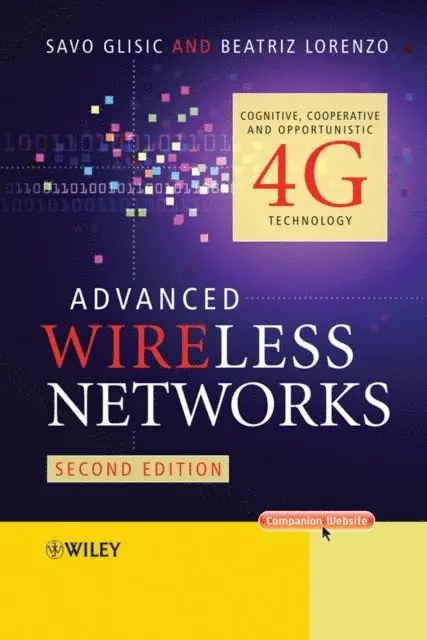
    Advanced Wireless Networks

    Cognitive, Cooperative and Opportunistic 4G Technology

    AvSavo G. Glisic,Beatriz Lorenzo

    Inbunden, Engelska, 2009

    1 875 kr

    Beställningsvara. Skickas inom 11-20 vardagar. Fri frakt över 249 kr.

    Fler format och utgåvor

    E-bok

    1 562 kr

    Inbunden

    1 636 kr

    E-bok

    1 909 kr

    E-bok

    1 909 kr

    Beskrivning

    With 40% new material the new edition of Advanced Wireless Networks provides a comprehensive representation of the key issues in 4G wireless networks. Focussing on cognitive, cooperative and opportunistic paradigms to provide further increase in network efficiency, the book explores and addresses issues in wireless internet, mobile cellular and WLAN, as well as sensor, ad hoc, bio-inspired, active and cognitive networks. It examines the problem of cross-layer optimisation and network information theory as well as adaptability and reconfigurability in wireless networks. This book is an integral description of future wireless networks and the interconnection between their elements.The information is presented in a logical order within each chapter making it ideal for all levels of reader including researchers involved in modelling and analysis of future networks as well as engineers working in the area. Each chapter starts with introductory material and gradually includes more sophisticated models and mathematical tools concluding with a comprehensive list of references. Fully updated throughout with five new chapters on Opportunistic Communications; Relaying and Mesh Networks; Topology Control; Network Optimization; and Cognitive Radio Resource ManagementUnifies the latest research on cognitive, cooperative and opportunistic paradigms in wireless communicationsProvides efficient analytical tools for network analysisDiscusses security issues, an essential element of working with wireless networksSupports advanced university and training courses in the fieldCompanion website containing extra appendix on Queuing theory

    Produktinformation

    • Utgivningsdatum:2009-06-05
    • Mått:174 x 252 x 51 mm
    • Vikt:1 669 g
    • Format:Inbunden
    • Språk:Engelska
    • Antal sidor:892
    • Upplaga:2
    • Förlag:John Wiley & Sons Inc
    • ISBN:9780470742501

    Utforska kategorier

    • Elektronik och kommunikationer inom Naturvetenskap och teknik

    Mer om författaren

    Savo Glisic, Professor of Telecommunications, University of Oulu, Finland.Professor Glisic obtained his PhD from Cranfield Institute of Technology, UK, before pursuing post doctoral studies at the University of California at San Diego, USA. His areas of interest include radio resource management in wireless mobile IP networks, network management, symbol synchronization in digital communications, automatic decision threshold level control (ADTLC) and frequency hopping modulation for wireless ad hoc networks. He has vast international experience in the field of telecommunications and has published prolifically on the subject, including three previous books with Wiley. Beatriz Lorenzo, University of Oulu Telecommunications Laboratory, Finland.

    Innehållsförteckning

    • Preface to the Second Edition xix1 Fundamentals 11.1 4G Networks and Composite Radio Environment 11.2 Protocol Boosters 71.3 Green Wireless Networks 11References 112 Opportunistic Communications 152.1 Multiuser Diversity 152.2 Proportional Fair Scheduling 162.3 Opportunistic Beamforming 192.4 Opportunistic Nulling in Cellular Systems 202.5 Network Cooperation and Opportunistic Communications 222.6 Multiuser Diversity in Wireless Ad Hoc Networks 272.7 Mobility-Assisted Opportunistic Scheduling (MAOS) 462.8 Opportunistic and Cooperative Cognitive Wireless Networks 53References 703 Relaying and Mesh Networks 733.1 Relaying Strategies in Cooperative Cellular Networks 733.2 Mesh/Relay Networks 853.3 Opportunistic Ad Hoc Relaying For Multicast 97References 1074 Topology Control 1134.1 Local Minimum Spanning Tree (LMST) Topology Control 1154.2 Joint Topology Control, Resource Allocation and Routing 1184.3 Fault-Tolerant Topology 1234.4 Topology Control in Directed Graphs 1324.5 Adjustable Topology Control 1384.6 Self-Configuring Topologies 143References 1485 Adaptive Medium Access Control 1575.1 WLAN Enhanced Distributed Coordination Function 1575.2 Adaptive MAC for WLAN with Adaptive Antennas 1605.3 MAC for Wireless Sensor Networks 1665.4 MAC for Ad Hoc Networks 174References 1806 Teletraffic Modeling and Analysis 1836.1 Channel Holding Time in PCS Networks 183References 1917 Adaptive Network Layer 1937.1 Graphs and Routing Protocols 1937.2 Graph Theory 2127.3 Routing with Topology Aggregation 2147.4 Network and Aggregation Models 215References 2288 Effective Capacity 2358.1 Effective Traffic Source Parameters 2358.2 Effective Link Layer Capacity 243References 2549 Adaptive TCP Layer 2579.1 Introduction 2579.2 TCP Operation and Performance 2649.3 TCP for Mobile Cellular Networks 2689.4 Random Early Detection Gateways for Congestion Avoidance 2769.5 TCP for Mobile Ad Hoc Networks 280References 28710 Network Optimization Theory 28910.1 Introduction 28910.2 Layering as Optimization Decomposition 29010.3 Crosslayer Optimization 29810.4 Optimization Problem Decomposition Methods 30710.5 Optimization of Distributed Rate Allocation for Inelastic Utility Flows 31910.6 Nonconvex Optimization Problem in Network with QoS Provisioning 32310.7 Optimization of Layered Multicast by Using Integer and Dynamic Programming 32610.8 QoS Optimization in Time-Varying Channels 33110.9 Network Optimization by Geometric Programming 33710.10 QoS Scheduling by Geometric Programming 340References 34611 Mobility Management 35111.1 Introduction 35111.2 Cellular Systems with Prioritized Handoff 37411.3 Cell Residing Time Distribution 38311.4 Mobility Prediction in Pico- and MicroCellular Networks 388Appendix: Distance Calculation in an Intermediate Cell 398References 40312 Cognitive Radio Resource Management 40712.1 Channel Assignment Schemes 40712.2 Dynamic Channel Allocation with SDMA 42612.3 Packet-Switched SDMA/TDMA Networks 43512.4 SDMA/OFDM Networks with Adaptive Data Rate 44612.5 Intercell Interference Cancellation – SP Separability 45412.6 Intercell Interference Avoidance in SDMA Systems 46112.7 Multilayer RRM 47012.8 Resource Allocation with Power Preassignment (RAPpA) 47512.9 Cognitive and Cooperative Dynamic Radio Resource Allocation 484Appendix 12A: Power Control, CD Protocol, in the Presence of Fading 494Appendix 12B: Average Intercell Throughput 498References 49913 Ad Hoc Networks 50513.1 Routing Protocols 50513.2 Hybrid routing protocol 52413.3 Scalable Routing Strategies 53113.4 Multipath Routing 53713.5 Clustering Protocols 53913.6 Cashing Schemes for Routing 54913.7 Distributed QoS Routing 558References 56714 Sensor Networks 57314.1 Introduction 57314.2 Sensor Networks Parameters 57514.3 Sensor networks architecture 57714.4 Mobile Sensor Networks Deployment 58714.5 Directed Diffusion 59014.6 Aggregation in Wireless Sensor Networks 59314.7 Boundary Estimation 59614.8 Optimal Transmission Radius in Sensor Networks 60214.9 Data Funneling 60714.10 Equivalent Transport Control Protocol in Sensor Networks 610References 61315 Security 62315.1 Authentication 62315.2 Security Architecture 63115.3 Key Management 63515.4 Security management in GSM networks 63915.5 Security management in UMTS 64315.6 Security architecture for UMTS/WLAN Interworking 64515.7 Security in Ad Hoc Networks 64715.8 Security in Sensor Networks 652References 65416 Active Networks 65916.1 Introduction 65916.2 Programable Networks Reference Models 66116.3 Evolution to 4G Wireless Networks 66516.4 Programmable 4G Mobile Network Architecture 66716.5 Cognitive Packet Networks 67016.6 Game Theory Models in Cognitive Radio Networks 67516.7 Biologically Inspired Networks 682References 68617 Network Deployment 69317.1 Cellular Systems with Overlapping Coverage 69317.2 Imbedded Microcell in CDMA Macrocell Network 69817.3 Multitier Wireless Cellular Networks 70317.4 Local Multipoint Distribution Service 70917.5 Self-Organization in 4G Networks 713References 71718 Network Management 72118.1 The Simple Network Management Protocol 72118.2 Distributed Network Management 72518.3 Mobile Agent-Based Network Management 72618.4 Ad Hoc Network Management 735References 74319 Network Information Theory 74719.1 Effective Capacity of Advanced Cellular Networks 74719.2 Capacity of Ad Hoc Networks 76119.3 Information Theory and Network Architectures 77319.4 Cooperative Transmission in Wireless Multihop Ad Hoc Networks 78019.5 Network Coding 78719.6 Capacity of Wireless Networks Using MIMO Technology 79819.7 Capacity of Sensor Networks with Many-to-One Transmissions 805References 80920 Energy-efficient Wireless Networks 81320.1 Energy Cost Function 81320.2 Minimum Energy Routing 81520.3 Maximizing Network Lifetime 81620.4 Energy-efficient MAC in Sensor Networks 821References 82321 Quality-of-Service Management 82721.1 Blind QoS Assessment System 82721.2 QoS Provisioning in WLAN 83121.3 Dynamic Scheduling on RLC/MAC Layer 83521.4 QoS in OFDMA-Based Broadband Wireless Access Systems 84221.5 Predictive Flow Control and QoS 849References 854Index 859