Savo G. Glisic - Böcker
Visar alla böcker från författaren Savo G. Glisic. Handla med fri frakt och snabb leverans.
10 produkter
10 produkter
1 878 kr
Skickas inom 7-10 vardagar
ADVANCED WIRELESS COMMUNICATIONS AND INTERNET THIRD EDITION ADVANCED WIRELESS COMMUNICATIONS AND INTERNET Future Evolving Technologies The new edition of Advanced Wireless Communications: 4G Cognitive and Cooperative Broadband Technology, 2nd Edition, including the latest developments In the evolution of wireless communications, the dominant challenges are in the areas of networking and their integration with the Future Internet. Even the classical concept of cellular networks is changing and new technologies are evolving to replace it. To reflect these new trends, Advanced Wireless Communications & INTERNET builds upon the previous volumes, enhancing the existing chapters, and including a number of new topics. Systematically guiding readers from the fundamentals through to advanced areas, each chapter begins with an introductory explanation of the basic problems and solutions followed with an analytical treatment in greater detail. The most important aspects of new emerging technologies in wireless communications are comprehensively covered including: next generation Internet; cloud computing and network virtualization; economics of utility computing and wireless grids and clouds. This gives readers an essential understanding of the overall environment in which future wireless networks will be operating. Furthermore, a number of methodologies for maintaining the network connectivity, by using tools ranging from genetic algorithms to stochastic geometry and random graphs theory, and a discussion on percolation and connectivity, are also offered. The book includes a chapter on network formation games, covering the general models, knowledge based network formation games, and coalition games in wireless ad hoc networks. Illustrates points throughout using real-life case studies drawn from the author’s extensive international experience in the field of telecommunicationsFully updated to include the latest developments, key topics covered include: advanced routing and network coding; network stability control; relay-assisted Wireless Networks; multicommodity flow optimization problems, flow optimization in heterogeneous networks, and dynamic resource allocation in computing cloudsMethodically guides readers through each topic from basic to advanced areasFocuses on system elements that provide adaptability and re-configurability, and discusses how these features can improve wireless communications system performanceEnjoyed this book?Why not tell others about itand write a review on yourfavourite online bookseller.
Advanced Wireless Networks
Cognitive, Cooperative and Opportunistic 4G Technology
Inbunden, Engelska, 2009
1 782 kr
Skickas inom 11-20 vardagar
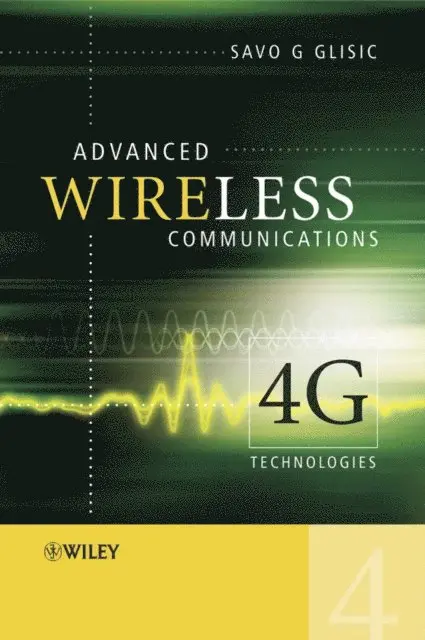
With 40% new material the new edition of Advanced Wireless Networks provides a comprehensive representation of the key issues in 4G wireless networks. Focussing on cognitive, cooperative and opportunistic paradigms to provide further increase in network efficiency, the book explores and addresses issues in wireless internet, mobile cellular and WLAN, as well as sensor, ad hoc, bio-inspired, active and cognitive networks. It examines the problem of cross-layer optimisation and network information theory as well as adaptability and reconfigurability in wireless networks. This book is an integral description of future wireless networks and the interconnection between their elements.The information is presented in a logical order within each chapter making it ideal for all levels of reader including researchers involved in modelling and analysis of future networks as well as engineers working in the area. Each chapter starts with introductory material and gradually includes more sophisticated models and mathematical tools concluding with a comprehensive list of references. Fully updated throughout with five new chapters on Opportunistic Communications; Relaying and Mesh Networks; Topology Control; Network Optimization; and Cognitive Radio Resource ManagementUnifies the latest research on cognitive, cooperative and opportunistic paradigms in wireless communicationsProvides efficient analytical tools for network analysisDiscusses security issues, an essential element of working with wireless networksSupports advanced university and training courses in the fieldCompanion website containing extra appendix on Queuing theory
2 409 kr
Skickas inom 7-10 vardagar
CDMA (Code Division Multiple Access) is one type of multiple access system used in radio communication. Other multiple access methods include TDMA, FDMA, etc. WCDMA (Wideband Code Division Multiple Access) is the main air interface used for third generation mobile communication systems - UMTS (Universal Mobile Telecommunication System) and is characterised by a wider band than CDMA. WCDMA uses a wider radio band than CDMA, which was used for 2G systems, and has a high transfer rate and increased system capacity and communication quality by statistical multiplexing, etc. WCDMA efficiently utilises the radio spectrum to provide a maximum data rate of 2 Mbit/s.Third generation mobile communication systems are scheduled for operational startup in Japan and Europe in 2001-2002. Applying high-speed data transfer and state-of-the-art radio terminal technology, third generations systems enable multimedia and are currently in the process of being standardised under 3GPP. Among the three types of system to be standardised (i.e. WCDMA, MC-CDMA, UTRA TDD), Japan and Europe will adopt WCDMA in a strategy to take the lead through superior service. This volume will cover the latest theoretical principles of WCDMA and explain why these principles are used in the standards. Starting with a general overview, the more advanced material is then gradually introduced providing an excellent roadmap for the reader.* Presents comprehensive coverage of the theoretical and practical aspects of WCDMA* Provides a detailed roadmap by presenting the material step-by-step for readers from differing backgrounds* Systematically presents the latest results in the fieldIdeal for Engineers, academics and postgraduate students involved in research and development, engineers involved in management and administration.
1 578 kr
Skickas inom 10-15 vardagar
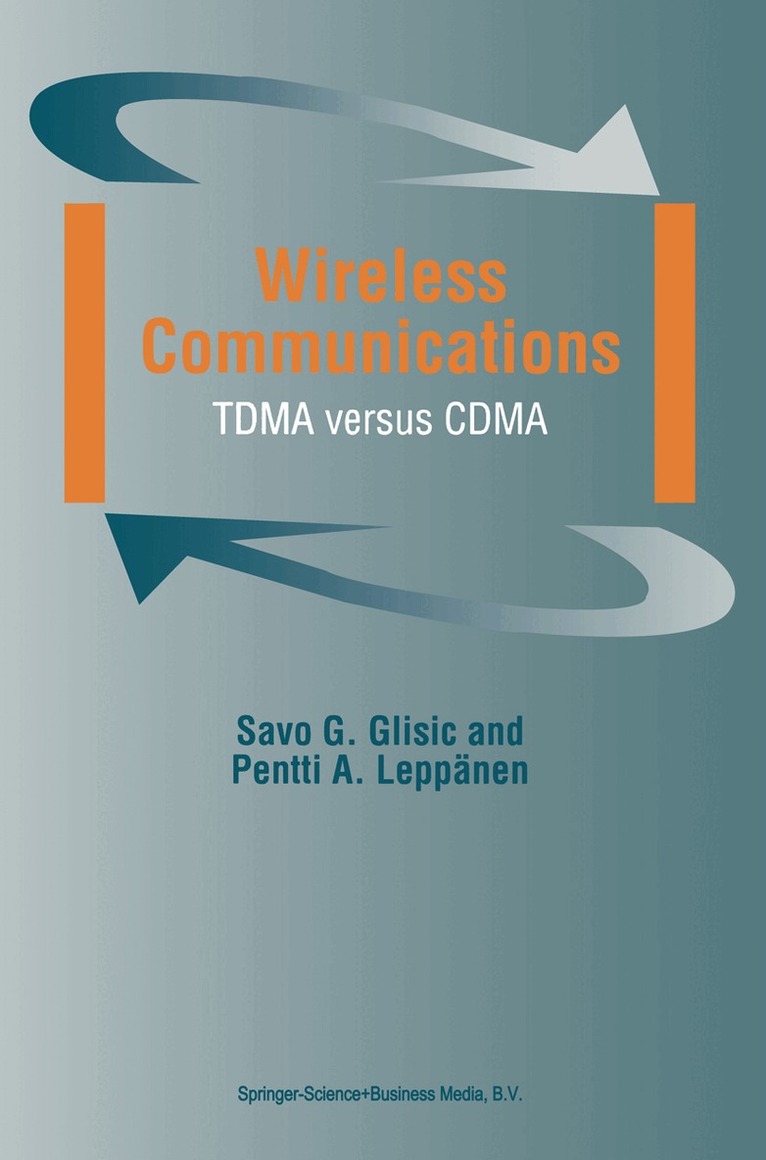
In Time Division Multiple Access (TDMA), within a given time frame a particular user is allowed to transmit within a given time slot. This technique is used in most of the second-generation digital mobile communication systems. In Europe the system is known as GSM, in USA as DAMPS and in Japan as MPT. In Code Division Multiple Access (CDMA) every user is using a distinct code so that it can occupy the same frequency bandwidth at the same time with other users and still can be separated on the basis of low correlation between the codes. These systems like IS-95 in the USA are also developed and standardized within the second generation of the mobile communication systems. CDMA systems within a cellular network can provide higher capacity and for this reason they become more and more attractive. At this moment it seems that both TDMA and CDMA remain viable candidates for application in future systems. This book provides enough information for correct understanding of the arguments in favour of one or other multiple access technique.The final decision about which of the two techniques should be employed will depend not only on technical arguments but also on the amount of new investments needed and compatibility with previous systems and their infrastructures. The book comprises a collection of specially written contributions from some prominent specialists in wireless communications and presents the major, up to date, issues in this field. The material is grouped into four chapters: communication theory, covering coding and modulation; wireless communications; antenna and propagation; and advanced systems and technology. The book describes clearly the issues and presents the information in such a way that informed decisions about third generation wireless systems can be taken.
1 578 kr
Skickas inom 10-15 vardagar
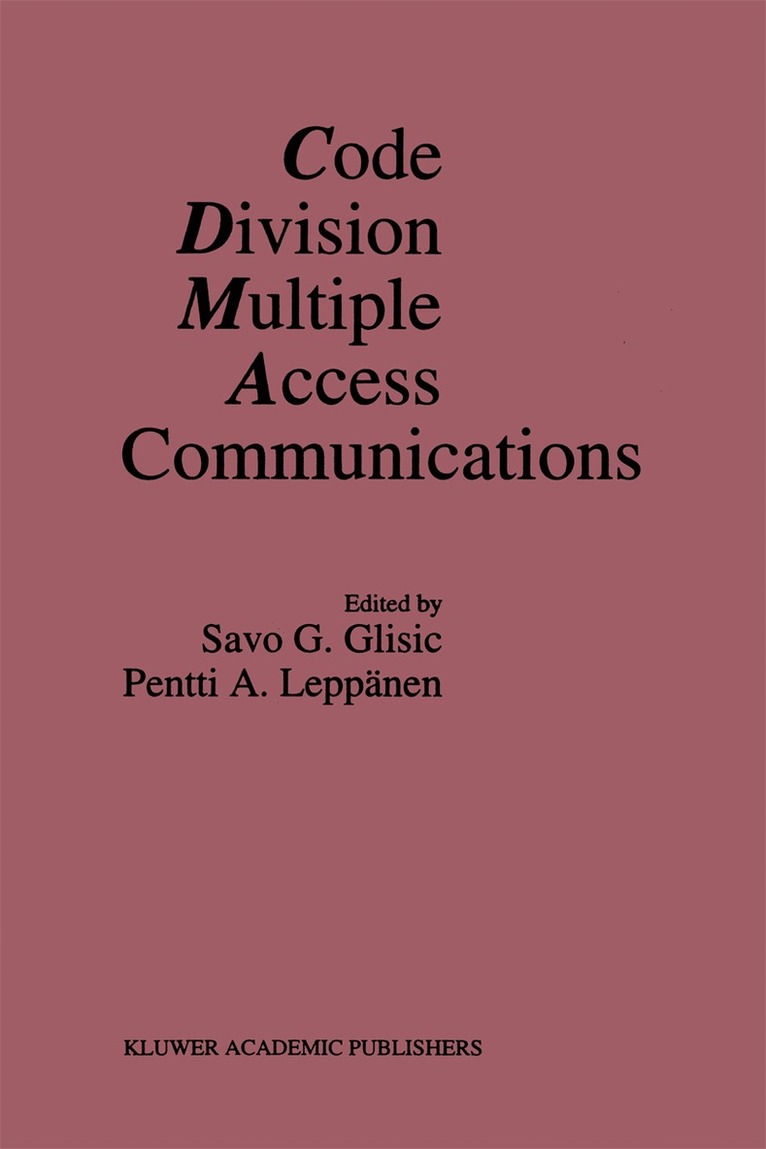
Code Division Multiple Access (CDMA) has become one of the main candidates for the next generation of mobile land and satellite communication systems. CDMA is based on spread spectrum techniques, which have been used in military applications for over half a century. Only recently however, has it been recognized that spread spectrum techniques, combined with some additional steps, can provide higher capacity and better flexibility for the mobile cellular radio communications. This work comprises a set of contributions from distinguished world scientists in the field. These papers review the basic theory and some of the most important problems related to spread spectrum and CDMA. The topics covered centre on the information theory aspects of CDMA, interference suppression and performance analysis. The material presented in this book summarizes the main problems in modern CDMA theory and practice and gives a solid starting point for studying this complex and still challenging field. It is intended for all researchers and designers working in mobile communication systems and provides an excellent text for a course on the subject.
1 238 kr
Skickas inom 5-8 vardagar
The spread-spectrum technique is becoming increasingly important in wireless communication systems. In this work, the main advantages of this techniques are outlined, describing its key elements, presenting important code acquisition strategies for direct sequences (DS) and frequency hopping (FH) systems, comparing various code tracking loop systems, and detailing receiver configurations based on CCD, SAW and DSP matched filters. The authors also examine system capacity issues related to the CDMA cellular network, and explain the CDMA overlay, packetized transmission in CDMA networks, and the problems of multiuser detection.
1 606 kr
Skickas inom 11-20 vardagar
The third edition of this popular reference covers enabling technologies for building up 5G wireless networks. Due to extensive research and complexity of the incoming solutions for the next generation of wireless networks it is anticipated that the industry will select a subset of these results and leave some advanced technologies to be implemented later,. This new edition presents a carefully chosen combination of the candidate network architectures and the required tools for their analysis. Due to the complexity of the technology, the discussion on 5G will be extensive and it will be difficult to reach consensus on the new global standard. The discussion will have to include the vendors, operators, regulators as well as the research and academic community in the field. Having a comprehensive book will help many participants to join actively the discussion and make meaningful contribution to shaping the new standard.
Artificial Intelligence and Quantum Computing for Advanced Wireless Networks
Inbunden, Engelska, 2022
1 562 kr
Skickas inom 7-10 vardagar
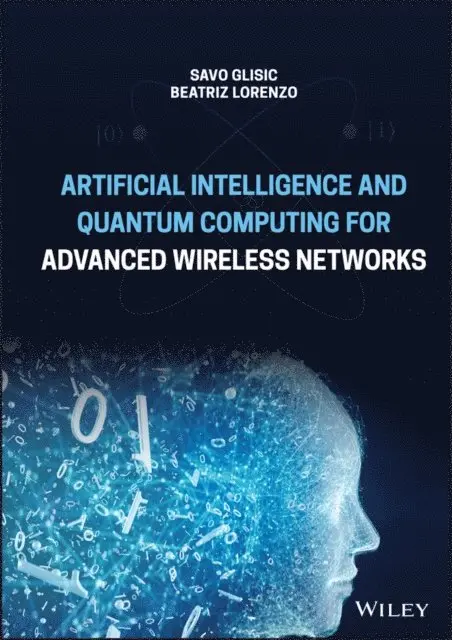
ARTIFICIAL INTELLIGENCE AND QUANTUM COMPUTING FOR ADVANCED WIRELESS NETWORKS A comprehensive presentation of the implementation of artificial intelligence and quantum computing technology in large-scale communication networksIncreasingly dense and flexible wireless networks require the use of artificial intelligence (AI) for planning network deployment, optimization, and dynamic control. Machine learning algorithms are now often used to predict traffic and network state in order to reserve resources for smooth communication with high reliability and low latency.In Artificial Intelligence and Quantum Computing for Advanced Wireless Networks, the authors deliver a practical and timely review of AI-based learning algorithms, with several case studies in both Python and R. The book discusses the game-theory-based learning algorithms used in decision making, along with various specific applications in wireless networks, like channel, network state, and traffic prediction. Additional chapters include Fundamentals of ML, Artificial Neural Networks (NN), Explainable and Graph NN, Learning Equilibria and Games, AI Algorithms in Networks, Fundamentals of Quantum Communications, Quantum Channel, Information Theory and Error Correction, Quantum Optimization Theory, and Quantum Internet, to name a few.The authors offer readers an intuitive and accessible path from basic topics on machine learning through advanced concepts and techniques in quantum networks. Readers will benefit from: A thorough introduction to the fundamentals of machine learning algorithms, including linear and logistic regression, decision trees, random forests, bagging, boosting, and support vector machinesAn exploration of artificial neural networks, including multilayer neural networks, training and backpropagation, FIR architecture spatial-temporal representations, quantum ML, quantum information theory, fundamentals of quantum internet, and moreDiscussions of explainable neural networks and XAIExaminations of graph neural networks, including learning algorithms and linear and nonlinear GNNs in both classical and quantum computing technologyPerfect for network engineers, researchers, and graduate and masters students in computer science and electrical engineering, Artificial Intelligence and Quantum Computing for Advanced Wireless Networks is also an indispensable resource for IT support staff, along with policymakers and regulators who work in technology.
1 578 kr
Skickas inom 10-15 vardagar
In Time Division Multiple Access (TDMA), within a given time frame a particular user is allowed to transmit within a given time slot. This technique is used in most of the second-generation digital mobile communication systems. In Europe the system is known as GSM, in USA as DAMPS and in Japan as MPT. In Code Division Multiple Access (CDMA) every user is using a distinct code so that it can occupy the same frequency bandwidth at the same time with other users and still can be separated on the basis of low correlation between the codes. These systems like IS-95 in the USA are also developed and standardized within the second generation of the mobile communication systems. CDMA systems within a cellular network can provide higher capacity and for this reason they become more and more attractive. At this moment it seems that both TDMA and CDMA remain viable candidates for application in future systems. Wireless Communications: TDMA versus CDMA provides enough information for correct understanding of the arguments in favour of one or other multiple access technique. The final decision about which of the two techniques should be employed will depend not only on technical arguments but also on the amount of new investments needed and compatibility with previous systems and their infrastructures. Wireless Communications: TDMA versus CDMA comprises a collection of specially written contributions from the most prominent specialists in wireless communications in the world today and presents the major, up to date, issues in this field. The material is grouped into four chapters: Communication theory, covering coding and modulation, Wireless communications, Antenna & Propagation and Advanced Systems & Technology. The book describes clearly the issues and presents the information in such a way that informed decisions about third generation wireless systems can be taken. It is essential reading for all researchers,engineers and managers working in the field of Wireless Communications.
1 578 kr
Skickas inom 10-15 vardagar
Code Division Multiple Access (CDMA) has become one of the main candidates for the next generation of mobile land and satellite communication systems. CDMA is based on spread spectrum techniques, which have been used in military applications for over half a century. Only recently, however, has it been recognised that spread spectrum techniques, combined with some additional steps, can provide higher capacity and better flexibility for the mobile cellular radio communications. Code Division Multiple Access Communications comprises a set of contributions from the most distinguished world scientists in the field. These papers review the basic theory and some of the most important problems related to spread spectrum and CDMA. The topics covered centre on the information theory aspects of CDMA; interference suppression and performance analysis. The material presented in this book summarises the main problems in modern CDMA theory and practice and gives a solid starting point for studying this complex and still challenging field. As such Code Division Multiple Access Communications is essential reading for all researchers and designers working in mobile communication systems and provides an excellent text for a course on the subject.