• Fri frakt över 249 kr
  • •
  • Snabba leveranser
  • •
  • Billiga böcker
Kundservice

Du är på sajten för privatpersoner.

Företag, bibliotek eller offentlig verksamhet?

Du handlar på classic.bokus.com, där alla dina funktioner finns intakta.
Till classic.bokus.com
Bokus logotyp. Gå till startsidan.
  • Erbjudanden
  • Student
  • Topplistor
  • Barn & ungdom
  • Bokus Play
  • E-böcker
  • Ljudböcker
  • Pocketböcker
  • Spel & pussel

10% rabatt på allt med kod NYSTART10 →

Sidfot

Mina sidor

    Hjälp

    • Kundservice
    • Vanliga frågor och svar
    • Frakt och leverans
    • Retur vid ångerrätt
    • Reklamera vara
    • Betalning
    • Köpvillkor
    • Allmänna villkor
    • Information om webbplatsens tillgänglighet

    Om Bokus

    • Om oss
    • Pressrum
    • För studenter
    • För företag
    • För bibliotek och offentlig verksamhet
    • För leverantörer
    • Hållbarhet

    Populärt

    • Aktuella erbjudanden
    • Presentkort
    • Studentlitteratur
    • Nya böcker
    • Topplistor
    • Signerade böcker
    • Engelska böcker

    Inspiration

    • Boktips
    • BookTok
    • Populära bokserier
    • Barnbokskaraktärer
    • Populära författare
    Logotyp för Bokus
    Följ oss på Facebook (extern länk)Följ oss på Instagram (extern länk)Följ oss på YouTube (extern länk)Följ oss på TikTok (extern länk)
    bokus @ CookiesAnpassa cookiesIntegritetspolicyKöpvillkor
    Till Citymail hemsida (extern länk)Till Budbee hemsida (extern länk)Till Postnord hemsida (extern länk)Till Schenker hemsida (extern länk)Till Early Bird hemsida (extern länk)Till Walleys hemsida (extern länk)
    1. Naturvetenskap och teknik
    2. Teknik och industri
    3. Elektronik och kommunikationer

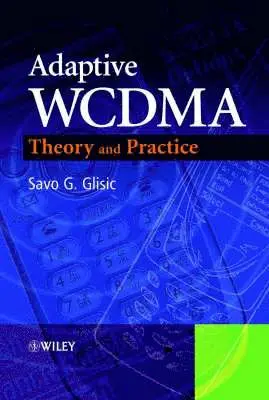
    Adaptive WCDMA

    Theory and Practice

    AvSavo G. Glisic

    Inbunden, Engelska, 2002

    2 588 kr

    Skickas . Fri frakt över 249 kr.

    Fler format och utgåvor

    E-bok

    3 045 kr

    Beskrivning

    CDMA (Code Division Multiple Access) is one type of multiple access system used in radio communication. Other multiple access methods include TDMA, FDMA, etc. WCDMA (Wideband Code Division Multiple Access) is the main air interface used for third generation mobile communication systems - UMTS (Universal Mobile Telecommunication System) and is characterised by a wider band than CDMA. WCDMA uses a wider radio band than CDMA, which was used for 2G systems, and has a high transfer rate and increased system capacity and communication quality by statistical multiplexing, etc. WCDMA efficiently utilises the radio spectrum to provide a maximum data rate of 2 Mbit/s.Third generation mobile communication systems are scheduled for operational startup in Japan and Europe in 2001-2002. Applying high-speed data transfer and state-of-the-art radio terminal technology, third generations systems enable multimedia and are currently in the process of being standardised under 3GPP. Among the three types of system to be standardised (i.e. WCDMA, MC-CDMA, UTRA TDD), Japan and Europe will adopt WCDMA in a strategy to take the lead through superior service. This volume will cover the latest theoretical principles of WCDMA and explain why these principles are used in the standards. Starting with a general overview, the more advanced material is then gradually introduced providing an excellent roadmap for the reader.* Presents comprehensive coverage of the theoretical and practical aspects of WCDMA* Provides a detailed roadmap by presenting the material step-by-step for readers from differing backgrounds* Systematically presents the latest results in the fieldIdeal for Engineers, academics and postgraduate students involved in research and development, engineers involved in management and administration.

    Produktinformation

    • Utgivningsdatum:2002-12-20
    • Mått:173 x 248 x 43 mm
    • Vikt:1 332 g
    • Format:Inbunden
    • Språk:Engelska
    • Antal sidor:640
    • Förlag:John Wiley & Sons Inc
    • ISBN:9780470848258

    Utforska kategorier

    • Elektronik och kommunikationer inom Naturvetenskap och teknik

    Mer om författaren

    Savo G. Glisic is the author of Adaptive WCDMA: Theory and Practice, published by Wiley.

    Innehållsförteckning

    • Preface xiii1 Fundamentals 11.1 Adaptive Communications and the Book Layout 11.2 Spread Spectrum Fundamentals 101.3 Theory versus Practice 16References 192 Pseudorandom sequences 232.1 Properties of Binary Shift Register Sequences 232.2 Properties of Binary Maximal-Length Sequence 262.3 Sets of Binary Sequences with Small Cross-Correlation Maximal Connected Sets of m-Sequences 302.4 Gold Sequences 302.5 Goldlike and Dual-BCH Sequences 332.6 Kasami Sequences 332.7 JPL Sequences 352.8 Kroncker Sequences 362.9 Walsh Functions 362.10 Optimum PN Sequences 372.11 Theory and Practice of PN Codes 392.12 PN Matched Filter 39Symbols 40References 413 Code acquisition 433.1 Optimum Solution 433.2 Practical Solutions 453.3 Code Acquisition Analysis 463.4 Code Acquisition in CDMA Network 513.5 Modeling of the Serial Code Acquisition Process for RAKE Receivers in CDMA Wireless Networks with Multipath and Transmitter Diversity 543.6 Two-Dimensional Code Acquisition in Spatially and Temporarily White Noise 573.7 Two-Dimensional Code Acquisition in Environments with Spatially Nonuniform Distribution of Interference 623.8 Cell Search in W-CDMA 71References 754 Code tracking 794.1 Code-Tracking Loops 794.2 Code Tracking in Fading Channels 874.3 Signal Subspace-Based Channel Estimation for CDMA Systems 944.4 Turbo Processor Aided RAKE Receiver Synchronization for UMTS W-CDMA 102Appendix: Linear and Matrix Algebra 114References 1205 Modulation and demodulation 1235.1 Maximum Likelihood Estimation 1235.2 Frequency-Error Detection 1255.3 Carrier Phase Measurement: Nonoffset Signals 1295.4 Performance of the Frequency and Phase Synchronizers 136Symbols 145References 1456 Power control 1476.1 Algorithms 1476.2 Closed-Loop Power Control in DS-CDMA Cellular System: Problem Definition 1506.3 Reference Power Level 1566.4 Feedback Control Loop Analysis 1596.5 Nonlinear Power Control 1636.6 Fuzzy Logic Power Control 1656.7 Imperfect Power Control in CDMA Systems 1776.8 Adaptive Communications 182Symbols 185References 1867 Interference suppression and CDMA overlay 1917.1 Narrowband Interference Suppression 1917.2 Generalization of Narrowband Interference Suppression 1947.3 Recursive Solutions for the Filter Coefficients 1987.4 The Learning Curve and its Time Constant 2037.5 Practical Applications: CDMA Network Overlay 210References 2148 CDMA network 2178.1 CDMA Network Capacity 2178.2 Cellular CDMA Network 2208.3 Impact of Imperfect Power Control 2288.4 Channel Modeling in CDMA Networks 2358.5 RAKE Receiver 2498.6 CDMA Cellular System with Adaptive Interference Cancellation 2548.7 Diversity Handover in DS-CDMA Cellular Systems 258Symbols 267References 2709 CDMA network design 2719.1 Basic System Design Philosophy 2719.2 CDMA Network Planning 2789.3 Spectral Efficiency of WCDMA 289Symbols 292References 29210 Resource management and access control 29510.1 Power Control and Resource Management for a Multimedia CDMA Wireless System 29510.2 Access Control of Data in Integrated Voice/Data in CDMA Systems 30010.3 Delta Modulation–Based Prediction for Access Control in Integrated Voice/Data CDMA Systems 30810.4 Mixed Voice/Data Transmission using PRMA Protocol 31310.5 Fuzzy/Neural Congestion Control 32010.6 Adaptive Traffic Admission Based on Kalman Filter 33110.7 Soft Handoff in CDMA Cellular Networks 34310.8 A Measurement-Based Prioritization Scheme for Handovers 354Symbols 364References 36511 CDMA packet radio networks 36911.1 Dual-Class CDMA System 36911.2 Access Control for Wireless Multicode CDMA Systems 37511.3 Reservation-Code Multiple Access 37911.4 MAC Protocol for a Cellular Packet CDMA with Differentiated QoS 38611.5 CDMA ALOHA Network Using p-Persistent CSMA/CD Protocol 39011.6 Implementation Losses in MAC Protocols in Wireless CDMA Networks 39711.7 Radio Resource Management in Wireless IP Networks and Differentiated Services 404References 41812 Adaptive CDMA networks 42112.1 Bit Rate/Space Adaptive CDMA Network 42112.2 MAC Layer Packet Length Adaptive CDMA Radio Networks 433Appendix 451References 45213 Multiuser CDMA receivers 45513.1 Optimal Receiver 45513.2 Linear Multiuser CDMA Detectors 46013.3 Multistage Detection in Asynchronous CDMA 46213.4 Noncoherent Detector 46513.5 Multiuser Detection in Frequency Nonselective Rayleigh Fading Channel 47013.6 Multiuser Detection in Frequency-Selective Rayleigh Fading Channel 476Symbols 487References 48814 MMSE multiuser detectors 49114.1 Minimum Mean-Square Error (MMSE) Linear Multiuser Detection 49114.2 System Model in Multipath Fading Channel 49414.3 MMSE Detector Structures 49714.4 Spatial Processing 50014.5 Single-User LMMSE Receivers for Frequency-Selective Fading Channels 503Symbols 516References 51615 Wideband CDMA network sensitivity 51915.1 Theory and Practice of Multiuser Detection 51915.2 System Model 52115.3 Capacity Losses 52715.4 Near Far Self-Resistant CDMA Wireless Network 537Appendix 1 Coherent Detection of (mMτ-CDMA) 549Appendix 2 Coherent Detection of (amMτ-CDMA) 553Appendix 3 Noncoherent Detection of (mMτ-CDMA) 556Appendix 4 Noncoherent Detection of (amMτ-CDMA) 559References 56216 Standards 56516.1 IS 95 Standard 56516.2 IS-95B CDMA 57516.3 CDMA2000 57516.4 IS-665 W-CDMA 581References 58817 UMTS standard: WCDMA/FDD Layer 1 59117.1 Transport Channels and Physical Channels (FDD) 59117.2 Multiplexing, Channel Coding and Interleaving 59817.3 Spreading and Modulation 60017.4 Physical Layer Procedures (FDD) 604References 607Index 609