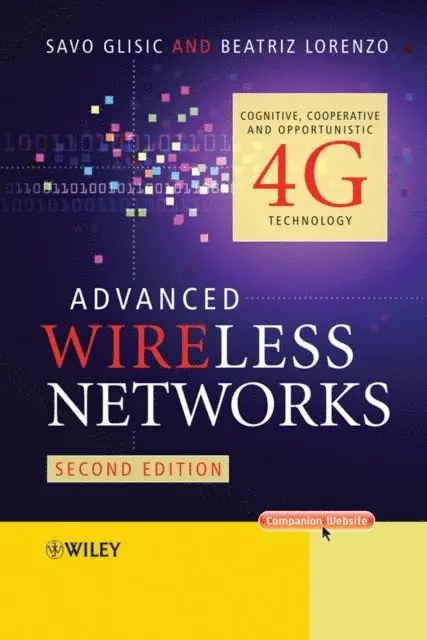
1 606 kr
Beställningsvara. Skickas inom 11-20 vardagar. Fri frakt över 249 kr.
Fler format och utgåvor
Beskrivning
Produktinformation
- Utgivningsdatum:2016-07-29
- Mått:178 x 252 x 43 mm
- Vikt:1 397 g
- Format:Inbunden
- Språk:Engelska
- Antal sidor:864
- Upplaga:3
- Förlag:John Wiley & Sons Inc
- ISBN:9781119096856
Utforska kategorier
Mer om författaren
Savo Glisic, Professor of Telecommunications, University of Oulu, FinlandHead of the Networking Research Group, and Director of Globalcomm Institute for Telecommunications. He was Visiting Scientist at Cranfield Institute of Technology, Cranfield, U.K. (1976-1977) and University of California, San Diego (1986-1987). He has been active in the field of wireless communications for 30 years. His research interest is in the area of network optimization theory, network topology control and graph theory, cognitive networks and game theory, radio resource management, QoS and queuing theory, networks information theory, protocol design, advanced routing and network coding, relaying, cellular, WLAN, ad hoc, sensor, active and bio inspired networks with emphasis on genetic algorithms and stochastic geometry. He runs an extensive doctoral program in the field of wireless networking (www.telecomlab.oulu.fi/kurssit/networks/).
Innehållsförteckning
- Preface xv 1 Introduction: Generalized Model of Advanced Wireless Networks 11.1 Network Model 31.2 Network Connectivity 51.3 Wireless Network Design with Small World Properties 71.4 Frequency Channels Backup 111.5 Generalized Network Model 131.6 Routing Protocols Over s-Lattice Network 141.7 Network Performance 161.8 Node, Route, Topology, and Network Robustness 191.9 Power Consumption 201.10 Protocol Complexity 201.11 Performance Evaluation 211.12 Book Layout 27Appendix A.1 33References 342 Adaptive Network Layer 352.1 Graphs and Routing Protocols 352.2 Graph Theory 542.3 Routing with Topology Aggregation 56References 603 Mobility Management 653.1 Cellular Networks 653.2 Cellular Systems with Prioritized Handoff 893.3 Cell Residing Time Distribution 1003.4 Mobility Prediction in Pico- and Micro-Cellular Networks 105Appendix A.3 Distance Calculation in an Intermediate Cell 116References 1224 Ad Hoc Networks 1264.1 Routing Protocols 1264.2 Hybrid Routing Protocol 1464.3 Scalable Routing Strategies 1524.4 Multipath Routing 1604.5 Clustering Protocols 1624.6 Cashing Schemes for Routing 1754.7 Distributed QoS Routing 181References 1905 Sensor Networks 1945.1 Introduction 1945.2 Sensor Network Parameters 1965.3 Sensor Network Architecture 1995.4 Mobile Sensor Network Deployment 2095.5 Directed Diffusion 2125.6 Aggregation in Wireless Sensor Networks 2165.7 Boundary Estimation 2205.8 Optimal Transmission Radius in Sensor Networks 2275.9 Data Funneling 2335.10 Equivalent Transport Control Protocol in Sensor Networks 236References 2376 Security 2446.1 Authentication 2446.2 Security Architecture 2536.3 Key Management 2576.4 Security in Ad Hoc Networks 2616.5 Security in Sensor Networks 268References 2697 Network Economics 2727.1 Fundamentals of Network Economics 2727.2 Wireless Network Microeconomics: Data Sponsoring 2867.3 Spectrum Pricing for Market Equilibrium 2917.4 Sequential Spectrum Sharing 3007.5 Data Plan Trading 308References 3158 Multi-Hop Cellular Networks 3188.1 Modeling Multi-Hop Multi-Operator Multi-Technology Wireless Networks 3188.2 Technology Background 3198.3 System Model and Notation 3218.4 m3 Route Discovery Protocols 3238.5 Performance of m3 Route Discovery Protocols 3278.6 Protocol Complexity 3298.7 Traffic Offloading Incentives 3308.8 Performance Illustrations 335References 3449 Cognitive Networks 3469.1 Technology Background 3469.2 Spectrum Auctions for Multi-hop Cognitive Networks 3509.3 Compound Auctioning in Multi-hop Cognitive Cellular Networks 363References 38810 Stochastic Geometry 39110.1 Background Theory 391References 39811 Heterogeneous Networks 40211.1 Preliminaries 40211.2 Self-Organized Small Cell Networks 40411.3 Dynamic Network Architecture 41111.4 Economics of Heterogeneous Networks 434References 44312 Access Point Selection 44612.1 Background Technology 44612.2 Network Selection Game 44912.3 Joint Access Point Selection and Power Allocation 45312.4 Joint AP Selection and Beamforming Optimization 463References 47413 Self-Organizing Networks 47813.1 Self-Organizing Network Optimization 47813.2 System Model 47813.3 Joint Optimization of Tilts and AP Association 481References 48414 Complex Networks 48614.1 Evolution Towards Large-Scale Networks 48614.2 Network Characteristics 49114.3 Random Graphs 494References 49615 Massive MIMO 49915.1 Linearly Precoded Multicellular Downlink System 49915.2 System Model 50315.3 Optimization for Perfect Channel State Information 50515.4 Robust Designs for WSRM Problem 509Appendix A.15 519Appendix B.15 519References 52116 Network Optimization Theory 52316.1 Introduction 52316.2 Layering as Optimization Decomposition 52416.3 Cross-Layer Optimization 53316.4 Optimization Problem Decomposition Methods 543References 55417 Network Information Theory 55717.1 Capacity of Ad Hoc Networks 55717.2 Information Theory and Network Architectures 56917.3 Cooperative Transmission in Wireless Multihop Ad Hoc Networks 577References 58418 Stability of Advanced Network Architectures 58518.1 Stability of Cooperative Cognitive Wireless Networks 58518.2 System Model 58618.4 Optimal Control Policy 59218.5 Achievable Rates 59418.6 Stabilizing Transmission Policies 598References 60519 Multi-Operator Spectrum Sharing 60719.1 Business Models for Spectrum Sharing 60719.2 Spectrum Sharing in Multi-hop Networks 638References 65620 Large Scale Networks and Mean Field Theory 65920.1 MFT for Large Heterogeneous Cellular Networks 65920.2 Large Scale Network Model Compression 66420.3 Mean Field Theory Model of Large Scale DTN Networks 66820.4 Mean Field Modeling of Adaptive Infection Recovery in Multicast DTN Networks 67420.5 Mean Field Theory for Scale-Free Random Networks 70120.6 Spectrum Sharing and MFT 70920.7 Modeling Dynamics of Complex System 711Appendix A.20 Iterative Algorithm to Solve Systems of Nonlinear ODEs (DiNSE-Algorithm) 721Appendix B.20 Infection Rate of Destinations for DNCM 722Appendix C.20 Infection Rate for Basic Epidemic Routing 722References 72221 mmWave Networks 72621.1 mmWave Technology in Subcellular Architecture 72621.2 Microeconomics of Dynamic mmWave Networks 737References 74722 Cloud Computing in Wireless Networks 75022.1 Technology Background 75022.2 System Model 75222.3 System Optimization 75622.4 Dynamic Control Algorithm 75822.5 Achievable Rates 76122.6 Stabilizing Control Policies 763References 76923 Wireless Networks and Matching Theory 77123.1 Background Technology: Matching Markets 77223.2 Distributed Stable Matching in Multiple Operator Cellular Network with Traffic Offloading 77623.3 College Admissions Game Model for Cellular Networks with Traffic Offloading 77923.4 Many to Many Matching Games for Caching in Wireless Networks 78323.5 Many to One Matching with Externalities in Cellular Networks with Traffic Offloading 78723.6 Security in Matching of Device to Device Pairs in Cellular Networks 791References 79524 Dynamic Wireless Network Infrastructure 79724.1 Infrastructure Sharing in Multi-Operator Cellular Networks 79724.2 User Provided Connectivity 80224.3 Network Virtualization 80624.4 Software Defined Networks 81024.5 SDN Security 816References 819Index 827
Mer från samma författare
Spread Spectrum CDMA Systems for Wireless Communications
Savo G. Glisic, Branka Vucetic
1 238 kr
Artificial Intelligence and Quantum Computing for Advanced Wireless Networks
Savo G. Glisic, Beatriz Lorenzo
1 562 kr
Du kanske också är intresserad av
Artificial Intelligence and Quantum Computing for Advanced Wireless Networks
Savo G. Glisic, Beatriz Lorenzo
1 562 kr
Spread Spectrum CDMA Systems for Wireless Communications
Savo G. Glisic, Branka Vucetic
1 238 kr
- Nyhet