• Fri frakt över 249 kr
  • •
  • Snabba leveranser
  • •
  • Billiga böcker
Kundservice

Du är på sajten för privatpersoner.

Företag, bibliotek eller offentlig verksamhet?

Du handlar på classic.bokus.com, där alla dina funktioner finns intakta.
Till classic.bokus.com
Bokus logotyp. Gå till startsidan.
  • Erbjudanden
  • Nyheter
  • Student
  • Topplistor
  • Barn & ungdom
  • Bokus Play
  • E-böcker
  • Pocketböcker
  • Spel & pussel

10% rabatt på allt med kod NYSTART10 →

Sidfot

Mina sidor

    Hjälp

    • Kundservice
    • Vanliga frågor och svar
    • Frakt och leverans
    • Retur vid ångerrätt
    • Reklamera vara
    • Betalning
    • Köpvillkor
    • Allmänna villkor
    • Information om webbplatsens tillgänglighet

    Om Bokus

    • Om oss
    • Pressrum
    • För studenter
    • För företag
    • För bibliotek och offentlig verksamhet
    • För leverantörer
    • Hållbarhet

    Populärt

    • Aktuella erbjudanden
    • Presentkort
    • Studentlitteratur
    • Nya böcker
    • Topplistor
    • Signerade böcker
    • Engelska böcker

    Inspiration

    • Boktips
    • BookTok
    • Populära bokserier
    • Barnbokskaraktärer
    • Populära författare
    Logotyp för Bokus
    Följ oss på Facebook (extern länk)Följ oss på Instagram (extern länk)Följ oss på YouTube (extern länk)Följ oss på TikTok (extern länk)
    bokus @ CookiesAnpassa cookiesIntegritetspolicyKöpvillkor
    Till Citymail hemsida (extern länk)Till Budbee hemsida (extern länk)Till Postnord hemsida (extern länk)Till Schenker hemsida (extern länk)Till Early Bird hemsida (extern länk)Till Walleys hemsida (extern länk)
    1. Ekonomi och Ledarskap
    2. Företagsekonomi
    3. Redovisning och finansiering

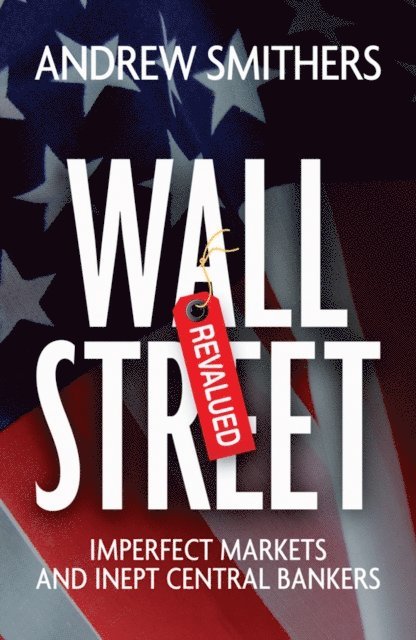
    Wall Street Revalued

    Imperfect Markets and Inept Central Bankers

    AvAndrew Smithers

    Inbunden, Engelska, 2009

    334 kr

    Beställningsvara. Skickas inom 11-20 vardagar. Fri frakt över 249 kr.

    Fler format och utgåvor

    E-bok

    390 kr

    E-bok

    390 kr

    Beskrivning

    In 2000 one of the world’s foremost economists, Andrew Smithers, showed that the US stock market was widely over-priced at its peak and correctly advised investors to sell. He also argued that central bankers should adjust their policies not only in light of expected inflation but also if stock prices reach excessive levels. At the time, few economists agreed with him, today it is hard to find those who would disagree.In the past central bankers have denied that markets can be valued and that it did not matter if they fell. These two intellectual mistakes are the fundamentals cause of the current financial market crisis. In addition, a lack of understanding by investors as to how to value the market has also resulted in widespread losses.It is clearly of great importance to everyone that neither these losses nor the current financial chaos should be repeated and thus that the principle of asset valuation should be widely understood.In this timely and thought-provoking sequel to the hugely successful Valuing Wall Street Andrew Smithers puts forward a coherent and testable economic theory in order to influence investors, pension consultants and central bankers policy decisions so that thy may prevent history repeating itself. Backed by theory and substantial evidence Andrew shows that assets can be valued, as financial markets are neither perfectly efficient nor absurd casinos.
    Produktinformation

    • Utgivningsdatum:2009-07-24
    • Mått:159 x 234 x 25 mm
    • Vikt:567 g
    • Format:Inbunden
    • Språk:Engelska
    • Antal sidor:288
    • Förlag:John Wiley & Sons Inc
    • ISBN:9780470750056

    Utforska kategorier

    • Redovisning och finansiering inom Ekonomi och Ledarskap

    Mer om författaren

    Andrew Smithers is the founder of Smithers & Co., which provides economics-based asset allocation advice to over 100 fund management companies worldwide.  Andrew is a regular contributor in Japan to the Nikkei Veritas. He was a regular contributor to the London Evening Standard and Japan's Sentaku magazine, and has written for many other newspapers and magazines, including the Financial Times, Forbes (US), Sunday Telegraph (UK), Independent on Sunday (UK) and Genron (Japan).  Andrew is an invited contributor to the prestigious Economist's Forum on the FT website.Andrew is a member of the Advisory Board for the Centre for International Macroeconomics and Finance (CIMF) at Cambridge and has also been a member of the Investment Committee at Clare College, Cambridge since 1998.Prior to starting his own firm, Andrew was at S.G.Warburg & Co. Ltd. from 1962 to 1989 where he ran the investment management business for some years and which, by the end of his tenure, was the acknowledged market leader. This was subsequently floated off as a separate company, Mercury Asset Management, which was acquired by Merrill Lynch in 1998.

    Recensioner i media

    "... excellent book...." (Fool.co.uk, August 2010) "... an interesting book with many challengers to conventional thought." (TheActuary.org.uk, June 2010) "Mr Smithers makes his case convincingly, dismissing alternative indicators of valuation, such as the dividend yield, along the way." (The Economist, August 14th 2009) "... an economist with a good record in identifying bubbles... provides evidence." (Financial Times, August 5th 2009)

    Innehållsförteckning

    • Foreword vChapter 1 Introduction 1Chapter 2 Synopsis 15Chapter 3 Interest Rate Levels and the Stock Market 25Chapter 4 Interest Rate Changes and Share Price Changes 37Chapter 5 Household Savings and the Stock Market 41Chapter 6 A Moderately rather than a Perfectly Efficient Market 49Chapter 7 The Efficient Market Hypothesis 57Chapter 8 Testing the Imperfectly Efficient Market Hypothesis 67Chapter 9 Other Claims for Valuing Equities 81Chapter 10 Forecasting Returns without Using Value 91Chapter 11 Valuing Stock Markets by Hindsight Combined with Subsequent Returns 97Chapter 12 House Prices 105Chapter 13 The Price of Liquidity – The Return for Holding Illiquid Assets 109Chapter 14 The Return on Equities and the Return on Equity Portfolios 115Chapter 15 The General Undesirability of Leveraging Equity Portfolios 121Chapter 16 A Rare Exception to the Rule against Leverage 131Chapter 17 Profits are Overstated 137Chapter 18 Intangibles 145Chapter 19 Accounting Issues 159Chapter 20 The Impact on q 171Chapter 21 Problems with Valuing the Markets of Developing Economies 175Chapter 22 Central Banks’ Response to Asset Prices 181Chapter 23 The Response to Asset Prices from Investors, Fund Managers and Pension Consultants 191Chapter 24 International Imbalances 195Chapter 25 Summing Up 197Appendix 1 Sources and Obligations 199Appendix 2 Glossary of Terms 203Appendix 3 Interest Rates, Profits and Share Prices by James Mitchell 209Appendix 4 Examples of the Current (Trailing) and Next Year’s (Prospective) PEs Giving Misleading Guides to Value 217Appendix 5 Real Returns from Equity Markets Comparing 1899–1954 with 1954–2008 219Appendix 6 Errors in Inflation Expectations and the Impact on Bond Returns by Stephen Wright and Andrew Smithers 221Appendix 7 An Algebraic Demonstration that Negative Serial Correlation can make the Leverage of an Equity Portfolio Unattractive 233Appendix 8 Correlations between International Stock Markets 235Bibliography 237Index 239