• Fri frakt över 249 kr
  • •
  • Snabba leveranser
  • •
  • Billiga böcker
Kundservice

Du är på sajten för privatpersoner.

Företag, bibliotek eller offentlig verksamhet?

Du handlar på classic.bokus.com, där alla dina funktioner finns intakta.
Till classic.bokus.com
Bokus logotyp. Gå till startsidan.
  • Erbjudanden
  • Student
  • Topplistor
  • Barn & ungdom
  • Bokus Play
  • E-böcker
  • Ljudböcker
  • Pocketböcker
  • Spel & pussel

10% rabatt på allt med kod NYSTART10 →

Sidfot

Mina sidor

    Hjälp

    • Kundservice
    • Vanliga frågor och svar
    • Frakt och leverans
    • Retur vid ångerrätt
    • Reklamera vara
    • Betalning
    • Köpvillkor
    • Allmänna villkor
    • Information om webbplatsens tillgänglighet

    Om Bokus

    • Om oss
    • Pressrum
    • För studenter
    • För företag
    • För bibliotek och offentlig verksamhet
    • För leverantörer
    • Hållbarhet

    Populärt

    • Aktuella erbjudanden
    • Presentkort
    • Studentlitteratur
    • Nya böcker
    • Topplistor
    • Signerade böcker
    • Engelska böcker

    Inspiration

    • Boktips
    • BookTok
    • Populära bokserier
    • Barnbokskaraktärer
    • Populära författare
    Logotyp för Bokus
    Följ oss på Facebook (extern länk)Följ oss på Instagram (extern länk)Följ oss på YouTube (extern länk)Följ oss på TikTok (extern länk)
    bokus @ CookiesAnpassa cookiesIntegritetspolicyKöpvillkor
    Till Citymail hemsida (extern länk)Till Budbee hemsida (extern länk)Till Postnord hemsida (extern länk)Till Schenker hemsida (extern länk)Till Early Bird hemsida (extern länk)Till Walleys hemsida (extern länk)
    1. Naturvetenskap och teknik
    2. Geovetenskap
    3. Geovetenskap
    4. Geologi

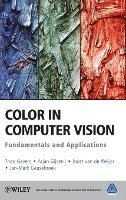
    Color in Computer Vision

    Fundamentals and Applications

    AvTheo Gevers,Arjan Gijsenij

    Inbunden, Engelska, 2012

    Del 19 i serien Wiley-IS&T Series in Imaging Science and Technology

    1 422 kr

    Beställningsvara. Skickas inom 5-8 vardagar. Fri frakt över 249 kr.

    Beskrivning

    While the field of computer vision drives many of today’s digital technologies and communication networks, the topic of color has emerged only recently in most computer vision applications. One of the most extensive works to date on color in computer vision, this book provides a complete set of tools for working with color in the field of image understanding.Based on the authors’ intense collaboration for more than a decade and drawing on the latest thinking in the field of computer science, the book integrates topics from color science and computer vision, clearly linking theories, techniques, machine learning, and applications. The fundamental basics, sample applications, and downloadable versions of the software and data sets are also included. Clear, thorough, and practical, Color in Computer Vision explains: Computer vision, including color-driven algorithms and quantitative results of various state-of-the-art methodsColor science topics such as color systems, color reflection mechanisms, color invariance, and color constancyDigital image processing, including edge detection, feature extraction, image segmentation, and image transformationsSignal processing techniques for the development of both image processing and machine learningRobotics and artificial intelligence, including such topics as supervised learning and classifiers for object and scene categorization Researchers and professionals in computer science, computer vision, color science, electrical engineering, and signal processing will learn how to implement color in computer vision applications and gain insight into future developments in this dynamic and expanding field.

    Produktinformation

    • Utgivningsdatum:2012-10-05
    • Mått:161 x 241 x 20 mm
    • Vikt:789 g
    • Format:Inbunden
    • Språk:Engelska
    • Serie:Wiley-IS&T Series in Imaging Science and Technology
    • Antal sidor:384
    • Förlag:John Wiley & Sons Inc
    • ISBN:9780470890844

    Utforska kategorier

    • Geologi inom Naturvetenskap och teknik

    Mer om författaren

    THEO GEVERS, PhD, is Professor of Computer Science in the Intelligent Systems Lab at the University of Amsterdam in the Netherlands, and CVC Full Professor at the Computer Vision Center in Barcelona, Spain.ARJAN GIJSENIJ, PhD, was a postdoctoral researcher in the Intelligent Systems Lab at the University of Amsterdam, the Netherlands, while writing this book.JOOST van de WEIJER, PhD, is a Ramon y Cajal Fellow at the Universitat Autònoma de Barcelona, Spain.JAN-MARK GEUSEBROEK, PhD, was assistant professor in the Intelligent Systems Lab at the University of Amsterdam, the Netherlands, while writing this book.

    Innehållsförteckning

    • Preface xv1 Introduction 11.1 From Fundamental to Applied 21.2 Part I: Color Fundamentals 31.3 Part II: Photometric Invariance 31.4 Part III: Color Constancy 41.5 Part IV: Color Feature Extraction 51.6 Part V: Applications 71.7 Summary 9PART I Color Fundamentals 112 Color Vision 132.1 Introduction 132.2 Stages of Color Information Processing 142.3 Chromatic Properties of the Visual System 182.4 Summary 243 Color Image Formation 263.1 Lambertian Reflection Model 283.2 Dichromatic Reflection Model 293.3 Kubelka–Munk Model 323.4 The Diagonal Model 343.5 Color Spaces 363.6 Summary 44PART II Photometric Invariance 474 Pixel-Based Photometric Invariance 494.1 Normalized Color Spaces 504.2 Opponent Color Spaces 524.3 The HSV Color Space 524.4 Composed Color Spaces 534.5 Noise Stability and Histogram Construction 584.6 Application: Color-Based Object Recognition 644.7 Summary 685 Photometric Invariance from Color Ratios 695.1 Illuminant Invariant Color Ratios 715.2 Illuminant Invariant Edge Detection 735.3 Blur-Robust and Color Constant Image Description 745.4 Application: Image Retrieval Based on Color Ratios 775.5 Summary 806 Derivative-Based Photometric Invariance 816.1 Full Photometric Invariants 846.2 Quasi-Invariants 1016.3 Summary 1117 Photometric Invariance by Machine Learning 1137.1 Learning from Diversified Ensembles 1147.2 Temporal Ensemble Learning 1197.3 Learning Color Invariants for Region Detection 1207.4 Experiments 1247.5 Summary 134PART III Color Constancy 1358 Illuminant Estimation and Chromatic Adaptation 1378.1 Illuminant Estimation 1398.2 Chromatic Adaptation 1419 Color Constancy Using Low-level Features 1439.1 General Gray-World 1439.2 Gray-Edge 1469.3 Physics-Based Methods 1509.4 Summary 15110 Color Constancy Using Gamut-Based Methods 15210.1 Gamut Mapping Using Derivative Structures 15510.2 Combination of Gamut Mapping Algorithms 15710.3 Summary 16011 Color Constancy Using Machine Learning 16111.1 Probabilistic Approaches 16111.2 Combination Using Output Statistics 16211.3 Combination Using Natural Image Statistics 16311.4 Methods Using Semantic Information 16711.5 Summary 17112 Evaluation of Color Constancy Methods 17212.1 Data Sets 17212.2 Performance Measures 17512.3 Experiments 18012.4 Summary 185PART IV Color Feature Extraction 18713 Color Feature Detection 18913.1 The Color Tensor 19113.2 Color Saliency 20513.3 Conclusions 21814 Color Feature Description 22114.1 Gaussian Derivative-Based Descriptors 22514.2 Discriminative Power 22914.3 Level of Invariance 23514.4 Information Content 23614.5 Summary 24315 Color Image Segmentation 24415.1 Color Gabor Filtering 24515.2 Invariant Gabor Filters Under Lambertian Reflection 24715.3 Color-Based Texture Segmentation 24715.4 Material Recognition Using Invariant Anisotropic Filtering 24915.5 Color Invariant Codebooks and Material-Specific Adaptation 25615.6 Experiments 25815.7 Image Segmentation by Delaunay Triangulation 26315.8 Summary 268PART V Applications 26916 Object and Scene Recognition 27116.1 Diagonal Model 27216.2 Color SIFT Descriptors 27316.3 Object and Scene Recognition 27616.4 Results 28016.5 Summary 28517 Color Naming 28717.1 Basic Color Terms 28817.3 Color Names from Uncalibrated Data 30417.4 Experimental Results 31317.5 Conclusions 31618 Segmentation of Multispectral Images 31818.1 Reflection and Camera Models 31918.2 Photometric Invariant Distance Measures 32118.3 Error Propagation 32518.4 Photometric Invariant Region Detection by Clustering 32818.5 Experiments 33018.6 Summary 338Citation Guidelines 339References 341Index 363