• Fri frakt över 249 kr
  • •
  • Snabba leveranser
  • •
  • Billiga böcker
Kundservice

Du är på sajten för privatpersoner.

Företag, bibliotek eller offentlig verksamhet?

Du handlar på classic.bokus.com, där alla dina funktioner finns intakta.
Till classic.bokus.com
Bokus logotyp. Gå till startsidan.
  • Erbjudanden
  • Student
  • Topplistor
  • Barn & ungdom
  • Bokus Play
  • E-böcker
  • Ljudböcker
  • Pocketböcker
  • Spel & pussel

Upp till 25% på utvalda nyheter →

Sidfot

Mina sidor

    Hjälp

    • Kundservice
    • Vanliga frågor och svar
    • Frakt och leverans
    • Retur vid ångerrätt
    • Reklamera vara
    • Betalning
    • Köpvillkor
    • Allmänna villkor
    • Information om webbplatsens tillgänglighet

    Om Bokus

    • Om oss
    • Pressrum
    • För studenter
    • För företag
    • För bibliotek och offentlig verksamhet
    • För leverantörer
    • Hållbarhet

    Populärt

    • Aktuella erbjudanden
    • Presentkort
    • Studentlitteratur
    • Nya böcker
    • Topplistor
    • Signerade böcker
    • Engelska böcker

    Inspiration

    • Boktips
    • BookTok
    • Populära bokserier
    • Barnbokskaraktärer
    • Populära författare
    Logotyp för Bokus
    Följ oss på Facebook (extern länk)Följ oss på Instagram (extern länk)Följ oss på YouTube (extern länk)Följ oss på TikTok (extern länk)
    bokus @ CookiesAnpassa cookiesIntegritetspolicyKöpvillkor
    Till Citymail hemsida (extern länk)Till Budbee hemsida (extern länk)Till Postnord hemsida (extern länk)Till Schenker hemsida (extern länk)Till Early Bird hemsida (extern länk)Till Walleys hemsida (extern länk)
    1. Naturvetenskap och teknik
    2. Teknik och industri
    3. Energiteknik

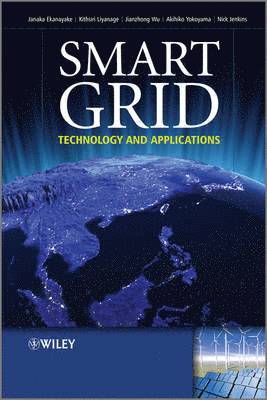
    Smart Grid

    Technology and Applications

    AvJanaka B. Ekanayake,Nick Jenkins

    Inbunden, Engelska, 2012

    933 kr

    Tillfälligt slut

    Beskrivning

    Electric power systems worldwide face radical transformation with the need to decarbonise electricity supply, replace ageing assets and harness new information and communication technologies (ICT). The Smart Grid uses advanced ICT to control next generation power systems reliably and efficiently. This authoritative guide demonstrates the importance of the Smart Grid and shows how ICT will extend beyond transmission voltages to distribution networks and customer-level operation through Smart Meters and Smart Homes.Smart Grid Technology and Applications: Clearly unravels the evolving Smart Grid concept with extensive illustrations and practical examples.Describes the spectrum of key enabling technologies required for the realisation of the Smart Grid with worked examples to illustrate the applications.Enables readers to engage with the immediate development of the power system and take part in the debate over the future Smart Grid.Introduces the constituent topics from first principles, assuming only a basic knowledge of mathematics, circuits and power systems.Brings together the expertise of a highly experienced and international author team from the UK, Sri Lanka, China and Japan.Electrical, electronics and computer engineering researchers, practitioners and consultants working in inter-disciplinary Smart Grid RD&D will significantly enhance their knowledge through this reference. The tutorial style will greatly benefit final year undergraduate and master’s students as the curriculum increasing focuses on the breadth of technologies that contribute to Smart Grid realisation.

    Produktinformation

    • Utgivningsdatum:2012-03-23
    • Mått:168 x 244 x 21 mm
    • Vikt:624 g
    • Format:Inbunden
    • Språk:Engelska
    • Antal sidor:320
    • Förlag:John Wiley & Sons Inc
    • ISBN:9780470974094

    Utforska kategorier

    • Energiteknik inom Naturvetenskap och teknik

    Mer om författaren

    Professor Janaka Ekanayake, Cardiff University, UKProfessor Ekanayake is currently at the Institute of Energy at Cardiff University. As module leader on an MSc course, he teaches intelligent electronic devices, their applications and automation. He also teaches power electronic applications to power systems, flexible ac transmission systems and HVDC.Previous to this he was a Research Fellow at the University of Manchester. He was promoted to Professor in Electrical and Electronic Engineering at the University of Peradeniya, Sri Lanka in 2003. Professor Ekanayake has published over 25 papers in refereed journals and has co-authored three books in the area of wind integration. Dr Kithsiri Liyanage, University of Peradeniya, Sri LankaDr Liyanage is Senior Lecturer in the Department of Electrical and Electronic Engineering, University of Peradeniya. Prior to this he served as Dean of the Faculty of Engineering, University of Ruhuna and as Director of the Information Technology Centre, University of Peradenyia. He has been with the University of Tokyo as a Visiting Research Fellow since 2008.  He has served as coordinator of and consultant to several ICT and power generation projects.Dr Jianzhong Wu, Cardiff University, UKDr Wu is a lecturer at the Institute of Energy, School of Engineering, Cardiff University. Privious to this he was a research fellow at the University of Manchester and Associate Professor at Tianjin University, China. He has been involved in several Chinese national research programmes, developing advanced software tools for distribution network operation, planning, for on-line security monitoring, assessment and optimisation for transmission networks.Professor Akihiko Yokoyama, University of Tokyo, JapanProfessor Yokoyama is based at the Department of Engineering at the University of Tokyo. He is alsoProfessor in the Department of Advanced Energy at the Graduate School of Frontier Sciences He has co-authored two books, and is Chairman of PES Council of IEEE Japan. He is Vice Chair- man of the Japanese National Committee of CIGRE, and Vice President of Central Research Institute of Electric Power Industry of Japan.Professor Nicholas Jenkins, Cardiff University, UKProfessor Jenkins moved to Cardiff University in 2008 after ten years as a professor at the University of Manchester. He has contributed to ten books and is a Fellow of the IET, IEEE and the Royal Academy of Engineering. He was a member of Advisory Council of the CEU SmartGrid Technology Platform. Professor Jenkins is presently the Shimizu Visiting Professor at Stanford University.

    Innehållsförteckning

    • About the authors xiPreface xiiiAcknowledgements xvList of abbreviations xvii1 The Smart Grid 11.1 Introduction 11.2 Why implement the Smart Grid now? 21.2.1 Ageing assets and lack of circuit capacity 21.2.2 Thermal constraints 21.2.3 Operational constraints 31.2.4 Security of supply 31.2.5 National initiatives 41.3 What is the Smart Grid? 61.4 Early Smart Grid initiatives 71.4.1 Active distribution networks 71.4.2 Virtual power plant 91.4.3 Other initiatives and demonstrations 91.5 Overview of the technologies required for the Smart Grid 12References 14Part I Information and Communication Technologies2 Data communication 192.1 Introduction 192.2 Dedicated and shared communication channels 192.3 Switching techniques 232.3.1 Circuit switching 242.3.2 Message switching 242.3.3 Packet switching 242.4 Communication channels 252.4.1 Wired communication 272.4.2 Optical fibre 292.4.3 Radio communication 332.4.4 Cellular mobile communication 342.4.5 Satellite communication 342.5 Layered architecture and protocols 352.5.1 The ISO/OSI model 362.5.2 TCP/IP 40References 433 Communication technologies for the Smart Grid 453.1 Introduction 453.2 Communication technologies 463.2.1 IEEE 802 series 463.2.2 Mobile communications 593.2.3 Multi protocol label switching 603.2.4 Power line communication 623.3 Standards for information exchange 623.3.1 Standards for smart metering 623.3.2 Modbus 633.3.3 DNP 3 643.3.4 IEC 61850 65References 664 Information security for the Smart Grid 694.1 Introduction 694.2 Encryption and decryption 704.2.1 Symmetric key encryption 714.2.2 Public key encryption 754.3 Authentication 764.3.1 Authentication based on shared secret key 764.3.2 Authentication based on key distribution centre 774.4 Digital signatures 774.4.1 Secret key signature 774.4.2 Public key signature 774.4.3 Message digest 784.5 Cyber security standards 794.5.1 IEEE 1686: IEEE standard for substation intelligent electronic devices (IEDs) cyber security capabilities 794.5.2 IEC 62351: Power systems management and associated information exchange – data and communications security 80References 80Part II Sensing, Measurement, Control and Automation Technologies5 Smart metering and demand-side integration 835.1 Introduction 835.2 Smart metering 845.2.1 Evolution of electricity metering 845.2.2 Key components of smart metering 865.3 Smart meters: An overview of the hardware used 865.3.1 Signal acquisition 875.3.2 Signal conditioning 895.3.3 Analogue to digital conversion 905.3.4 Computation 945.3.5 Input/output 955.3.6 Communication 965.4 Communications infrastructure and protocols for smart metering 965.4.1 Home-area network 965.4.2 Neighbourhood area network 975.4.3 Data concentrator 985.4.4 Meter data management system 985.4.5 Protocols for communications 985.5 Demand-side integration 995.5.1 Services provided by DSI 1005.5.2 Implementations of DSI 1045.5.3 Hardware support to DSI implementations 1075.5.4 Flexibility delivered by prosumers from the demand side 1095.5.5 System support from DSI 110References 1116 Distribution automation equipment 1136.1 Introduction 1136.2 Substation automation equipment 1146.2.1 Current transformers 1166.2.2 Voltage transformers 1216.2.3 Intelligent electronic devices 1216.2.4 Bay controller 1246.2.5 Remote terminal units 1246.3 Faults in the distribution system 1256.3.1 Components for fault isolation and restoration 1276.3.2 Fault location, isolation and restoration 1326.4 Voltage regulation 135References 1397 Distribution management systems 1417.1 Introduction 1417.2 Data sources and associated external systems 1427.2.1 SCADA 1437.2.2 Customer information system 1447.3 Modelling and analysis tools 1447.3.1 Distribution system modelling 1447.3.2 Topology analysis 1497.3.3 Load forecasting 1517.3.4 Power flow analysis 1527.3.5 Fault calculations 1567.3.6 State estimation 1607.3.7 Other analysis tools 1657.4 Applications 1657.4.1 System monitoring 1657.4.2 System operation 1667.4.3 System management 1687.4.4 Outage management system (OMS) 168References 1718 Transmission system operation 1738.1 Introduction 1738.2 Data sources 1738.2.1 IEDs and SCADA 1738.2.2 Phasor measurement units 1748.3 Energy management systems 1778.4 Wide area applications 1798.4.1 On-line transient stability controller 1818.4.2 Pole-slipping preventive controller 1818.5 Visualisation techniques 1838.5.1 Visual 2-D presentation 1848.5.2 Visual 3-D presentation 185References 186Part III Power Electronics and Energy Storage9 Power electronic converters 1899.1 Introduction 1899.2 Current source converters 1919.3 Voltage source converters 1959.3.1 VSCs for low and medium power applications 1969.3.2 VSC for medium and high power applications 199References 20310 Power electronics in the Smart Grid 20510.1 Introduction 20510.2 Renewable energy generation 20610.2.1 Photovoltaic systems 20610.2.2 Wind, hydro and tidal energy systems 20910.3 Fault current limiting 21310.4 Shunt compensation 21710.4.1 D-STATCOM 21810.4.2 Active filtering 22410.4.3 Shunt compensator with energy storage 22410.5 Series compensation 228References 23111 Power electronics for bulk power flows 23311.1 Introduction 23311.2 FACTS 23411.2.1 Reactive power compensation 23511.2.2 Series compensation 24111.2.3 Thyristor-controlled phase shifting transformer 24311.2.4 Unified power flow controller 24511.2.5 Interline power flow controller 24611.3 HVDC 24811.3.1 Current source converters 24911.3.2 Voltage source converters 25311.3.3 Multi-terminal HVDC 256References 25712 Energy storage 25912.1 Introduction 25912.2 Energy storage technologies 26312.2.1 Batteries 26312.2.2 Flow battery 26412.2.3 Fuel cell and hydrogen electrolyser 26612.2.4 Flywheels 26712.2.5 Superconducting magnetic energy storage systems 27012.2.6 Supercapacitors 27012.3 Case study 1: Energy storage for wind power 27112.4 Case study 2: Agent-based control of electrical vehicle battery charging 273References 277Index 279