• Fri frakt över 249 kr
  • •
  • Snabba leveranser
  • •
  • Billiga böcker
Kundservice

Du är på sajten för privatpersoner.

Företag, bibliotek eller offentlig verksamhet?

Du handlar på classic.bokus.com, där alla dina funktioner finns intakta.
Till classic.bokus.com
Bokus logotyp. Gå till startsidan.
  • Erbjudanden
  • Nyheter
  • Student
  • Topplistor
  • Barn & ungdom
  • Bokus Play
  • E-böcker
  • Pocketböcker
  • Spel & pussel

10% rabatt på allt med kod NYSTART10 →

Sidfot

Mina sidor

    Hjälp

    • Kundservice
    • Vanliga frågor och svar
    • Frakt och leverans
    • Retur vid ångerrätt
    • Reklamera vara
    • Betalning
    • Köpvillkor
    • Allmänna villkor
    • Information om webbplatsens tillgänglighet

    Om Bokus

    • Om oss
    • Pressrum
    • För studenter
    • För företag
    • För bibliotek och offentlig verksamhet
    • För leverantörer
    • Hållbarhet

    Populärt

    • Aktuella erbjudanden
    • Presentkort
    • Studentlitteratur
    • Nya böcker
    • Topplistor
    • Signerade böcker
    • Engelska böcker

    Inspiration

    • Boktips
    • BookTok
    • Populära bokserier
    • Barnbokskaraktärer
    • Populära författare
    Logotyp för Bokus
    Följ oss på Facebook (extern länk)Följ oss på Instagram (extern länk)Följ oss på YouTube (extern länk)Följ oss på TikTok (extern länk)
    bokus @ CookiesAnpassa cookiesIntegritetspolicyKöpvillkor
    Till Citymail hemsida (extern länk)Till Budbee hemsida (extern länk)Till Postnord hemsida (extern länk)Till Schenker hemsida (extern länk)Till Early Bird hemsida (extern länk)Till Walleys hemsida (extern länk)
    1. Naturvetenskap och teknik
    2. Teknik och industri
    3. Byggnadsteknik

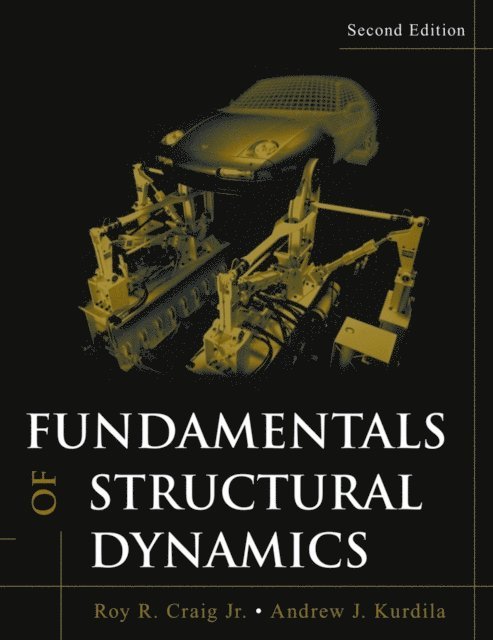
    Fundamentals of Structural Dynamics

    AvRoy R. Craig Jr.,Andrew J. Kurdila

    Inbunden, Engelska, 2006

    1 962 kr

    Beställningsvara. Skickas inom 5-8 vardagar. Fri frakt över 249 kr.

    Beskrivning

    FUNDAMENTALS OF STRUCTURAL DYNAMICS From theory and fundamentals to the latest advances in computational and experimental modal analysis, this is the definitive, updated reference on structural dynamics. This edition updates Professor Craig’s classic introduction to structural dynamics, which has been an invaluable resource for practicing engineers and a textbook for undergraduate and graduate courses in vibrations and/or structural dynamics. Along with comprehensive coverage of structural dynamics fundamentals, finite-element–based computational methods, and dynamic testing methods, this Second Edition includes new and expanded coverage of computational methods, as well as introductions to more advanced topics, including experimental modal analysis and “active structures.” With a systematic approach, it presents solution techniques that apply to various engineering disciplines. It discusses single degree-of-freedom (SDOF) systems, multiple degrees-of-freedom (MDOF) systems, and continuous systems in depth; and includes numeric evaluation of modes and frequency of MDOF systems; direct integration methods for dynamic response of SDOF systems and MDOF systems; and component mode synthesis. Numerous illustrative examples help engineers apply the techniques and methods to challenges they face in the real world. MATLAB® is extensively used throughout the book, and many of the .m-files are made available on the book’s Web site. Fundamentals of Structural Dynamics, Second Edition is an indispensable reference and “refresher course” for engineering professionals; and a textbook for seniors or graduate students in mechanical engineering, civil engineering, engineering mechanics, or aerospace engineering.

    Produktinformation

    • Utgivningsdatum:2006-09-01
    • Mått:198 x 239 x 43 mm
    • Vikt:1 225 g
    • Format:Inbunden
    • Språk:Engelska
    • Antal sidor:752
    • Upplaga:2
    • Förlag:John Wiley & Sons Inc
    • ISBN:9780471430445

    Utforska kategorier

    • Byggnadsteknik inom Naturvetenskap och teknik
    • Maskinteknik och material inom Naturvetenskap och teknik

    Mer om författaren

    ROY R. CRAIG JR., PHD, is Professor Emeritus of Aerospace Engineering and Engineering Mechanics at The University of Texas at Austin. He has received numerous teaching awards and has worked in industry at Boeing, NASA, and Exxon Production Research Corporation, among others. ANDREW J. KURDILA, PHD, is the W. Martin Johnson Professor of Mechanical Engineering at the Virginia Polytechnic Institute and State University. His current research focuses on structural dynamics, dynamic systems theory, control theory, and computational mechanics.

    Innehållsförteckning

    • Preface to Structural Dynamics—An Introduction to Computer Methods xiPreface to Fundamentals of Structural Dynamics xiiiAbout the Authors xv1 The Science and Art of Structural Dynamics 11.1 Introduction to Structural Dynamics 11.2 Modeling of Structural Components and Systems 21.3 Prototype Spring–Mass Model 71.4 Vibration Testing of Structures 121.5 Scope of the Book 121.6 Computer Simulations; Supplementary Material on the Website 15References 16Problems 16Part I Single-Degree-of-Freedom Systems 192 Mathematical Models of SDOF Systems 212.1 Brief Review of the Dynamics of Particles and Rigid Bodies 212.2 Elements of Lumped-Parameter Models 242.3 Application of Newton’s Laws to Lumped-Parameter Models 272.4 Application of the Principle of Virtual Displacements to Lumped-Parameter Models 342.5 Application of the Principle of Virtual Displacements to Continuous Models: Assumed-Modes Method 41References 50Problems 513 Free Vibration of SDOF Systems 563.1 Free Vibration of Undamped SDOF Systems 583.2 Free Vibration of Viscous-Damped SDOF Systems 613.3 Stability of Motion 663.4 Free Vibration of an SDOF System with Coulomb Damping 703.5 Experimental Determination of the Natural Frequency and Damping Factor of an SDOF System 72References 77Problems 784 Response of SDOF Systems to Harmonic Excitation 814.1 Response of Undamped SDOF Systems to Harmonic Excitation 824.2 Response of Viscous-Damped SDOF Systems to Harmonic Excitation: Frequency-Response Functions 874.3 Complex Frequency Response 934.4 Vibration Isolation: Force Transmissibility and Base Motion 964.5 Vibration Measuring Instruments: Accelerometers and Vibrometers 1014.6 Use of Frequency-Response Data to Determine the Natural Frequency and Damping Factor of a Lightly Damped SDOF System 1044.7 Equivalent Viscous Damping 1074.8 Structural Damping 111References 112Problems 1135 Response of SDOF Systems to Nonperiodic Excitation 1175.1 Response of a Viscous-Damped SDOF System to an Ideal Step Input 1175.2 Response of Undamped SDOF Systems to Rectangular Pulse and Ramp Loadings 1195.3 Response of Undamped SDOF Systems to a Short-Duration Impulse: Unit Impulse Response 1235.4 Response of SDOF Systems to General Dynamic Excitation: Convolution Integral Method 1255.5 Response Spectra 1285.6 System Response by the Laplace Transform Method: System Transfer Function 136References 142Problems 1436 Numerical Evaluation of the Dynamic Response of SDOF Systems 1476.1 Integration of Second-Order Ordinary Differential Equations 1486.2 Integration of First-Order Ordinary Differential Equations 1596.3 Nonlinear SDOF Systems 171References 181Problems 1827 Response of SDOF Systems to Periodic Excitation: Frequency-Domain Analysis 1847.1 Response to Periodic Excitation: Real Fourier Series 1847.2 Response to Periodic Excitation: Complex Fourier Series 1897.3 Response to Nonperiodic Excitation: Fourier Integral 1957.4 Relationship Between Complex Frequency Response and Unit Impulse Response 1997.5 Discrete Fourier Transform and Fast Fourier Transform 200References 205Problems 205Part II Multiple-Degree-of-Freedom Systems—Basic Topics 2098 Mathematical Models of MDOF Systems 2118.1 Application of Newton’s Laws to Lumped-Parameter Models 2128.2 Introduction to Analytical Dynamics: Hamilton’s Principle and Lagrange’s Equations 2188.3 Application of Lagrange’s Equations to Lumped-Parameter Models 2238.4 Application of Lagrange’s Equations to Continuous Models: Assumed-Modes Method 2288.5 Constrained Coordinates and Lagrange Multipliers 238References 240Problems 2419 Vibration of Undamped 2-DOF Systems 2489.1 Free Vibration of 2-DOF Systems: Natural Frequencies and Mode Shapes 2499.2 Beat Phenomenon 2549.3 Additional Examples of Modes and Frequencies of 2-DOF Systems: Assumed-Modes Models 2589.4 Free Vibration of Systems with Rigid-Body Modes 2669.5 Introduction to Mode Superposition: Frequency Response of an Undamped 2-DOF System 2689.6 Undamped Vibration Absorber 272Reference 275Problems 27510 Vibration Properties of MDOF Systems: Modes, Frequencies, and Damping 28110.1 Some Properties of Natural Frequencies and Natural Modes of Undamped MDOF Systems 28210.2 Model Reduction: Rayleigh, Rayleigh–Ritz, and Assumed-Modes Methods 29810.3 Uncoupled Damping in MDOF Systems 30210.4 Structures with Arbitrary Viscous Damping: Complex Modes 30710.5 Natural Frequencies and Mode Shapes of Damped Structures with Rigid-BodyModes 316References 322Problems 32211 Dynamic Response of MDOF Systems: Mode-Superposition Method 32511.1 Mode-Superposition Method: Principal Coordinates 32511.2 Mode-Superposition Solutions for MDOF Systems with Modal Damping: Frequency-Response Analysis 33011.3 Mode-Displacement Solution for the Response of MDOF Systems 34211.4 Mode-Acceleration Solution for the Response of Undamped MDOF Systems 34911.5 Dynamic Stresses by Mode Superposition 35111.6 Mode Superposition for Undamped Systems with Rigid-Body Modes 353References 359Problems 360Part III Continuous Systems 36512 Mathematical Models of Continuous Systems 36712.1 Applications of Newton’s Laws: Axial Deformation and Torsion 36712.2 Application of Newton’s Laws: Transverse Vibration of Linearly Elastic Beams (Bernoulli–Euler Beam Theory) 37412.3 Application of Hamilton’s Principle: Torsion of a Rod with Circular Cross Section 37912.4 Application of the Extended Hamilton’s Principle: Beam Flexure Including Shear Deformation and Rotatory Inertia (Timoshenko Beam Theory) 382References 385Problems 38513 Free Vibration of Continuous Systems 38813.1 Free Axial and Torsional Vibration 38813.2 Free Transverse Vibration of Bernoulli–Euler Beams 39213.3 Rayleigh’s Method for Approximating the Fundamental Frequency of a Continuous System 39813.4 Free Transverse Vibration of Beams Including Shear Deformation and Rotatory Inertia 40013.5 Some Properties of Natural Modes of Continuous Systems 40113.6 Free Vibration of Thin Flat Plates 405References 409Problems 409Part IV Computational Methods in Structural Dynamics 41514 Introduction to Finite Element Modeling of Structures 41714.1 Introduction to the Finite Element Method 41814.2 Element Stiffness and Mass Matrices and Element Force Vector 41914.3 Transformation of Element Matrices 43014.4 Assembly of System Matrices: Direct Stiffness Method 43814.5 Boundary Conditions 44514.6 Constraints: Reduction of Degrees of Freedom 44714.7 Systems with Rigid-Body Modes 45114.8 Finite Element Solutions for Natural Frequencies and Mode Shapes 453References 462Problems 46315 Numerical Evaluation of Modes and Frequencies of MDOF Systems 46915.1 Introduction to Methods for Solving Algebraic Eigenproblems 46915.2 Vector Iteration Methods 47115.3 Subspace Iteration 48015.4 QR Method for Symmetric Eigenproblems 48315.5 Lanczos Eigensolver 48915.6 Numerical Case Study 496References 498Problems 49816 Direct Integration Methods for Dynamic Response of MDOF Systems 50016.1 Damping in MDOF Systems 50116.2 Numerical Integration: Mathematical Framework 50416.3 Integration of Second-Order MDOF Systems 51016.4 Single-Step Methods and Spectral Stability 51616.5 Numerical Case Study 525References 527Problems 52817 Component-Mode Synthesis 53117.1 Introduction to Component-Mode Synthesis 53217.2 Component Modes: Normal, Constraint, and Rigid-Body Modes 53417.3 Component Modes: Attachment and Inertia-Relief Attachment Modes 53917.4 Flexibility Matrices and Residual Flexibility 54417.5 Substructure Coupling Procedures 54917.6 Component-Mode Synthesis Methods: Fixed-Interface Methods 55717.7 Component-Mode Synthesis Methods: Free-Interface Methods 55917.8 Brief Introduction to Multilevel Substructuring 564References 571Problems 572Part V Advanced Topics in Structural Dynamics 57718 Introduction to Experimental Modal Analysis 57918.1 Introduction 58018.2 Frequency-Response Function Representations 58418.3 Vibration Test Hardware 59018.4 Fourier Transforms, Digital Signal Processing, and Estimation of FRFs 59418.5 Modal Parameter Estimation 60418.6 Mode Shape Estimation and Model Verification 612References 615Problems 61619 Introduction to Active Structures 61719.1 Introduction to Piezoelectric Materials 61719.2 Constitutive Laws of Linear Piezoelectricity 62019.3 Application of Newton’s Laws to Piezostructural Systems 62419.4 Application of Extended Hamilton’s Principle to Piezoelectricity 62719.5 Active Truss Models 63019.6 Active Beam Models 63719.7 Active Composite Laminates 641References 646Problems 64720 Introduction to Earthquake Response of Structures 65020.1 Introduction 65020.2 Response of a SDOF System to Earthquake Excitation: Response Spectra 65220.3 Response of MDOF Systems to Earthquake Excitation 66020.4 Further Considerations 664References 665Problems 666A Units 667B Complex Numbers 671C Elements of Laplace Transforms 674D Fundamentals of Linear Algebra 682E Introduction to the Use of Matlab 697Index 715

    Betyg & recensioner

    3/5