• Fri frakt över 249 kr
  • •
  • Snabba leveranser
  • •
  • Billiga böcker
Kundservice

Du är på sajten för privatpersoner.

Företag, bibliotek eller offentlig verksamhet?

Du handlar på classic.bokus.com, där alla dina funktioner finns intakta.
Till classic.bokus.com
Bokus logotyp. Gå till startsidan.
  • Erbjudanden
  • Nyheter
  • Student
  • Topplistor
  • Barn & ungdom
  • Bokus Play
  • E-böcker
  • Pocketböcker
  • Spel & pussel

Upp till 20% på populära nyheter →

Sidfot

Mina sidor

    Hjälp

    • Kundservice
    • Vanliga frågor och svar
    • Frakt och leverans
    • Retur vid ångerrätt
    • Reklamera vara
    • Betalning
    • Köpvillkor
    • Allmänna villkor
    • Information om webbplatsens tillgänglighet

    Om Bokus

    • Om oss
    • Pressrum
    • För studenter
    • För företag
    • För bibliotek och offentlig verksamhet
    • För leverantörer
    • Hållbarhet

    Populärt

    • Aktuella erbjudanden
    • Presentkort
    • Studentlitteratur
    • Nya böcker
    • Topplistor
    • Signerade böcker
    • Engelska böcker

    Inspiration

    • Boktips
    • BookTok
    • Populära bokserier
    • Barnbokskaraktärer
    • Populära författare

    Mina sidor

      Hjälp

      • Kundservice
      • Vanliga frågor och svar
      • Frakt och leverans
      • Retur vid ångerrätt
      • Reklamera vara
      • Betalning
      • Köpvillkor
      • Allmänna villkor
      • Information om webbplatsens tillgänglighet

      Om Bokus

      • Om oss
      • Pressrum
      • För studenter
      • För företag
      • För bibliotek och offentlig verksamhet
      • För leverantörer
      • Hållbarhet

      Populärt

      • Aktuella erbjudanden
      • Presentkort
      • Studentlitteratur
      • Nya böcker
      • Topplistor
      • Signerade böcker
      • Engelska böcker

      Inspiration

      • Boktips
      • BookTok
      • Populära bokserier
      • Barnbokskaraktärer
      • Populära författare
      Logotyp för Bokus
      Följ oss på Facebook (extern länk)Följ oss på Instagram (extern länk)Följ oss på YouTube (extern länk)Följ oss på TikTok (extern länk)
      bokus @ CookiesIntegritetspolicyKöpvillkor
      Till Citymail hemsida (extern länk)Till Budbee hemsida (extern länk)Till Postnord hemsida (extern länk)Till Schenker hemsida (extern länk)Till Early Bird hemsida (extern länk)Till Walleys hemsida (extern länk)
      1. Data och IT
      2. Systemvetenskap och AI

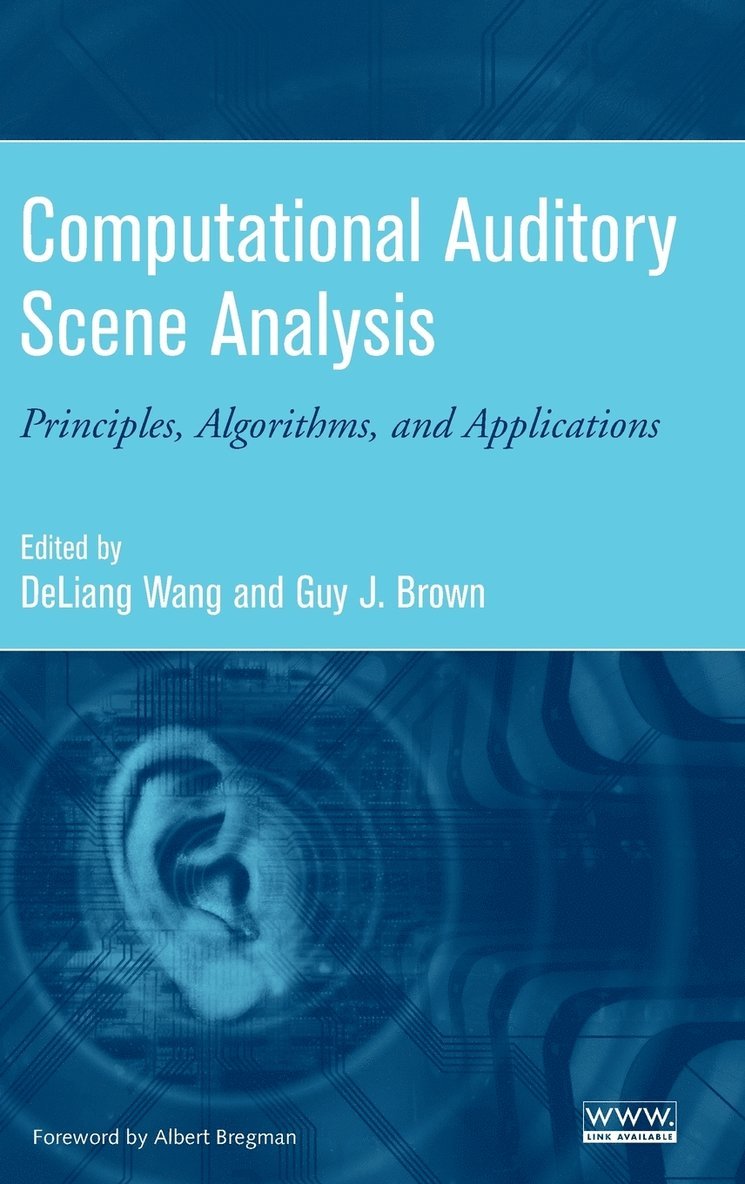
      Computational Auditory Scene Analysis

      Principles, Algorithms, and Applications

      AvWang,Brown

      Inbunden, Engelska, 2006

      1 541 kr

      Beställningsvara. Skickas inom 5-8 vardagar. Fri frakt över 249 kr.

      Beskrivning

      How can we engineer systems capable of "cocktail party" listening? Human listeners are able to perceptually segregate one sound source from an acoustic mixture, such as a single voice from a mixture of other voices and music at a busy cocktail party. How can we engineer "machine listening" systems that achieve this perceptual feat?Albert Bregman's book Auditory Scene Analysis, published in 1990, drew an analogy between the perception of auditory scenes and visual scenes, and described a coherent framework for understanding the perceptual organization of sound. His account has stimulated much interest in computational studies of hearing. Such studies are motivated in part by the demand for practical sound separation systems, which have many applications including noise-robust automatic speech recognition, hearing prostheses, and automatic music transcription. This emerging field has become known as computational auditory scene analysis (CASA).Computational Auditory Scene Analysis: Principles, Algorithms, and Applications provides a comprehensive and coherent account of the state of the art in CASA, in terms of the underlying principles, the algorithms and system architectures that are employed, and the potential applications of this exciting new technology. With a Foreword by Bregman, its chapters are written by leading researchers and cover a wide range of topics including: Estimation of multiple fundamental frequenciesFeature-based and model-based approaches to CASASound separation based on spatial locationProcessing for reverberant environmentsSegregation of speech and musical signalsAutomatic speech recognition in noisy environmentsNeural and perceptual modeling of auditory organizationThe text is written at a level that will be accessible to graduate students and researchers from related science and engineering disciplines. The extensive bibliography accompanying each chapter will also make this book a valuable reference source. A web site accompanying the text, http://www.casabook.org, features software tools and sound demonstrations.

      Produktinformation

      • Utgivningsdatum:2006-10-17
      • Mått:164 x 236 x 26 mm
      • Vikt:721 g
      • Format:Inbunden
      • Språk:Engelska
      • Antal sidor:424
      • Förlag:John Wiley & Sons Inc
      • ISBN:9780471741091

      Utforska kategorier

      • Systemvetenskap och AI inom Data och IT
      • Biologisk psykologi och neuropsykologi inom Psykologi och pedagogik

      Mer om författaren

      Editors DeLIANG WANG and GUY J. BROWN are well-known for their contributions to the development of CASA. Wang is a Professor in the Department of Computer Science and Engineering and the Center for Cognitive Science at The Ohio State University. He is an IEEE Fellow. Brown is a Senior Lecturer in the Department of Computer Science at the University of Sheffield, UK.

      Innehållsförteckning

      • Foreword. Preface.Contributors.Acronyms.1. Fundamentals of Computational Auditory Scene Analysis (DeLiang Wang and Guy J. Brown).1.1 Human Auditory Scene Analysis.1.1.1 Structure and Function of the Auditory System.1.1.2 Perceptual Organization of Simple Stimuli.1.1.3 Perceptual Segregation of Speech from Other Sounds.1.1.4 Perceptual Mechanisms.1.2 Computational Auditory Scene Analysis (CASA).1.2.1 What Is CASA?1.2.2 What Is the Goal of CASA?1.2.3 Why CASA?1.3 Basics of CASA Systems.1.3.1 System Architecture.1.3.2 Cochleagram.1.3.3 Correlogram.1.3.4 Cross-Correlogram.1.3.5 Time-Frequency Masks.1.3.6 Resynthesis.1.4 CASA Evaluation.1.4.1 Evaluation Criteria.1.4.2 Corpora.1.5 Other Sound Separation Approaches.1.6 A Brief History of CASA (Prior to 2000).1.6.1 Monaural CASA Systems.1.6.2 Binaural CASA Systems.1.6.3 Neural CASA Models.1.7 Conclusions 36Acknowledgments.References.2. Multiple F0 Estimation (Alain de Cheveigné).2.1 Introduction.2.2 Signal Models.2.3 Single-Voice F0 Estimation.2.3.1 Spectral Approach.2.3.2 Temporal Approach.2.3.3 Spectrotemporal Approach.2.4 Multiple-Voice F0 Estimation.2.4.1 Spectral Approach.2.4.2 Temporal Approach.2.4.3 Spectrotemporal Approach.2.5 Issues.2.5.1 Spectral Resolution.2.5.2 Temporal Resolution.2.5.3 Spectrotemporal Resolution.2.6 Other Sources of Information.2.6.1 Temporal and Spectral Continuity.2.6.2 Instrument Models.2.6.3 Learning-Based Techniques.2.7 Estimating the Number of Sources.2.8 Evaluation.2.9 Application Scenarios.2.10 Conclusion.Acknowledgments.References.3. Feature-Based Speech Segregation (DeLiang Wang).3.1 Introduction.3.2 Feature Extraction.3.2.1 Pitch Detection.3.2.2 Onset and Offset Detection.3.2.3 Amplitude Modulation Extraction.3.2.4 Frequency Modulation Detection.3.3 Auditory Segmentation.3.3.1 What Is the Goal of Auditory Segmentation?3.3.2 Segmentation Based on Cross-Channel Correlation and Temporal Continuity.3.3.3 Segmentation Based on Onset and Offset Analysis.3.4 Simultaneous Grouping.3.4.1 Voiced Speech Segregation.3.4.2 Unvoiced Speech Segregation.3.5 Sequential Grouping.3.5.1 Spectrum-Based Sequential Grouping.3.5.2 Pitch-Based Sequential Grouping.3.5.3 Model-Based Sequential Grouping.3.6 Discussion.Acknowledgments.References.4. Model-Based Scene Analysis (Daniel P. W. Ellis).4.1 Introduction.4.2 Source Separation as Inference.4.3 Hidden Markov Models.4.4 Aspects of Model-Based Systems.4.4.1 Constraints: Types and Representations.4.4.2 Fitting Models.4.4.3 Generating Output.4.5 Discussion.4.5.1 Unknown Interference.4.5.2 Ambiguity and Adaptation.4.5.3 Relations to Other Separation Approaches.4.6 Conclusions.References.5. Binaural Sound Localization (Richard M. Stern, Guy J. Brown, and DeLiang Wang).5.1 Introduction.5.2 Physical and Physiological Mechanisms Underlying Auditory Localization.5.2.1 Physical Cues.5.2.2 Physiological Estimation of ITD and IID.5.3 Spatial Perception of Single Sources.5.3.1 Sensitivity to Differences in Interaural Time and Intensity.5.3.2 Lateralization of Single Sources.5.3.3 Localization of Single Sources.5.3.4 The Precedence Effect.5.4 Spatial Perception of Multiple Sources.5.4.1 Localization of Multiple Sources.5.4.2 Binaural Signal Detection.5.5 Models of Binaural Perception.5.5.1 Classical Models of Binaural Hearing.5.5.2 Cross-Correlation-Based Models of Binaural Interaction.5.5.3 Some Extensions to Cross-Correlation-Based Binaural Models.5.6 Multisource Sound Localization.5.6.1 Estimating Source Azimuth from Interaural Cross-Correlation.5.6.2 Methods for Resolving Azimuth Ambiguity.5.6.3 Localization of Moving Sources.5.7 General Discussion.Acknowledgments.References.6. Localization-Based Grouping (Albert S. Feng and Douglas L. Jones).6.1 Introduction.6.2 Classical Beamforming Techniques.6.2.1 Fixed Beamforming Techniques.6.2.2 Adaptive Beamforming Techniques.6.2.3 Independent Component Analysis Techniques.6.2.4 Other Localization-Based Techniques.6.3 Location-Based Grouping Using Interaural Time Difference Cue.6.4 Location-Based Grouping Using Interaural Intensity Difference Cue.6.5 Location-Based Grouping Using Multiple Binaural Cues.6.6 Discussion and Conclusions.Acknowledgments.References.7. Reverberation (Guy J. Brown and Kalle J. Palomäki).7.1 Introduction.7.2 Effects of Reverberation on Listeners.7.2.1 Speech Perception.7.2.2 Sound Localization.7.2.3 Source Separation and Signal Detection.7.2.4 Distance Perception.7.2.5 Auditory Spatial Impression.7.3 Effects of Reverberation on Machines.7.4 Mechanisms Underlying Robustness to Reverberation in Human Listeners.7.4.1 The Role of Slow Temporal Modulations in Speech Perception.7.4.2 The Binaural Advantage.7.4.3 The Precedence Effect.7.4.4 Perceptual Compensation for Spectral Envelope Distortion.7.5 Reverberation-Robust Acoustic Processing.7.5.1 Dereverberation.7.5.2 Reverberation-Robust Acoustic Features.7.5.3 Reverberation Masking.7.6 CASA and Reverberation.7.6.1 Systems Based on Directional Filtering.7.6.2 CASA for Robust ASR in Reverberant Conditions.7.6.3 Systems that Use Multiple Cues.7.7 Discussion and Conclusions.Acknowledgments.References.8. Analysis of Musical Audio Signals (Masataka Goto).8.1 Introduction.8.2 Music Scene Description.8.2.1 Music Scene Descriptions.8.2.2 Difficulties Associated with Musical Audio Signals.8.3 Estimating Melody and Bass Lines.8.3.1 PreFEst-front-end: Forming the Observed Probability Density Functions.8.3.2 PreFEst-core: Estimating the F0’s Probability Density Function.8.3.3 PreFEst-back-end: Sequential F0 Tracking by Multiple-Agent Architecture.8.3.4 Other Methods.8.4 Estimating Beat Structure.8.4.1 Estimating Period and Phase.8.4.2 Dealing with Ambiguity.8.4.3 Using Musical Knowledge.8.5 Estimating Chorus Sections and Repeated Sections.8.5.1 Extracting Acoustic Features and Calculating Their Similarity.8.5.2 Finding Repeated Sections.8.5.3 Grouping Repeated Sections.8.5.4 Detecting Modulated Repetition.8.5.5 Selecting Chorus Sections.8.5.6 Other Methods.8.6 Discussion and Conclusions.8.6.1 Importance.8.6.2 Evaluation Issues.8.6.3 Future Directions.References.9. Robust Automatic Speech Recognition (Jon Barker).9.1 Introduction.9.2 ASA and Speech Perception in Humans.9.2.1 Speech Perception and Simultaneous Grouping.9.2.2 Speech Perception and Sequential Grouping.9.2.3 Speech Schemes.9.2.4 Challenges to the ASA Account of Speech Perception.9.2.5 Interim Summary.9.3 Speech Recognition by Machine.9.3.1 The Statistical Basis of ASR.9.3.2 Traditional Approaches to Robust ASR.9.3.3 CASA-Driven Approaches to ASR.9.4 Primitive CASA and ASR.9.4.1 Speech and Time-Frequency Masking.9.4.2 The Missing-Data Approach to ASR.9.4.3 Marginalization-Based Missing-Data ASR Systems.9.4.4 Imputation-Based Missing-Data Solutions.9.4.5 Estimating the Missing-Data Mask.9.4.6 Difficulties with the Missing-Data Approach.9.5 Model-Based CASA and ASR.9.5.1 The Speech Fragment Decoding Framework.9.5.2 Coupling Source Segregation and Recognition.9.6 Discussion and Conclusions.9.7 Concluding Remarks.References.10. Neural and Perceptual Modeling (Guy J. Brown and DeLiang Wang).10.1 Introduction.10.2 The Neural Basis of Auditory Grouping.10.2.1 Theoretical Solutions to the Binding Problem.10.2.2 Empirical Results on Binding and ASA.10.3 Models of Individual Neurons.10.3.1 Relaxation Oscillators.10.3.2 Spike Oscillators.10.3.3 A Model of a Specific Auditory Neuron.10.4 Models of Specific Perceptual Phenomena.10.4.1 Perceptual Streaming of Tone Sequences.10.4.2 Perceptual Segregation of Concurrent Vowels with Different F0s.10.5 The Oscillatory Correlation Framework for CASA.10.5.1 Speech Segregation Based on Oscillatory Correlation.10.6 Schema-Driven Grouping.10.7 Discussion.10.7.1 Temporal or Spatial Coding of Auditory Grouping.10.7.2 Physiological Support for Neural Time Delays.10.7.3 Convergence of Psychological, Physiological, and Computational Approaches.10.7.4 Neural Models as a Framework for CASA.10.7.5 The Role of Attention.10.7.6 Schema-Based Organization.Acknowledgments.References.Index.
      Hoppa över listan

      Mer från samma författare

      Zaleski, Enrile, Weiss, Wang - Women's Journey to Empowerment in the 21st Century, Inbunden

      Women's Journey to Empowerment in the 21st Century

      Zaleski, Enrile, Weiss, Wang

      Inbunden, 2019

      504 kr

      Wang - Homogeneous Banach Algebras, Häftad

      Homogeneous Banach Algebras

      Wang

      Häftad, 1977

      3 882 kr

      WANG, Yongmei Wang, Wei Gao, X. Michael Liu, Sara Orski - Recent Progress in Separation of Macromolecules and Particulates, Inbunden

      Recent Progress in Separation of Macromolecules and Particulates

      WANG, Yongmei Wang, Wei Gao, X. Michael Liu, Sara Orski

      Inbunden, 2019

      1 943 kr

      Wang - Laughing Lost in the Mountains, Häftad

      Laughing Lost in the Mountains

      Wang

      Häftad, 1992

      247 kr

      Wang - Homogeneous Banach Algebras, Inbunden

      Homogeneous Banach Algebras

      Wang

      Inbunden, 2017

      3 756 kr

      Wang, L.K. Hua - Popularizing Mathematical Methods in the People's Republic of China, E-bok

      Popularizing Mathematical Methods in the People's Republic of China

      Wang, L.K. Hua

      E-bok
      2012

      718 kr

      L.K. Hua, Wang - Popularizing Mathematical Methods in the People’s Republic of China, Häftad
      Del 2

      Popularizing Mathematical Methods in the People’s Republic of China

      L.K. Hua, Wang

      Häftad, 2012

      564 kr

      Wang, George Takei - Cruising J-Town, Inbunden

      Cruising J-Town

      Wang, George Takei

      Inbunden, 2025

      450 kr

      Wang - Handbook of Research on Technologies for Improving the 21st Century Workforce, Inbunden

      Handbook of Research on Technologies for Improving the 21st Century Workforce

      Wang

      Inbunden, 2012

      4 114 kr

      Wang - Handbook of Research on Technologies for Improving the 21st Century Workforce, Inbunden

      Handbook of Research on Technologies for Improving the 21st Century Workforce

      Wang

      Inbunden, 2012

      4 114 kr

      Hoppa över listan

      Du kanske också är intresserad av

      Jun Wang, Laiwan Chan, DeLiang Wang - Neural Information Processing, Häftad

      Neural Information Processing

      Jun Wang, Laiwan Chan, DeLiang Wang

      Häftad, 2006

      1 465 kr

      Wang - Contacts de langues en contexte multiethnique, E-bok
      • Nyhet

      Contacts de langues en contexte multiethnique

      Wang

      E-bok
      2026

      517 kr

      Jun Wang, Laiwan Chan, DeLiang Wang - Neural Information Processing, Häftad

      Neural Information Processing

      Jun Wang, Laiwan Chan, DeLiang Wang

      Häftad, 2006

      1 419 kr

      Wang, L.K. Hua - Popularizing Mathematical Methods in the People's Republic of China, E-bok

      Popularizing Mathematical Methods in the People's Republic of China

      Wang, L.K. Hua

      E-bok
      2012

      718 kr

      Jun Wang, Laiwan Chan, DeLiang Wang - Neural Information Processing, Häftad

      Neural Information Processing

      Jun Wang, Laiwan Chan, DeLiang Wang

      Häftad, 2006

      1 385 kr

      DeLiang Wang, Laiwan Chan, Jun Wang - Neural Information Processing, E-bok

      Neural Information Processing

      DeLiang Wang, Laiwan Chan, Jun Wang

      E-bok
      2006

      1 722 kr

      Wang - Structure of Power, Häftad

      Structure of Power

      Wang

      Häftad

      180 kr

      DeLiang Wang, Laiwan Chan, Jun Wang - Neural Information Processing, E-bok

      Neural Information Processing

      DeLiang Wang, Laiwan Chan, Jun Wang

      E-bok
      2006

      1 826 kr

      DeLiang Wang, Laiwan Chan, Jun Wang - Neural Information Processing, E-bok

      Neural Information Processing

      DeLiang Wang, Laiwan Chan, Jun Wang

      E-bok
      2006

      1 770 kr

      Wang - Henri Michaux, E-bok

      Henri Michaux

      Wang

      E-bok
      2026

      349 kr