• Fri frakt över 249 kr
  • •
  • Snabba leveranser
  • •
  • Billiga böcker
Kundservice

Du är på sajten för privatpersoner.

Företag, bibliotek eller offentlig verksamhet?

Du handlar på classic.bokus.com, där alla dina funktioner finns intakta.
Till classic.bokus.com
Bokus logotyp. Gå till startsidan.
  • Erbjudanden
  • Nyheter
  • Student
  • Topplistor
  • Barn & ungdom
  • Bokus Play
  • E-böcker
  • Pocketböcker
  • Spel & pussel

10% rabatt på allt med kod: NYSTART10 →

Sidfot

Mina sidor

    Hjälp

    • Kundservice
    • Vanliga frågor och svar
    • Frakt och leverans
    • Retur vid ångerrätt
    • Reklamera vara
    • Betalning
    • Köpvillkor
    • Allmänna villkor
    • Information om webbplatsens tillgänglighet

    Om Bokus

    • Om oss
    • Pressrum
    • För studenter
    • För företag
    • För bibliotek och offentlig verksamhet
    • För leverantörer
    • Hållbarhet

    Populärt

    • Aktuella erbjudanden
    • Presentkort
    • Studentlitteratur
    • Nya böcker
    • Topplistor
    • Signerade böcker
    • Engelska böcker

    Inspiration

    • Boktips
    • BookTok
    • Populära bokserier
    • Barnbokskaraktärer
    • Populära författare
    Logotyp för Bokus
    Följ oss på Facebook (extern länk)Följ oss på Instagram (extern länk)Följ oss på YouTube (extern länk)Följ oss på TikTok (extern länk)
    bokus @ CookiesAnpassa cookiesIntegritetspolicyKöpvillkor
    Till Citymail hemsida (extern länk)Till Budbee hemsida (extern länk)Till Postnord hemsida (extern länk)Till Schenker hemsida (extern länk)Till Early Bird hemsida (extern länk)Till Walleys hemsida (extern länk)
    1. Naturvetenskap och teknik
    2. Matematik och naturvetenskap
    3. Matematik
    4. Matematisk statistik

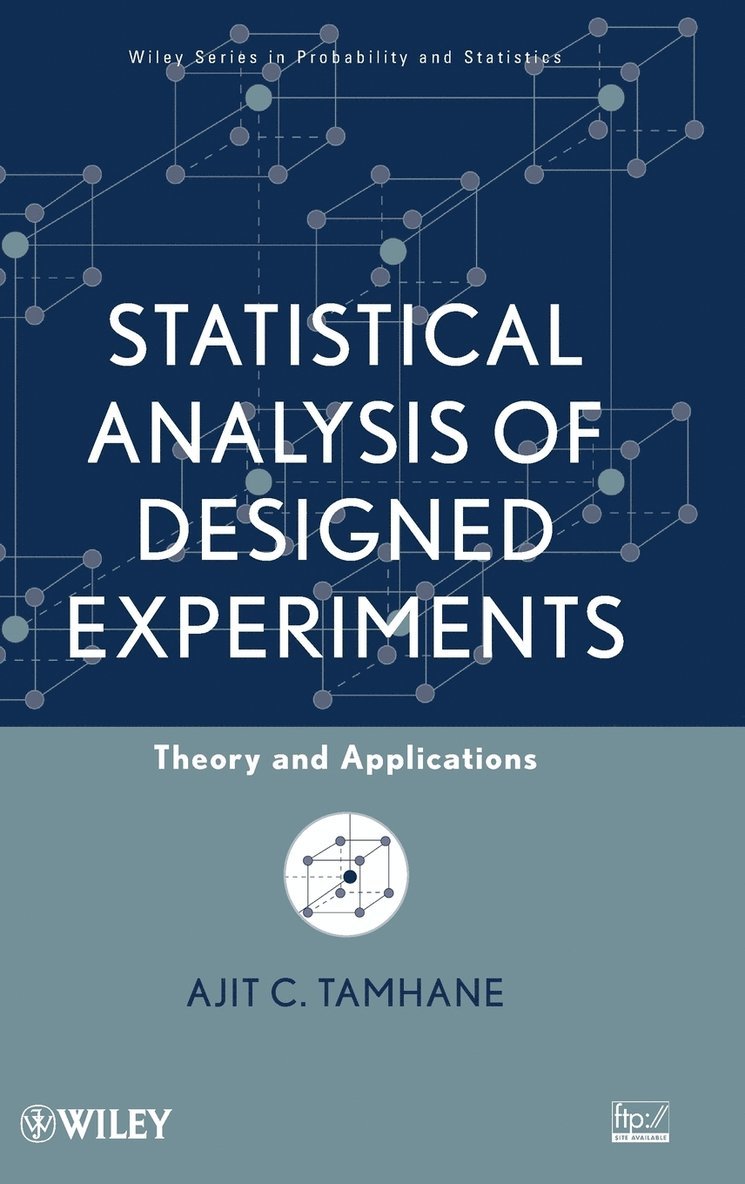
    Statistical Analysis of Designed Experiments

    Theory and Applications

    AvAjit C. Tamhane

    Inbunden, Engelska, 2009

    Del 609 i serien Wiley Series in Probability and Statistics

    2 159 kr

    Beställningsvara. Skickas inom 5-8 vardagar. Fri frakt över 249 kr.

    Fler format och utgåvor

    E-bok

    2 493 kr

    E-bok

    2 493 kr

    Beskrivning

    A indispensable guide to understanding and designing modern experiments The tools and techniques of Design of Experiments (DOE) allow researchers to successfully collect, analyze, and interpret data across a wide array of disciplines. Statistical Analysis of Designed Experiments provides a modern and balanced treatment of DOE methodology with thorough coverage of the underlying theory and standard designs of experiments, guiding the reader through applications to research in various fields such as engineering, medicine, business, and the social sciences.The book supplies a foundation for the subject, beginning with basic concepts of DOE and a review of elementary normal theory statistical methods. Subsequent chapters present a uniform, model-based approach to DOE. Each design is presented in a comprehensive format and is accompanied by a motivating example, discussion of the applicability of the design, and a model for its analysis using statistical methods such as graphical plots, analysis of variance (ANOVA), confidence intervals, and hypothesis tests.Numerous theoretical and applied exercises are provided in each chapter, and answers to selected exercises are included at the end of the book. An appendix features three case studies that illustrate the challenges often encountered in real-world experiments, such as randomization, unbalanced data, and outliers. Minitab® software is used to perform analyses throughout the book, and an accompanying FTP site houses additional exercises and data sets.With its breadth of real-world examples and accessible treatment of both theory and applications, Statistical Analysis of Designed Experiments is a valuable book for experimental design courses at the upper-undergraduate and graduate levels. It is also an indispensable reference for practicing statisticians, engineers, and scientists who would like to further their knowledge of DOE.

    Produktinformation

    • Utgivningsdatum:2009-04-23
    • Mått:164 x 243 x 37 mm
    • Vikt:1 111 g
    • Format:Inbunden
    • Språk:Engelska
    • Serie:Wiley Series in Probability and Statistics
    • Antal sidor:720
    • Förlag:John Wiley & Sons Inc
    • ISBN:9780471750437

    Utforska kategorier

    • Matematisk statistik inom Naturvetenskap och teknik

    Mer om författaren

    Ajit C. Tamhane, PhD, is Professor of Industrial Engineering and Management Sciences at Northwestern University. A Fellow of the American Statistical Society, Institute of Mathematical Statistics, American Association for Advancement of Science and an elected member of the International Statistical Institute, Dr. Tamhane has over forty years of academic and consulting experience in the areas of applied and mathematical statistics. He is the coauthor of Multiple Comparison Procedures and a forthcoming book on Predictive Analytics: Parametric Models for Regression and Classification Using R, also published by Wiley. He is also the coauthor of Statistics and Data Analysis: From Elementary to Intermediate.

    Innehållsförteckning

    • Preface xvAbbreviations xxi1 Introduction 11.1 Observational Studies and Experiments 11.2 Brief Historical Remarks 41.3 Basic Terminology and Concepts of Experimentation 51.4 Basic Principles of Experimentation 91.4.1 How to Minimize Biases and Variability? 91.4.2 Sequential Experimentation 141.5 Chapter Summary 15Exercises 162 Review of Elementary Statistics 202.1 Experiments for a Single Treatment 202.1.1 Summary Statistics and Graphical Plots 212.1.2 Confidence Intervals and Hypothesis Tests 252.1.3 Power and Sample Size Calculation 272.2 Experiments for Comparing Two Treatments 282.2.1 Independent Samples Design 292.2.2 Matched Pairs Design 382.3 Linear Regression 412.3.1 Simple Linear Regression 422.3.2 Multiple Linear Regression 502.4 Chapter Summary 62Exercises 623 Single Factor Experiments: Completely Randomized Designs 703.1 Summary Statistics and Graphical Displays 713.2 Model 733.3 Statistical Analysis 753.3.1 Estimation 753.3.2 Analysis of Variance 763.3.3 Confidence Intervals and Hypothesis Tests 783.4 Model Diagnostics 793.4.1 Checking Homoscedasticity 803.4.2 Checking Normality 813.4.3 Checking Independence 813.4.4 Checking Outliers 813.5 Data Transformations 853.6 Power of F -Test and Sample Size Determination 873.7 Quantitative Treatment Factors 903.8 One-Way Analysis of Covariance 963.8.1 Randomized Block Design versus Analysis of Covariance 963.8.2 Model 963.8.3 Statistical Analysis 983.9 Chapter Notes 1063.9.1 Randomization Distribution of F -Statistic 1063.9.2 F -Test for Heteroscedastic Treatment Variances 1083.9.3 Derivations of Formulas for Orthogonal Polynomials 1103.9.4 Derivation of LS Estimators for One-Way Analysis of Covariance 1123.10 Chapter Summary 113Exercises 1144 Single-Factor Experiments: Multiple Comparison and Selection Procedures 1264.1 Basic Concepts of Multiple Comparisons 1274.1.1 Family 1274.1.2 Familywise Error Rate 1284.1.3 Bonferroni Method 1294.1.4 Union–Intersection Method 1304.1.5 Closure Method 1314.2 Pairwise Comparisons 1324.2.1 Least Significant Difference and Bonferroni Procedures 1334.2.2 Tukey Procedure for Pairwise Comparisons 1344.2.3 Step-Down Procedures for Pairwise Comparisons 1364.3 Comparisons with a Control 1394.3.1 Dunnett Procedure for Comparisons with a Control 1394.3.2 Step-Down Procedures for Comparisons with a Control 1424.4 General Contrasts 1444.4.1 Tukey Procedure for Orthogonal Contrasts 1454.4.2 Scheffé Procedure for All Contrasts 1464.5 Ranking and Selection Procedures 1484.5.1 Indifference-Zone Formulation 1484.5.2 Subset Selection Formulation 1544.5.3 Multiple Comparisons with the Best 1554.5.4 Connection between Multiple Comparisons with Best and Selection of Best Treatment 1574.6 Chapter Summary 158Exercises 1595 Randomized Block Designs and Extensions 1685.1 Randomized Block Designs 1695.1.1 Model 1695.1.2 Statistical Analysis 1715.1.3 Randomized Block Designs with Replicates 1775.2 Balanced Incomplete Block Designs 1805.2.1 Statistical Analysis 1825.2.2 Interblock Analysis 1855.3 Youden Square Designs 1885.3.1 Statistical Analysis 1895.4 Latin Square Designs 1925.4.1 Choosing a Latin Square 1925.4.2 Model 1955.4.3 Statistical Analysis 1955.4.4 Crossover Designs 1985.4.5 Graeco–Latin Square Designs 2025.5 Chapter Notes 2055.5.1 Restriction Error Model for Randomized Block Designs 2055.5.2 Derivations of Formulas for BIB Design 2065.6 Chapter Summary 211Exercises 2126 General Factorial Experiments 2246.1 Factorial versus One-Factor-at-a-Time Experiments 2256.2 Balanced Two-Way Layouts 2276.2.1 Summary Statistics and Graphical Plots 2276.2.2 Model 2306.2.3 Statistical Analysis 2316.2.4 Model Diagnostics 2356.2.5 Tukey’s Test for Interaction for Singly Replicated Two-Way Layouts 2366.3 Unbalanced Two-Way Layouts 2406.3.1 Statistical Analysis 2406.4 Chapter Notes 2456.4.1 Derivation of LS Estimators of Parameters for Balanced Two-Way Layouts 2456.4.2 Derivation of ANOVA Sums of Squares and F -Tests for Balanced Two-Way Layouts 2466.4.3 Three- and Higher Way Layouts 2486.5 Chapter Summary 250Exercises 2507 Two-Level Factorial Experiments 2567.1 Estimation of Main Effects and Interactions 2577.1.1 22 Designs 2577.1.2 23 Designs 2617.1.3 2p Designs 2667.2 Statistical Analysis 2677.2.1 Confidence Intervals and Hypothesis Tests 2677.2.2 Analysis of Variance 2687.2.3 Model Fitting and Diagnostics 2707.3 Single-Replicate Case 2727.3.1 Normal and Half-Normal Plots of Estimated Effects 2727.3.2 Lenth Method 2787.3.3 Augmenting a 2p Design with Observations at the Center Point 2797.4 2p Factorial Designs in Incomplete Blocks: Confounding of Effects 2827.4.1 Construction of Designs 2827.4.2 Statistical Analysis 2867.5 Chapter Notes 2877.5.1 Yates Algorithm 2877.5.2 Partial Confounding 2887.6 Chapter Summary 289Exercises 2908 Two-Level Fractional Factorial Experiments 3008.1 2p−q Fractional Factorial Designs 3018.1.1 2p−1 Fractional Factorial Design 3018.1.2 General 2p−q Fractional Factorial Designs 3078.1.3 Statistical Analysis 3128.1.4 Minimum Aberration Designs 3168.2 Plackett–Burman Designs 3178.3 Hadamard Designs 3238.4 Supersaturated Designs 3258.4.1 Construction of Supersaturated Designs 3258.4.2 Statistical Analysis 3278.5 Orthogonal Arrays 3298.6 Sequential Assemblies of Fractional Factorials 3338.6.1 Foldover of Resolution III Designs 3348.6.2 Foldover of Resolution IV Designs 3378.7 Chapter Summary 338Exercises 3399 Three-Level and Mixed-Level Factorial Experiments 3519.1 Three-Level Full Factorial Designs 3519.1.1 Linear–Quadratic System 3539.1.2 Orthogonal Component System 3619.2 Three-Level Fractional Factorial Designs 3649.3 Mixed-Level Factorial Designs 3729.3.1 2p4q Designs 3739.3.2 2p3q Designs 3789.4 Chapter Notes 3869.4.1 Alternative Derivations of Estimators of Linear and Quadratic Effects 3869.5 Chapter Summary 388Exercises 38910 Experiments for Response Optimization 39510.1 Response Surface Methodology 39610.1.1 Outline of Response Surface Methodology 39610.1.2 First-Order Experimentation Phase 39710.1.3 Second-Order Experimentation Phase 40210.2 Mixture Experiments 41210.2.1 Designs for Mixture Experiments 41410.2.2 Analysis of Mixture Experiments 41610.3 Taguchi Method of Quality Improvement 41910.3.1 Philosophy Underlying Taguchi Method 42210.3.2 Implementation of Taguchi Method 42510.3.3 Critique of Taguchi Method 43210.4 Chapter Summary 436Exercises 43711 Random and Mixed Crossed-Factors Experiments 44811.1 One-Way Layouts 44911.1.1 Random-Effects Model 44911.1.2 Analysis of Variance 45011.1.3 Estimation of Variance Components 45211.2 Two-Way Layouts 45511.2.1 Random-Effects Model 45511.2.2 Mixed-Effects Model 45911.3 Three-Way Layouts 46411.3.1 Random- and Mixed-Effects Models 46411.3.2 Analysis of Variance 46511.3.3 Approximate F -Tests 46811.4 Chapter Notes 47211.4.1 Maximum Likelihood and Restricted Maximum Likelihood (REML) Estimation of Variance Components 47211.4.2 Derivations of Results for One- and Two-Way Random-Effects Designs 47511.4.3 Relationship between Unrestricted and Restricted Models 47811.5 Chapter Summary 479Exercises 48012 Nested, Crossed–Nested, and Split-Plot Experiments 48712.1 Two-Stage Nested Designs 48812.1.1 Model 48812.1.2 Analysis of Variance 48912.2 Three-Stage Nested Designs 49012.2.1 Model 49112.2.2 Analysis of Variance 49212.3 Crossed and Nested Designs 49512.3.1 Model 49512.3.2 Analysis of Variance 49612.4 Split-Plot Designs 50112.4.1 Model 50412.4.2 Analysis of Variance 50512.4.3 Extensions of Split-Plot Designs 50812.5 Chapter Notes 51512.5.1 Derivations of E(MS) Expressions for Two-Stage Nested Design of Section 12.1 with Both Factors Random 51512.5.2 Derivations of E(MS) Expressions for Design of Section 12.3 with Crossed and Nested Factors 51712.5.3 Derivations of E(MS) Expressions for Split-Plot Design 52012.6 Chapter Summary 523Exercises 52413 Repeated Measures Experiments 53613.1 Univariate Approach 53613.1.1 Model 53713.1.2 Univariate Analysis of Variance for RM Designs 53713.2 Multivariate Approach 54813.2.1 One-Way Multivariate Analysis of Variance 54813.2.2 Multivariate Analysis of Variance for RM Designs 54913.3 Chapter Notes 55513.3.1 Derivations of E(MS) Expressions for Repeated Measures Design Assuming Compound Symmetry 55513.4 Chapter Summary 558Exercises 55914 Theory of Linear Models with Fixed Effects 56614.1 Basic Linear Model and Least Squares Estimation 56614.1.1 Geometric Interpretation of Least Squares Estimation 56814.1.2 Least Squares Estimation in Singular Case 57014.1.3 Least Squares Estimation in Orthogonal Case 57214.2 Confidence Intervals and Hypothesis Tests 57314.2.1 Sampling Distribution of ̂β 573  14.2.2 Sampling Distribution of s2 57414.2.3 Inferences on Scalar Parameters 57514.2.4 Inferences on Vector Parameters 57514.2.5 Extra Sum of Squares Method 57714.2.6 Analysis of Variance 57914.3 Power of F-Test 58314.4 Chapter Notes 58614.4.1 Proof of Theorem 14.1 (Gauss–Markov Theorem) 58614.4.2 Proof of Theorem 14.2 58614.5 Chapter Summary 587Exercises 588Appendix A Vector-Valued Random Variables and Some Distribution Theory 595A.1 Mean Vector and Covariance Matrix of Random Vector 596A.2 Covariance Matrix of Linear Transformation of Random Vector 597A.3 Multivariate Normal Distribution 598A.4 Chi-Square, F-, and t-Distributions 599A.5 Distributions of Quadratic Forms 601A.6 Multivariate t-Distribution 605A.7 Multivariate Normal Sampling Distribution Theory 606Appendix B Case Studies 608B.1 Case Study 1: Effects of Field Strength and Flip Angle on MRI Contrast 608B.1.1 Introduction 608B.1.2 Design 609B.1.3 Data Analysis 610B.1.4 Results 612B.2 Case Study 2: Growing Stem Cells for Bone Implants 613B.2.1 Introduction 613B.1.2 Design 614B.2.3 Data Analysis 614B.2.4 Results 614B.3 Case Study 3: Router Bit Experiment 619B.3.1 Introduction 619B.3.2 Design 619B.3.3 Data Analysis 623B.3.4 Results 624Appendix C Statistical Tables 627Answers to Selected Exercises 644References 664Index 675