• Fri frakt över 249 kr
  • •
  • Snabba leveranser
  • •
  • Billiga böcker
Kundservice

Du är på sajten för privatpersoner.

Företag, bibliotek eller offentlig verksamhet?

Du handlar på classic.bokus.com, där alla dina funktioner finns intakta.
Till classic.bokus.com
Bokus logotyp. Gå till startsidan.
  • Erbjudanden
  • Nyheter
  • Student
  • Topplistor
  • Barn & ungdom
  • Bokus Play
  • E-böcker
  • Pocketböcker
  • Spel & pussel

10% rabatt på allt med kod: NYSTART10 →

Sidfot

Mina sidor

    Hjälp

    • Kundservice
    • Vanliga frågor och svar
    • Frakt och leverans
    • Retur vid ångerrätt
    • Reklamera vara
    • Betalning
    • Köpvillkor
    • Allmänna villkor
    • Information om webbplatsens tillgänglighet

    Om Bokus

    • Om oss
    • Pressrum
    • För studenter
    • För företag
    • För bibliotek och offentlig verksamhet
    • För leverantörer
    • Hållbarhet

    Populärt

    • Aktuella erbjudanden
    • Presentkort
    • Studentlitteratur
    • Nya böcker
    • Topplistor
    • Signerade böcker
    • Engelska böcker

    Inspiration

    • Boktips
    • BookTok
    • Populära bokserier
    • Barnbokskaraktärer
    • Populära författare
    Logotyp för Bokus
    Följ oss på Facebook (extern länk)Följ oss på Instagram (extern länk)Följ oss på YouTube (extern länk)Följ oss på TikTok (extern länk)
    bokus @ CookiesAnpassa cookiesIntegritetspolicyKöpvillkor
    Till Citymail hemsida (extern länk)Till Budbee hemsida (extern länk)Till Postnord hemsida (extern länk)Till Schenker hemsida (extern länk)Till Early Bird hemsida (extern länk)Till Walleys hemsida (extern länk)
    1. Naturvetenskap och teknik
    2. Matematik och naturvetenskap
    3. Matematik

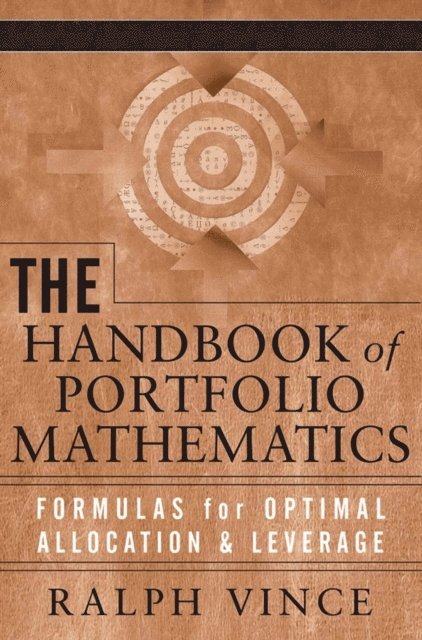
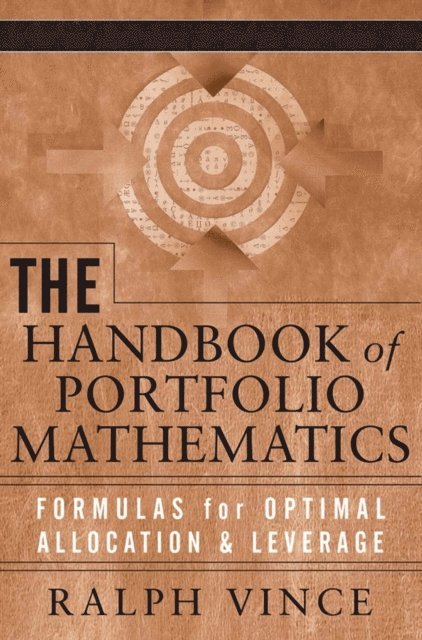
    Handbook of Portfolio Mathematics

    Formulas for Optimal Allocation and Leverage

    AvRalph Vince

    Inbunden, Engelska, 2007

    Del 257 i serien Wiley Trading

    651 kr

    Beställningsvara. Skickas inom 5-8 vardagar. Fri frakt över 249 kr.

    Fler format och utgåvor

    E-bok

    805 kr

    E-bok

    805 kr

    Beskrivning

    The Handbook of Portfolio Mathematics "For the serious investor, trader, or money manager, this book takes a rewarding look into modern portfolio theory. Vince introduces a leverage-space portfolio model, tweaks it for the drawdown probability, and delivers a superior model. He even provides equations to maximize returns for a chosen level of risk. So if you're serious about making money in today's markets, buy this book. Read it. Profit from it."—Thomas N. Bulkowski, author, Encyclopedia of Chart Patterns"This is an important book. Though traders routinely speak of their 'edge' in the marketplace and ways of handling 'risk,' few can define and measure these accurately. In this book, Ralph Vince takes readers step by step through an understanding of the mathematical foundations of trading, significantly extending his earlier work and breaking important new ground. His lucid writing style and liberal use of practical examples make this book must reading."—Brett N. Steenbarger, PhD, author, The Psychology of Trading and Enhancing Trader Performance"Ralph Vince is one of the world's foremost authorities on quantitative portfolio analysis. In this masterly contribution, Ralph builds on his early pioneering findings to address the real-world concerns of money managers in the trenches-how to systematically maximize gains in relation to risk."—Nelson Freeburg, Editor, Formula Research"Gambling and investing may make strange bedfellows in the eyes of many, but not Ralph Vince, who once again demonstrates that an open mind is the investor's most valuable asset. What does bet sizing have to do with investing? The answer to that question and many more lie inside this iconoclastic work. Want to make the most of your investing skills Open this book."—John Bollinger, CFA, CMT, www.BollingerBands.com

    Produktinformation

    • Utgivningsdatum:2007-06-08
    • Mått:163 x 237 x 36 mm
    • Vikt:658 g
    • Format:Inbunden
    • Språk:Engelska
    • Serie:Wiley Trading
    • Antal sidor:448
    • Förlag:John Wiley & Sons Inc
    • ISBN:9780471757689

    Utforska kategorier

    • Matematik inom Naturvetenskap och teknik
    • Finansiering inom Ekonomi och Ledarskap

    Mer om författaren

    RALPH VINCE got his start in the trading business as a margin clerk, and later worked as a consultant programmer to large futures traders and fund managers. Vince is also the author of Portfolio Management Formulas, The Mathematics of Money Management, and The New Money Management, also from Wiley. Numerous software companies have incorporated Vince's ideas into their products. Vince is an ultra-marathon runner and jiu jitsu black belt.

    Innehållsförteckning

    • Preface xiiiIntroduction xviiPart I Theory 1Chapter 1 The Random Process and Gambling Theory 3Independent versus Dependent Trials Processes 5Mathematical Expectation 6Exact Sequences, Possible Outcomes, and the Normal Distribution 8Possible Outcomes and Standard Deviations 11The House Advantage 15Mathematical Expectation Less than Zero Spells Disaster 18Baccarat 19Numbers 20Pari-Mutuel Betting 21Winning and Losing Streaks in the Random Process 24Determining Dependency 25The Runs Test, Z Scores, and Confidence Limits 27The Linear Correlation Coefficient 32Chapter 2 Probability Distributions 43The Basics of Probability Distributions 43Descriptive Measures of Distributions 45Moments of a Distribution 47The Normal Distribution 52The Central Limit Theorem 52Working with the Normal Distribution 54Normal Probabilities 59Further Derivatives of the Normal 65The Lognormal Distribution 67The Uniform Distribution 69The Bernoulli Distribution 71The Binomial Distribution 72The Geometric Distribution 78The Hypergeometric Distribution 80The Poisson Distribution 81The Exponential Distribution 85The Chi-Square Distribution 87The Chi-Square “Test” 88The Student’s Distribution 92The Multinomial Distribution 95The Stable Paretian Distribution 96Chapter 3 Reinvestment of Returns and Geometric Growth Concepts 99To Reinvest Trading Profits or Not 99Measuring a Good System for Reinvestment—The Geometric Mean 103Estimating the Geometric Mean 107How Best to Reinvest 109Chapter 4 Optimal f 117Optimal Fixed Fraction 117Asymmetrical Leverage 118Kelly 120Finding the Optimal f by the Geometric Mean 122To Summarize Thus Far 125How to Figure the Geometric Mean Using Spreadsheet Logic 127Geometric Average Trade 127A Simpler Method for Finding the Optimal f 128The Virtues of the Optimal f 130Why You Must Know Your Optimal f 132Drawdown and Largest Loss with f 141Consequences of Straying Too Far from the Optimal f 145Equalizing Optimal f 151Finding Optimal f via Parabolic Interpolation 157The Next Step 161Scenario Planning 162Scenario Spectrums 173Chapter 5 Characteristics of Optimal f 175Optimal f for Small Traders Just Starting Out 175Threshold to Geometric 177One Combined Bankroll versus Separate Bankrolls 180Treat Each Play as If Infinitely Repeated 182Efficiency Loss in Simultaneous Wagering or Portfolio Trading 185Time Required to Reach a Specified Goal and the Trouble with Fractional f 188Comparing Trading Systems 192Too Much Sensitivity to the Biggest Loss 193The Arc Sine Laws and Random Walks 194Time Spent in a Drawdown 197The Estimated Geometric Mean (or How the Dispersion of Outcomes Affects Geometric Growth) 198The Fundamental Equation of Trading 202Why Is f Optimal? 203Chapter 6 Laws of Growth, Utility, and Finite Streams 207Maximizing Expected Average Compound Growth 209Utility Theory 217The Expected Utility Theorem 218Characteristics of Utility Preference Functions 218Alternate Arguments to Classical Utility Theory 221Finding Your Utility Preference Curve 222Utility and the New Framework 226Chapter 7 Classical Portfolio Construction 231Modern Portfolio Theory 231The Markowitz Model 232Definition of the Problem 235Solutions of Linear Systems Using Row-Equivalent Matrices 246Interpreting the Results 252Chapter 8 The Geometry of Mean Variance Portfolios 261The Capital Market Lines (CMLs) 261The Geometric Efficient Frontier 266Unconstrained Portfolios 273How Optimal f Fits In 277Completing the Loop 281Chapter 9 The Leverage Space Model 287Why This New Framework Is Better 288Multiple Simultaneous Plays 299A Comparison to the Old Frameworks 302Mathematical Optimization 303The Objective Function 305Mathematical Optimization versus Root Finding 312Optimization Techniques 313The Genetic Algorithm 317Important Notes 321Chapter 10 The Geometry of Leverage Space Portfolios 323Dilution 323Reallocation 333Portfolio Insurance and Optimal f 335Upside Limit on Active Equity and the Margin Constraint 341f Shift and Constructing a Robust Portfolio 342Tailoring a Trading Program through Reallocation 343Gradient Trading and Continuous Dominance 345Important Points to the Left of the Peak in the n + 1 Dimensional Landscape 351Drawdown Management and the New Framework 359Part II Practice 365Chapter 11 What the Professionals Have Done 367Commonalities 368Differences 368Further Characteristics of Long-Term Trend Followers 369Chapter 12 The Leverage Space Portfolio Model in the Real World 377Postscript 415Index 417