• Fri frakt över 249 kr
  • •
  • Snabba leveranser
  • •
  • Billiga böcker
Kundservice

Du är på sajten för privatpersoner.

Företag, bibliotek eller offentlig verksamhet?

Du handlar på classic.bokus.com, där alla dina funktioner finns intakta.
Till classic.bokus.com
Bokus logotyp. Gå till startsidan.
  • Erbjudanden
  • Student
  • Topplistor
  • Barn & ungdom
  • Bokus Play
  • E-böcker
  • Ljudböcker
  • Pocketböcker
  • Spel och pussel

5% studentrabatt – använd koden KURSBOK27 →

Sidfot

Mina sidor

    Hjälp

    • Kundservice
    • Vanliga frågor och svar
    • Frakt och leverans
    • Retur vid ångerrätt
    • Reklamera vara
    • Betalning
    • Köpvillkor
    • Allmänna villkor
    • Information om webbplatsens tillgänglighet

    Om Bokus

    • Om oss
    • Pressrum
    • För studenter
    • För företag
    • För bibliotek och offentlig verksamhet
    • För leverantörer
    • Hållbarhet

    Populärt

    • Aktuella erbjudanden
    • Presentkort
    • Studentlitteratur
    • Nya böcker
    • Topplistor
    • Signerade böcker
    • Engelska böcker

    Inspiration

    • Boktips
    • BookTok
    • Barnbokskaraktärer
    • Populära författare
    Logotyp för Bokus
    Följ oss på Facebook (extern länk)Följ oss på Instagram (extern länk)Följ oss på YouTube (extern länk)Följ oss på TikTok (extern länk)
    bokus @ CookiesAnpassa cookiesIntegritetspolicyKöpvillkor
    Till Citymail hemsida (extern länk)Till Budbee hemsida (extern länk)Till Postnord hemsida (extern länk)Till Schenker hemsida (extern länk)Till Early Bird hemsida (extern länk)Till Walleys hemsida (extern länk)
    1. Data och IT
    2. Systemvetenskap och AI

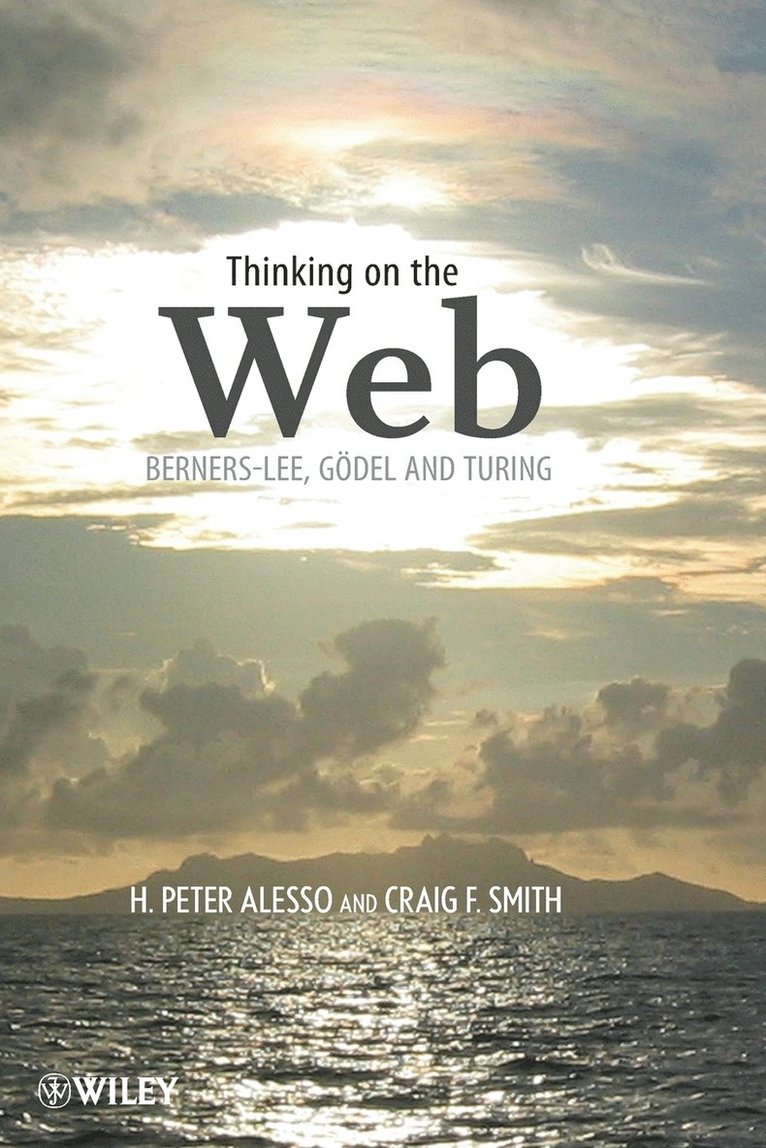
    Thinking on the Web

    Berners-Lee, Gödel, and Turing

    AvH. Peter Alesso,Craig F. Smith

    Häftad, Engelska, 2008

    525 kr

    Beställningsvara. Skickas inom 5-8 vardagar. Fri frakt över 249 kr.

    Beskrivning

    What Is Thinking? What is Turing's Test? What is Gödel's Undecidability Theorem? How is Berners-Lee's Semantic Web logic going to overcome paradoxes and complexity to produce machine processing on the Web?Thinking on the Web draws from the contributions of Tim Berners-Lee (What is solvable on the Web?), Kurt Gödel (What is decidable?), and Alan Turing (What is machine intelligence?) to evaluate how much "intelligence" can be projected onto the Web.The authors offer both abstract and practical perspectives to delineate the opportunities and challenges of a "smarter" Web through a threaded series of vignettes and a thorough review of Semantic Web development.

    Produktinformation

    • Utgivningsdatum:2008-12-16
    • Mått:156 x 236 x 15 mm
    • Vikt:454 g
    • Format:Häftad
    • Språk:Engelska
    • Antal sidor:328
    • Förlag:John Wiley & Sons Inc
    • ISBN:9780471768661

    Utforska kategorier

    • Systemvetenskap och AI inom Data och IT
    • Digital livsstil och datorspel inom Data och IT

    Mer om författaren

    H. Peter Alesso is an innovator with twenty years' research experience at Lawrence Livermore National Laboratory (LLNL). As Engineering Group Leader at LLNL, he led a team of computer scientists and engineers in innovative applications across a wide range of supercomputers, workstations, and networks. He has published several software titles and scientific journal and conference articles, and is the author or coauthor of five books.Craig F. Smith, PhD, is a Fellow of the American Association for the Advancement of Science (AAAS) with over thirty years' experience in research and development for applications of advanced technologies. He currently serves as the Lawrence Livermore Chair Professor at the Naval Postgraduate School in Monterey, California. He is the coauthor of four books.

    Recensioner i media

    ?Anyone with experience of HCI will want to read this book which after all, has provided a new and entirely different way of providing a stimulus to a subject that is very much in need of direction.? (Kybernetes, 2009) "Thinking on the Web offers a fascinating history and impressive background of the age we are living through, and serves as a tribute to three great minds. A true geek bonus is the depth of coverage, with rich explanations, examples, and a look at next generation web services." (Blogcritics.org, March 9, 2009)

    Innehållsförteckning

    • Preface. The Purpose of this Book.Who Should Read this Book.The Organization of this Book.PART I: WHAT IS WEB INTELLIGENCE.Chapter 1: The Information Age and the Web.Overview.Thinking and Intelligent Web Applications.The Information Age.The World Wide Web.The Limitations of Today’s Web.The Next Generation Web.Why Intelligent Ubiquitous Devices Improve Productivity.Conclusion.Exercises.Interlude #1 Thinking about Thinking.Chapter 2: Gödel - What is Decidable?Overview.Philosophical and Mathematical Logic.Kurt Gödel.Knowledge Representation.Computational Logic .Artificial Intelligence.Web Architecture and Business Logic.The Semantic Web.Conclusion.Exercises.Interlude #2 Truth and Beauty.Chapter 3: Turing - What is Machine Intelligence?Overview.What is Machine Intelligence?Alan Turing.What is Machine Intelligence?Turing Test and the Loebner Prize .John Searle’s Chinese Room.Artificial Intelligence.Machine Intelligence .Semantic Networks and Frames.Reasoning with Semantic Networks.Computational Complexity.Description Logic (DL).Ontology.Inference Engines.Software Agents.Adaptive Software.Limitations and Capabilities.Conclusion.Exercises.Interlude #3: Computing Machines.Chapter 4: Berners-Lee ? What is Solvable on the Web?Overview.The World Wide Web.Berners-Lee.Competing Web Standards.The Semantic Web Roadmap.Semantic Web Services.Logic on the Semantic Web.Semantic Web Capabilities and Limitations.Conclusion.Exercises.Interlude #4 Turing’s Test.PART II: WEB ONTOLOGY AND LOGIC.Chapter 5: Resource Framework Description -- RDF.Overview .HTML Language.XML Language.RDF Language.Basic Elements.RDF Schema.XQuery - XML Query Language.Conclusion .Exercises.Interlude #5 The Chinese Room.Chapter 6: Web Ontology Language -- OWL.Overview.Ontology Language.Ontology Language Requirements.Compatibility of OWL and RDF/RDFS.The OWL Language.Basic Elements.OWL Example -- Compute Ontology.Ontology Example -- Birthplace.Applying OWL.OWL Capabilities and Limitations.Conclusion.Exercises.Interlude #6: Machines and Brains.Chapter 7: Ontology Engineering.Overview.Ontology Engineering.Constructing Ontologies.Ontology Example.Ontology Methods.Ontology Libraries.Ontology Matching.Ontology Mapping .Ontology Mapping Tools .Conclusion.Exercises.Interlude #7: Machines and Meaning.Chapter 8: Logic, Inference and Rule Systems.Overview.Logic and Inference.Monotonic and Nonmonotonic Rules.Descriptive Logic.Inference Engines.Example RDF Inference Engine.Conclusion.Exercises.Interlude #8: Machines and Rules.Chapter 9: Semantic Web Rule Language -- SWRL.Overview.Rule Systems.Rule Languages.Semantic Web Rule Language (SWRL).Conclusion.Exercises.Interlude #9: Machines and Language.Chapter 10: Semantic Web Applications.Overview.Semantic Web Applications .Web Services.Semantic Search.e-Learning .Semantic Web and Bio-Informatics .Enterprise Application Integration.On-To-Knowledge (OTK) .Knowledge Base.Conclusion.Exercise.Interlude #10: Distributed Intelligence.Chapter 11: Web Ontology Language for Services -- OWL-S.Overview.XML-Based Web Services.Next Generation Web Services .OWL-S Primer.Creating an OWL-S Ontology for a Web Services.Conclusion.Exercises.Interlude #11: The Semantic Web.Chapter 12: Semantic Search Technology.Overview.Search Engines .Semantic Search.Semantic Search Technology.Web Search Agents.Semantic Methods.Latent Semantic Index Search.TAP.Swoogle.Conclusion.Exercises.Interlude #12: The Halting Problem.Chapter 13: Semantic Patterns and Adoptive Software.Overview .Patterns in Software Design.Pattern Frame.Semantic Patterns.Self-Organizing and Adaptive Software.Conclusion.Exercises.Interlude #13: The Semantic Web and Meaning.Chapter 14: Semantic Tools.Overview .Semantic Tools.Semantic Web Services Tools.Conclusion.Interlude #14: The Semantic Web and Language.Chapter 15: Opportunities and Challenges.Overview.Semantic Doubt.Semantic Opportunities.Challenges.Balancing Proprietary and Open Standards.Conclusion.Interlude #15: The Semantic Web and Zeno’s Paradox.Bibliography.Glossary.List of Acronyms.Index.