• Fri frakt över 249 kr
  • •
  • Snabba leveranser
  • •
  • Billiga böcker
Kundservice

Du är på sajten för privatpersoner.

Företag, bibliotek eller offentlig verksamhet?

Du handlar på classic.bokus.com, där alla dina funktioner finns intakta.
Till classic.bokus.com
Bokus logotyp. Gå till startsidan.
  • Erbjudanden
  • Nyheter
  • Student
  • Topplistor
  • Barn & ungdom
  • Bokus Play
  • E-böcker
  • Pocketböcker
  • Spel & pussel

10% rabatt på allt med kod: NYSTART10 →

Sidfot

Mina sidor

    Hjälp

    • Kundservice
    • Vanliga frågor och svar
    • Frakt och leverans
    • Retur vid ångerrätt
    • Reklamera vara
    • Betalning
    • Köpvillkor
    • Allmänna villkor
    • Information om webbplatsens tillgänglighet

    Om Bokus

    • Om oss
    • Pressrum
    • För studenter
    • För företag
    • För bibliotek och offentlig verksamhet
    • För leverantörer
    • Hållbarhet

    Populärt

    • Aktuella erbjudanden
    • Presentkort
    • Studentlitteratur
    • Nya böcker
    • Topplistor
    • Signerade böcker
    • Engelska böcker

    Inspiration

    • Boktips
    • BookTok
    • Populära bokserier
    • Barnbokskaraktärer
    • Populära författare
    Logotyp för Bokus
    Följ oss på Facebook (extern länk)Följ oss på Instagram (extern länk)Följ oss på YouTube (extern länk)Följ oss på TikTok (extern länk)
    bokus @ CookiesAnpassa cookiesIntegritetspolicyKöpvillkor
    Till Citymail hemsida (extern länk)Till Budbee hemsida (extern länk)Till Postnord hemsida (extern länk)Till Schenker hemsida (extern länk)Till Early Bird hemsida (extern länk)Till Walleys hemsida (extern länk)
    1. Filosofi och religion
    2. Filosofi
    3. Filosofiska discipliner

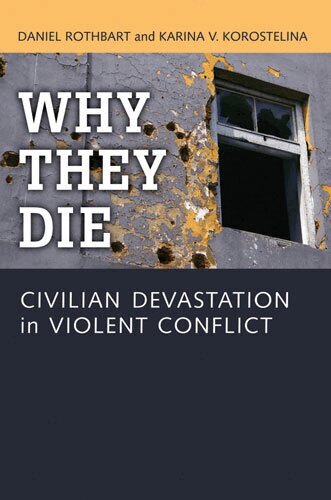
    Why They Die

    Civilian Devastation in Violent Conflict

    AvDaniel Rothbart,Karina Korostelina

    Häftad, Engelska, 2013

    448 kr

    Beställningsvara. Skickas inom 5-8 vardagar. Fri frakt över 249 kr.

    Beskrivning

    Why do civilians suffer most during times of violent conflict? Why are civilian fatalities as much as eight times higher, calculated globally for current conflicts, than military fatalities? In Why They Die, Daniel Rothbart and Karina V. Korostelina address these questions through a systematic study of civilian devastation in violent conflicts. Pushing aside the simplistic definition of war as a guns-and-blood battle between two militant groups, the authors investigate the identity politics underlying conflicts of many types. During a conflict, all those on the opposite side are perceived as the enemy, with little distinction between soldiers and civilians. As a result, random atrocities and systematic violence against civilian populations become acceptable.Rothbart and Korostelina devote the first half of the book to case studies: deportation of the Crimean Tatars from the Ukraine, genocide in Rwanda, the Lebanon War, and the war in Iraq. With the second half, they present new methodological tools for understanding different types of violent conflict and discuss the implications of these tools for conflict resolution.

    Produktinformation

    • Utgivningsdatum:2013-07-29
    • Mått:152 x 229 x undefined mm
    • Format:Häftad
    • Språk:Engelska
    • Antal sidor:224
    • Förlag:The University of Michigan Press
    • ISBN:9780472035588

    Utforska kategorier

    • Filosofiska discipliner inom Filosofi och religion
    • Militärhistoria inom Historia och arkeologi
    • Internationella relationer inom Samhälle och politik

    Mer om författaren

    Daniel Rothbart is Professor of Conflict Analysis and Resolution at George Mason University’s School for Conflict Analysis and Resolution.Karina V. Korostelina is Associate Professor and Director of the Program on History, Memory, and Conflict at George Mason University’s School for Conflict Analysis and Resolution.

    Recensioner i media

    "Why They Die is a work of imagination and insight. Based on wide reading and deep reflection, the authors have adopted a case study method to illustrate why it is that civilians are so often targeted in modern conflict, and why this development is such a departure from earlier forms of warfare. Rather than being that unfortunate phenomenon 'collateral damage,' as so often claimed by military theorists, the modern world has seen a situation where the destruction of civilian lives has all too often become the object of combatant behaviors. Rothbart and Korostelina have shown why this has happened, and how such behaviors can be explained. All in all, this is an excellent and worthy addition to a growing literature of mass murder, mayhem and destruction." —Paul R. Bartrop, Bialik College, Melbourne, Australia