• Fri frakt över 249 kr
  • •
  • Snabba leveranser
  • •
  • Billiga böcker
Kundservice

Du är på sajten för privatpersoner.

Företag, bibliotek eller offentlig verksamhet?

Du handlar på classic.bokus.com, där alla dina funktioner finns intakta.
Till classic.bokus.com
Bokus logotyp. Gå till startsidan.
  • Erbjudanden
  • Nyheter
  • Student
  • Topplistor
  • Barn & ungdom
  • Bokus Play
  • E-böcker
  • Pocketböcker
  • Spel & pussel

10% rabatt på allt med kod: NYSTART10 →

Sidfot

Mina sidor

    Hjälp

    • Kundservice
    • Vanliga frågor och svar
    • Frakt och leverans
    • Retur vid ångerrätt
    • Reklamera vara
    • Betalning
    • Köpvillkor
    • Allmänna villkor
    • Information om webbplatsens tillgänglighet

    Om Bokus

    • Om oss
    • Pressrum
    • För studenter
    • För företag
    • För bibliotek och offentlig verksamhet
    • För leverantörer
    • Hållbarhet

    Populärt

    • Aktuella erbjudanden
    • Presentkort
    • Studentlitteratur
    • Nya böcker
    • Topplistor
    • Signerade böcker
    • Engelska böcker

    Inspiration

    • Boktips
    • BookTok
    • Populära bokserier
    • Barnbokskaraktärer
    • Populära författare
    Logotyp för Bokus
    Följ oss på Facebook (extern länk)Följ oss på Instagram (extern länk)Följ oss på YouTube (extern länk)Följ oss på TikTok (extern länk)
    bokus @ CookiesAnpassa cookiesIntegritetspolicyKöpvillkor
    Till Citymail hemsida (extern länk)Till Budbee hemsida (extern länk)Till Postnord hemsida (extern länk)Till Schenker hemsida (extern länk)Till Early Bird hemsida (extern länk)Till Walleys hemsida (extern länk)
    1. Samhälle och politik
    2. Politik och statsskick
    3. Statsvetenskap och politisk teori

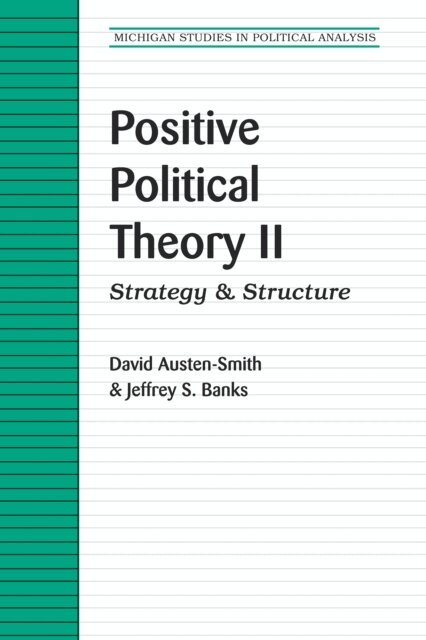
    Positive Political Theory II

    Strategy and Structure

    AvDavid Austen-Smith,Jeffrey S. Banks

    Häftad, Engelska, 2005

    Del i serien Michigan Studies in Political Analysis

    478 kr

    Beställningsvara. Skickas inom 5-8 vardagar. Fri frakt över 249 kr.

    Beskrivning

    “A major piece of work . . . a classic. There is noother book like it.”—Norman Schofield, Washington University“The authors succeed brilliantly in tackling a largenumber of important questions concerning theinteraction among voters and elected representativesin the political arena, using a common, rigorouslanguage.”—Antonio Merlo, University of PennsylvaniaPositive Political Theory II: Strategy and Structureis the second volume in Jeffrey Banks and DavidAusten-Smith’s monumental study of the linksbetween individual preferences and collective choice.The book focuses on representative systems, includingboth elections and legislative decision-makingprocesses, clearly connecting individual preferences tocollective outcomes. This book is not a survey. Rather,it is the coherent, cumulative result of the authors’brilliant efforts to indirectly connect preferences tocollective choice through strategic behaviors such asagenda-selection and voting.The book will be an invaluable reference and teachingtool for economists and political scientists, and anessential companion to any scholar interested in thelatest theoretical advances in positive political theory.

    Produktinformation

    • Utgivningsdatum:2005-01-05
    • Mått:152 x 229 x undefined mm
    • Format:Häftad
    • Språk:Engelska
    • Serie:Michigan Studies in Political Analysis
    • Antal sidor:472
    • Förlag:The University of Michigan Press
    • ISBN:9780472068944

    Utforska kategorier

    • Statsvetenskap och politisk teori inom Samhälle och politik

    Mer om författaren

    David Austen-Smith is Earl Dean Howard Distinguished Professor of Political Economy and Professor of Political Science and Economics at Northwestern University. The late Jeffrey S. Banks was Professor of Political Science at California Institute of Technology.

    Recensioner i media

    Explores the connection between individuals' preferences within any society and the collective choices of that society, taking an indirect or game- theoretic approach to the aggregation of individual preferences." —Journal of Economic Literature

    Innehållsförteckning

    • Acknowledgments vii; Preface ix; 1 Preliminaries 1; 1.1 Review 1; 1.2 Decision theory 8; 1.3 Discussion 17; 1.4 Exercises 17; 1.5 Further reading 18; 2 Strategy-Proof Collective Choice 19; 2.1 Strategy-proofness on finite sets 20; 2.2 Application: The amendment rule 29; 2.3 Strategy-proofness and Arrovian aggregation 30; 2.4 Single-peaked preferences 33; 2.5 Application: The amendment rule revisited 51; 2.6 Strategy-proofness in the spatial model 52; 2.7 Application: The issue-by-issue rule 60; 2.8 Separable preferences 62; 2.9 Discussion 65; 2.10 Exercises 66; 2.11 Further reading 67; 3 Implementable Collective Choice 69; 3.1 Mechanisms and equilibria 70; 3.2 The Revelation Principle 74; 3.3 Nash implementation 77; 3.4 Application: Monotonicity of electoral rules 90; 3.5 Quasi-linear preferences 94; 3.6 Application: Collective action 104; 3.7 Discussion 105; 3.8 Exercises 109; 3.9 Further reading 110; 4 Binary Agendas 113; 4.1 Binary agendas and sophisticated voting 114; 4.2 Equilibrium outcomes of binary agendas 128; 4.3 Application: Agenda independence 138; 4.4 Discussion 141; 4.5 Exercises 144; 4.6 Further reading 146; 5 Spatial Voting in Committees 147; 5.1 Issue-by-issue voting in the spatial model 148; 5.2 Application: Committees and cabinets 158; 5.3 Endogenous agendas 166; 5.4 Application: Sophisticated sincerity 184; 5.5 Discussion 186; 5.6 Exercises 188; 5.7 Further reading 190; 6 Legislative Bargaining 193; 6.1 A basic framework 194; 6.2 Bargaining over distributions 204; 6.3 Application: Pork barrel politics 221; 6.4 Bargaining over policy 224; 6.5 Application: Coalition government formation 244; 6.6 Discussion 248; 6.7 Exercises 250; 6.8 Further reading 251; 7 Two-Candidate Elections 253; 7.1 Electoral equilibrium and the core 254; 7.2 Application: Ideological convergence 259; 7.3 Equilibrium in multidimensional spaces 262; 7.4 Application: Progressive taxation 280; 7.5 Probabilistic voting 282; 7.6 Application: Director's Law 289; 7.7 Policy-motivated candidates 293; 7.8 Application: Ideological divergence 301; 7.9 Turnout 304; 7.10 Discussion 322; 7.11 Exercises 328; 7.12 Further reading 330; 8 Multicandidate Elections 333; 8.1 Sincere voting in multicandidate elections 335; 8.2 Application: Comparing electoral rules 342; 8.3 Strategic voting 344; 8.4 Application: Duverger's Law 352; 8.5 Candidate entry 353; 8.6 Application: Duverger and divergence 380; 8.7 Discussion 382; 8.8 Exercises 388; 8.9 Further reading 389; 9 Legislative Elections 391; 9.1 Elections, government and policy 392; 9.2 Application: Representative legislatures 413; 9.3 Discussion 415; 9.4 Exercises 416; 9.5 Further reading 417; 10 Summary and Conclusions 419; 10.1 Retrospective 421; 10.2 A conclusion 427; Bibliography 429; Index 445