• Fri frakt över 249 kr
  • •
  • Snabba leveranser
  • •
  • Billiga böcker
Kundservice

Du är på sajten för privatpersoner.

Företag, bibliotek eller offentlig verksamhet?

Du handlar på classic.bokus.com, där alla dina funktioner finns intakta.
Till classic.bokus.com
Bokus logotyp. Gå till startsidan.
  • Erbjudanden
  • Nyheter
  • Student
  • Topplistor
  • Barn & ungdom
  • Bokus Play
  • E-böcker
  • Pocketböcker
  • Spel & pussel

10% rabatt på allt med kod: NYSTART10 →

Sidfot

Mina sidor

    Hjälp

    • Kundservice
    • Vanliga frågor och svar
    • Frakt och leverans
    • Retur vid ångerrätt
    • Reklamera vara
    • Betalning
    • Köpvillkor
    • Allmänna villkor
    • Information om webbplatsens tillgänglighet

    Om Bokus

    • Om oss
    • Pressrum
    • För studenter
    • För företag
    • För bibliotek och offentlig verksamhet
    • För leverantörer
    • Hållbarhet

    Populärt

    • Aktuella erbjudanden
    • Presentkort
    • Studentlitteratur
    • Nya böcker
    • Topplistor
    • Signerade böcker
    • Engelska böcker

    Inspiration

    • Boktips
    • BookTok
    • Populära bokserier
    • Barnbokskaraktärer
    • Populära författare
    Logotyp för Bokus
    Följ oss på Facebook (extern länk)Följ oss på Instagram (extern länk)Följ oss på YouTube (extern länk)Följ oss på TikTok (extern länk)
    bokus @ CookiesAnpassa cookiesIntegritetspolicyKöpvillkor
    Till Citymail hemsida (extern länk)Till Budbee hemsida (extern länk)Till Postnord hemsida (extern länk)Till Schenker hemsida (extern länk)Till Early Bird hemsida (extern länk)Till Walleys hemsida (extern länk)
    1. Samhälle och politik
    2. Politik och statsskick
    3. Statsvetenskap och politisk teori

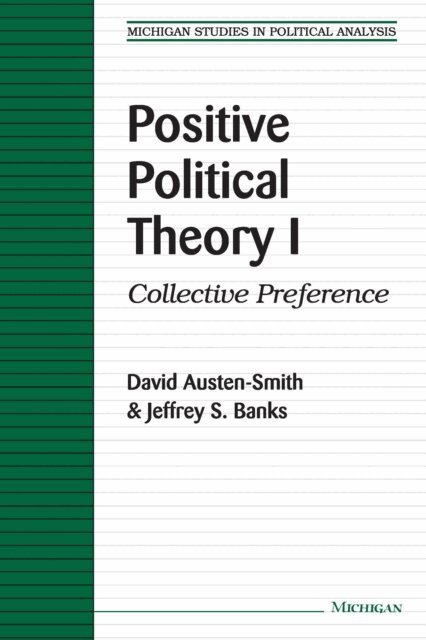
    Positive Political Theory I

    Collective Preference

    AvDavid Austen-Smith,Jeffrey S. Banks

    Häftad, Engelska, 2000

    Del i serien Michigan Studies in Political Analysis

    375 kr

    Beställningsvara. Skickas inom 5-8 vardagar. Fri frakt över 249 kr.

    Beskrivning

    Positive Political Theory I is concerned with the formal theory of preference aggregation for collective choice. The theory is developed as generally as possible, covering classes of aggregation methods that include such well-known examples as majority and unanimity rule and focusing in particular on the extent to which any aggregation method is assured to yield a set of "best" alternatives. The book is intended both as a contribution to the theory of collective choice and a pedagogic tool.Austen-Smith and Banks have made the exposition both rigorous and accessible to people with some technical background (e.g., a course in multivariate calculus). The intended readership ranges from more technically-oriented graduate students and specialists to those students in economics and political science interested less in the technical aspects of the results than in the depth, scope, and importance of the theoretical advances in positive political theory."This is a stunning book. Austen-Smith and Banks have a deep understanding of the material, and their text gives a powerfully unified and coherent perspective on a vast literature. The exposition is clear-eyed and efficient but never humdrum. Even those familiar with the subject will find trenchant remarks and fresh insights every few pages. Anyone with an interest in contemporary liberal democratic theory will want this book on the shelf." --Christopher Achen, University of MichiganDavid Austen-Smith is Professor of Political Science, Professor of Economics, and Professor of Management and Strategy, Northwestern University. Jeffrey S. Banks is Professor of Political Science, California Institute of Technology.

    Produktinformation

    • Utgivningsdatum:2000-12-27
    • Mått:152 x 229 x undefined mm
    • Format:Häftad
    • Språk:Engelska
    • Serie:Michigan Studies in Political Analysis
    • Antal sidor:224
    • Förlag:The University of Michigan Press
    • ISBN:9780472087211

    Utforska kategorier

    • Statsvetenskap och politisk teori inom Samhälle och politik

    Mer om författaren

    David Austen-Smith is Earl Dean Howard Distinguished Professor of Political Economy and Professor of Political Science and Economics at Northwestern University. Jeffrey S. Banks is Professor of Political Science, California Institute of Technology.

    Recensioner i media

    This is a stunning book. Austen-Smith and Banks have a deep understanding of the material, and their text gives a powerfully unified and coherent perspective on a vast literature. The exposition is clear-eyed and efficient but never humdrum. Even those familiar with the subject will find trenchant remarks and fresh insights every few pages. Anyone with an interest in contemporary liberal democratic theory will want this book on the shelf." —Christopher Achen, University of Michigan"Austen-Smith and Banks provide a crisp, state-of-the-art guide to the core results of social choice theory. They lay bare the conceptual foundations of the study of collective preferences, linking key results to both practical and theoretical issues in the study of politics. In addition to providing the best currently available review of social choice theory's implications for the study of politics, Positive Political Theory I also contains interesting reflections on the relationship between social choice and game theory"—Gary Cox, University of California, San Diego"All too rarely do books live up to the praise found in their jacket blurbs. This book is an exception. . . . With the prerequisite of some minimal tools—calculus, a little set theory, a feeling for Edgeworth-box style analyses—and a willlingness to follow extended mathematical arguments, the reader is guided from very basic definitions concerning individual preferences to complex discussions of the genericity of empty cores in spatial settings."—Robert Grafstein, University of Georgia, Public Choice, 102 (2000)". . . an extremely lucid and self-contained presentation. It collects together every important result of the fifty years of research in this field, since Kenneth Arrow's book in 1951."—Norman Schofield, Washington University, American Political Science Review, June 2001