• Fri frakt över 249 kr
  • •
  • Snabba leveranser
  • •
  • Billiga böcker
Kundservice

Du är på sajten för privatpersoner.

Företag, bibliotek eller offentlig verksamhet?

Du handlar på classic.bokus.com, där alla dina funktioner finns intakta.
Till classic.bokus.com
Bokus logotyp. Gå till startsidan.
  • Erbjudanden
  • Nyheter
  • Student
  • Topplistor
  • Barn & ungdom
  • Bokus Play
  • E-böcker
  • Pocketböcker
  • Spel & pussel

10% studentrabatt med kod TERM26

Sidfot

Mina sidor

    Hjälp

    • Kundservice
    • Vanliga frågor och svar
    • Frakt och leverans
    • Retur vid ångerrätt
    • Reklamera vara
    • Betalning
    • Köpvillkor
    • Allmänna villkor
    • Information om webbplatsens tillgänglighet

    Om Bokus

    • Om oss
    • Pressrum
    • För studenter
    • För företag
    • För bibliotek och offentlig verksamhet
    • För leverantörer
    • Hållbarhet

    Populärt

    • Aktuella erbjudanden
    • Presentkort
    • Studentlitteratur
    • Nya böcker
    • Topplistor
    • Signerade böcker
    • Engelska böcker

    Inspiration

    • Boktips
    • BookTok
    • Populära bokserier
    • Barnbokskaraktärer
    • Populära författare
    Logotyp för Bokus
    Följ oss på Facebook (extern länk)Följ oss på Instagram (extern länk)Följ oss på YouTube (extern länk)Följ oss på TikTok (extern länk)
    bokus @ CookiesAnpassa cookiesIntegritetspolicyKöpvillkor
    Till Citymail hemsida (extern länk)Till Budbee hemsida (extern länk)Till Postnord hemsida (extern länk)Till Schenker hemsida (extern länk)Till Early Bird hemsida (extern länk)Till Walleys hemsida (extern länk)
    1. Naturvetenskap och teknik
    2. Teknik och industri
    3. Teknik: allmänt

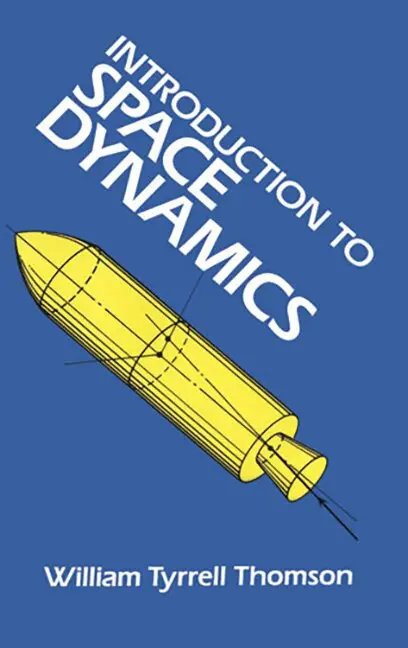
    Introduction to Space Dynamics

    AvWilliam T. Thomson

    Häftad, Engelska, 2003

    Del i serien Dover Books on Aeronautical Engineering

    205 kr

    Beställningsvara. Skickas inom 5-8 vardagar. Fri frakt över 249 kr.

    Beskrivning

    Comprehensive, classic introduction to space-flight engineering for advanced undergraduate and graduate students. Provides basic tools for quantitative analysis of the motions of satellites and other vehicles in space. Includes vector algebra, kinematics, transformation of coordinates, gyrodynamics, generalized theories of mechanics.

    Produktinformation

    • Utgivningsdatum:2003-03-28
    • Mått:135 x 215 x 18 mm
    • Vikt:360 g
    • Format:Häftad
    • Språk:Engelska
    • Serie:Dover Books on Aeronautical Engineering
    • Antal sidor:352
    • Förlag:Dover Publications Inc.
    • ISBN:9780486651132

    Utforska kategorier

    • Teknik: allmänt inom Naturvetenskap och teknik
    • Naturvetenskap:allmänt inom Naturvetenskap och teknik

    Innehållsförteckning

    • Chapter 1. Introduction 1.1 Basic concepts 1.2 Scalar and Vector Quantities 1.3 Properties of a Vector 1.4 Moment of a Vector 1.5 Angular Velocity Vector 1.6 Derivative of a Vector Chapter 2. Kinematics 2.1 Velocity and acceleration 2.2 Plane Motion (Radial and Transverse Components) 2.3 Tangential and Normal Components 2.4 Plane Motion along a Rotating Curve (Relative Motion) 2.5 General Case of Space Motion 2.6 Motion Relative to the Rotating Earth Chapter 3. Transformation of Coordinates 3.1 Transformation of Displacements 3.2 Transformation of Velocites 3.3 Instantaneous Center 3.4 Euler's Angles 3.5 Transformation of Angular Velocities Chapter 4. Particle Dynamics (Satellite Orbits) 4.1 Force and Momentum 4.2 Impulse and Momentum 4.3 Work and Energy 4.4 Moment of Momentum 4.5 Motion Under a Central Force 4.6 The Two-body Problem 4.7 Orbits of Planets and Satellites 4.8 Geometry of conic Sections 4.9 Orbit Established from Initial conditions 4.10 Satellite Launched with beta subscript 0 = 0 4.11 Cotangential Transfer between Coplanar Circular Orbits 4.12 Transfer between Coplanar Coaxial Elliptic Orbits 4.13 Orbital Change due to Impulsive Thrust 4.14 Perturbation of Orbital Parameters 4.15 Stability of Small Oscillations about a Circular Orbit 4.16 Interception and Rendezvous 4.17 Long-Range Ballistic Trajectories 4.18 Effect of the Earth's Oblateness Chapter 5. Gyrodynamics 5.1 Displacement of a Rigid Body 5.2 Moment of Momentum of a Rigid Body (About a Fixed Point or the Moving Center of Mass) 5.3 Kinetic Energy of a Rigid Body 5.4 Moment of Inertia about a Rotated Axis 5.5 Principal Axes 5.6 Euler's Moment Equation 5.7 Euler's Equation for Principal Axes 5.8 Body of Revolution with Zero External Moment (Body Coordinates) 5.9 Body of Revolution with Zero Moment, in Terms of Euler's Angles 5.10 Unsymmetrical Body with Zero External Moment (Poinsot's Geometric Solution) 5.11 Unequal Moments of Inertia with Zero Moment (Analytical Solution) 5.12 Stability of Rotation about Principal Axes 5.13 General Motion of a Symmetric Gyro or Top 5.14 Steady Precession of a Symmetric Gyro or Top 5.15. Precession and Nutation of the Earth's Polar Axis 5.16 General Motion of a Rigid Body Chapter 6. Dynamics of Gyroscopic Instruments 6.1 Small Oscillations of Gyros 6.2 Oscilaltions About Gimbal Axes 6.3 Gimbal Masses Included (Perturbation Technique) 6.4 The Gyrocompass 6.5 Oscillation of the Gyrocompass 6.6 The Rate Gyro 6.7 The Integrating Gyro 6.8 The Stable Platform 6.9 The Three-Axis Platform 6.10 Inertial Navigation 6.11 Oscillation of Navigational Errors Chapter 7. Space Vehicle Motion 7.1 General Equations in Body Coordinates 7.2 Thrust Misalignment 7.3 Rotations Referred to Inertial Coordinates 7.4 Near Symmetric Body of Revolution with Zero Moment 7.5 Despinning of Satellites 7.6 Attitude Drift of Space Vehicles 7.7 Variable Mass 7.8 Jet Damping (Nonspinning Variable Mass Rocket) 7.9 Euler's Dynamical Equations for Spinning Rockets 7.10 Angle of Attack of the Missile 7.11 General Motion of Spinning Bodies with Varying Configuration and Mass Chapter 8. Performance and Optimization 8.1 Performance of Single-Stage Rockets 8.2 Optimization of Multistage Rockets 8.3 Flight Trajectory Optimization 8.4 Optimum Program for Propellant Utilization 8.5 Gravity Turn Chapter 9. Generalized Theories of Mechanics 9.1 Introduction 9.2 System with Constraints 9.3 Generalized Coordinates 9.4 Holonomic and Nonholonomic systems 9.5 Principle of Virtual work 9.6 D'Alembert's Principle 9.7 Hamilton's Principle 9.8 Lagrange's Equation (Holonomic system) 9.9 Nonholonomic System 9.10 Lagrange's Equation for Impulsive Forces 9.11 Lagrange's Equations for Rotating Coordinates 9.12 Missile Dynamic Analysis General References Appendix A. Matrices Appendix B. Dyadics Appendix C. The Variational Calculus Index