• Fri frakt över 249 kr
  • •
  • Snabba leveranser
  • •
  • Billiga böcker
Kundservice

Du är på sajten för privatpersoner.

Företag, bibliotek eller offentlig verksamhet?

Du handlar på classic.bokus.com, där alla dina funktioner finns intakta.
Till classic.bokus.com
Bokus logotyp. Gå till startsidan.
  • Erbjudanden
  • Nyheter
  • Student
  • Topplistor
  • Barn & ungdom
  • Bokus Play
  • E-böcker
  • Pocketböcker
  • Spel & pussel

10% rabatt på allt med kod: NYSTART10 →

Sidfot

Mina sidor

    Hjälp

    • Kundservice
    • Vanliga frågor och svar
    • Frakt och leverans
    • Retur vid ångerrätt
    • Reklamera vara
    • Betalning
    • Köpvillkor
    • Allmänna villkor
    • Information om webbplatsens tillgänglighet

    Om Bokus

    • Om oss
    • Pressrum
    • För studenter
    • För företag
    • För bibliotek och offentlig verksamhet
    • För leverantörer
    • Hållbarhet

    Populärt

    • Aktuella erbjudanden
    • Presentkort
    • Studentlitteratur
    • Nya böcker
    • Topplistor
    • Signerade böcker
    • Engelska böcker

    Inspiration

    • Boktips
    • BookTok
    • Populära bokserier
    • Barnbokskaraktärer
    • Populära författare
    Logotyp för Bokus
    Följ oss på Facebook (extern länk)Följ oss på Instagram (extern länk)Följ oss på YouTube (extern länk)Följ oss på TikTok (extern länk)
    bokus @ CookiesAnpassa cookiesIntegritetspolicyKöpvillkor
    Till Citymail hemsida (extern länk)Till Budbee hemsida (extern länk)Till Postnord hemsida (extern länk)Till Schenker hemsida (extern länk)Till Early Bird hemsida (extern länk)Till Walleys hemsida (extern länk)
    1. Samhälle och politik
    2. Sociologi och antropologi
    3. Antropologi

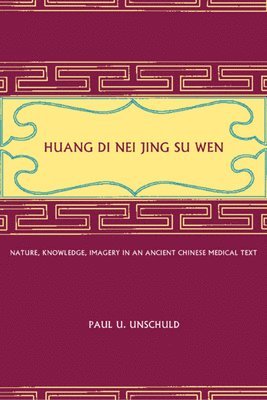
    Huang Di Nei Jing Su Wen

    Nature, Knowledge, Imagery in an Ancient Chinese Medical Text: With an appendix: The Doctrine of the Five Periods and Six Qi in the Huang Di Nei Jing Su Wen

    AvPaul U. Unschuld

    Inbunden, Engelska, 2003

    1 175 kr

    Beställningsvara. Skickas inom 5-8 vardagar. Fri frakt över 249 kr.

    Fler format och utgåvor

    Inbunden

    1 730 kr

    E-bok

    1 451 kr

    Beskrivning

    "The Huang Di nei jing su wen", known familiarly as the "Su wen", is a seminal text of ancient Chinese medicine, yet until now there has been no comprehensive, detailed analysis of its development and contents. At last Paul U. Unschuld offers entry into this still - vital artifact of China's cultural and intellectual past. Unschuld traces the history of the "Su wen" to its origins in the final centuries B.C.E., when numerous authors wrote short medical essays to explain the foundations of human health and illness on the basis of the newly developed vessel theory. He examines the meaning of the title and the way the work has been received throughout Chinese medical history, both before and after the eleventh century when the text as it is known today emerged. Unschuld's survey of the contents includes illuminating discussions of the yin-yang and five-agents doctrines, the perception of the human body and its organs, qi and blood, pathogenic agents, concepts of disease and diagnosis, and a variety of therapies, including the new technique of acupuncture.An extensive appendix, furthermore, offers a detailed introduction to the complicated climatological theories of Wu yun liu qi ('five periods and six qi'), which were added to the "Su wen" by Wang Bing in the Tang era. In an epilogue, Unschuld writes about the break with tradition and innovative style of thought represented by the "Su wen". For the first time, health care took the form of 'medicine', in that it focused on environmental conditions, climatic agents, and behavior as causal in the emergence of disease and on the importance of natural laws in explaining illness. Unschuld points out that much of what we surmise about the human organism is simply a projection, reflecting dominant values and social goals, and he constructs a hypothesis to explain the formation and acceptance of basic notions of health and disease in a given society. Reading the "Su wen", he says, not only offers a better understanding of the roots of Chinese medicine as an integrated aspect of Chinese civilization; it also provides a much needed starting point for discussions of the differences and parallels between European and Chinese ways of dealing with illness and the risk of early death.

    Produktinformation

    • Utgivningsdatum:2003-04-08
    • Mått:152 x 229 x 43 mm
    • Vikt:1 179 g
    • Format:Inbunden
    • Språk:Engelska
    • Antal sidor:536
    • Förlag:University of California Press
    • ISBN:9780520233225

    Utforska kategorier

    • Antropologi inom Samhälle och politik

    Mer om författaren

    Paul U. Unschuld is Professor and Director of the Institute for the History of Medicine at Munich University. His books previously published by California include Medicine in China: A History of Pharmaceutics (1986), Nan-ching--The Classic of Difficult Issues (1986), Medicine in China: A History of Ideas (1988), and Essential Subtleties on the Silver Sea (with Jurgen Kovacs, 1998).

    Innehållsförteckning

    • Prefatory RemarksI. Bibliographic History of the Su wen1. Some Scholarly Views on the Origin of the Su wen2. References to Huang Di nei jing and Su wen in Early Bibliographic SourcesII. The Meaning of the Title Huang Di Nei Jing Su wen1. Huang Di2. Nei3. Jing4. Su wenIII. Early Su wen texts and commentaries before the eleventh century1. Huangfu Mi and the Jia yi jing2. Quan Yuanqi and the Su wen xun jie3. Yang Shangshan and the Huang Di nei jing tai su3.1. History and Reconstruction of a Tai su Text in Japan3.2. The Issue of the Chinese Master Copies of the Tai su3.3. Yang Shangshan’s Commentaries4. Wang Bing’s Su wen Edition of a.d.4.1. Wang Bing, His Intentions and His Preface4.2. Structural Characteristics of the Wang Bing Edition4.3. Discourses 66 through 74 in Today’s Su wen4.4. The Influence of Wang Bing’s Worldview on His Su wen Edition4.5. Scope and Structure of Wang Bing’s CommentariesIV. Origin and tradition of the textus receptus of the Su wen1. The Imperial Editorial Office of 10572. The Scope of the Revision by Gao Baoheng et al.3. The Major Commentated Su wen Versions Subsequent to Gao Baoheng et al.3.1. Ma Shi’s Huang Di nei jing su wen zhu zheng fa wei3.2. Wu Kun’s Huang Di nei jing su wen zhu3.3. Zhang Jiebin’s Lei jing3.4. Zhang Zhicong’s Huang Di nei jing su wen ji zhu3.5. Gao Shishi’s Huang Di su wen zhi jie3.6. Zhang Qi’s Su wen shi yi3.7. Hu Shu’s Huang Di nei jing su wen jiao yi3.8. Yu Yue’s Nei jing bian yan4. Two Japanese Commentated Su wen Versions of the Edo Period4.1. Tamba Genkan’s Su wen shi4.2. Tamba Genken’s Su wen shao shiV. A survey of the contents of the Su wen1. The Literary Setting2. The Yin-Yang Doctrine2.1. The Discovery of Dualism2.2. The Fourfold Subcategorization2.3. The Sixfold Subcategorization2.4. An Eightfold or Tenfold Subcategorization?2.5. Yin-Yang Physiology, Pathology, and Diagnosis3. The Five-Agents Doctrine3.1. General Remarks3.2. Early References to Pentic Categorizations3.3. Early Notions of Correspondences among Phenomena3.4. Early Patterns of Correspondences3.5. The Status Quo of the Five-Agents Doctrine in the Su wen3.6. The Significance of the Five-Agents Doctrine in the Su wen4. The Body and Its Organs4.1. Su wen Morphology4.2. Chest and Abdomen4.3. The Head4.4. The Extremities4.5. General Structural Elements and Mobile Agents4.6. Toward a Hierarchy of Human Organs4.7. Depots, Palaces, Containers, and Officers4.8. Links between Organs and Orifices4.9. The Organism as a System of Morphological Entities and Their Functions5. Blood and Qi5.1. Blood5.2. Qi5.3. Camp Qi and Protective Qi6. The Vessels6.1. Vessel Theory in the Mawangdui Manuscripts6.2. Vessel Morphology in the Su wen6.3. Vessel Pathology6.4. The Contents of the Vessels6.5. Vessel Flow7. Pathogenic Agents7.1. From Bugs and Demons to Natural Environmental Factors7.2. Wind Etiology and Pathology7.3. Wind Etiology and Leprosy7.4. Wind Etiology and Malaria7.5. Dampness, Cold, Heat, and Dryness8. Diseases8.1. Lifestyle and Prevention8.2. Ontological and Functional Views8.3. Disease Terminology8.4. Malaria8.5. Cough8.6. Lower Back Pain8.7. Limpness8.8. Block8.9. Recession8.10. Somatopsychic Diseases8.11. Beyond Conceptualization9. Examination9.1. General Principles9.2. Inspection9.3. Inquiries9.4. Three Sections and Nine Indicators9.5. Empirical and Conceptualized Prognosis9.6. Vessel Diagnosis of Disease9.7. Conclusion10. Invasive Therapies10.1. The Concept of Invasive Intervention10.2. Bloodletting10.3. Bloodletting to Treat Qi10.4. Misleading Piercing and Grand Piercing10.5. Genuine Qi Manipulation10.6. Morphological Piercing10.7. The Technique of Piercing11. Substance Therapies11.1. From Materia Medica to Pharmacology11.2. Pharmacotherapy in the Main Text of the Su wen11.3. Drug Qualities and Dietary Therapy11.4. The Dawn of Pharmacology in the “Seven Comprehensive Discourses”12. Heat Therapies12.1. Conceptual Levels prior to Vessel Theory12.2. Cauterization and Vessel TheoryVI. Epilogue: toward a comparative historical anthropology of medical thought1. The Su wen: Document of a New Style of Thought2. Social Facts, Worldviews, and Medical Ideas: Parallel Structures3. Philosophical Key Terms in a Medical Context4. ConclusionNotesAppendixThe doctrine of the five periods and six qi in the huang di nei jing su wenBibliographyIndex