• Fri frakt över 249 kr
  • •
  • Snabba leveranser
  • •
  • Billiga böcker
Kundservice

Du är på sajten för privatpersoner.

Företag, bibliotek eller offentlig verksamhet?

Du handlar på classic.bokus.com, där alla dina funktioner finns intakta.
Till classic.bokus.com
Bokus logotyp. Gå till startsidan.
  • Erbjudanden
  • Nyheter
  • Student
  • Topplistor
  • Barn & ungdom
  • Bokus Play
  • E-böcker
  • Pocketböcker
  • Spel & pussel

10% rabatt på allt med kod: NYSTART10 →

Sidfot

Mina sidor

    Hjälp

    • Kundservice
    • Vanliga frågor och svar
    • Frakt och leverans
    • Retur vid ångerrätt
    • Reklamera vara
    • Betalning
    • Köpvillkor
    • Allmänna villkor
    • Information om webbplatsens tillgänglighet

    Om Bokus

    • Om oss
    • Pressrum
    • För studenter
    • För företag
    • För bibliotek och offentlig verksamhet
    • För leverantörer
    • Hållbarhet

    Populärt

    • Aktuella erbjudanden
    • Presentkort
    • Studentlitteratur
    • Nya böcker
    • Topplistor
    • Signerade böcker
    • Engelska böcker

    Inspiration

    • Boktips
    • BookTok
    • Populära bokserier
    • Barnbokskaraktärer
    • Populära författare
    Logotyp för Bokus
    Följ oss på Facebook (extern länk)Följ oss på Instagram (extern länk)Följ oss på YouTube (extern länk)Följ oss på TikTok (extern länk)
    bokus @ CookiesAnpassa cookiesIntegritetspolicyKöpvillkor
    Till Citymail hemsida (extern länk)Till Budbee hemsida (extern länk)Till Postnord hemsida (extern länk)Till Schenker hemsida (extern länk)Till Early Bird hemsida (extern länk)Till Walleys hemsida (extern länk)
    1. Samhälle och politik
    2. Politik och statsskick

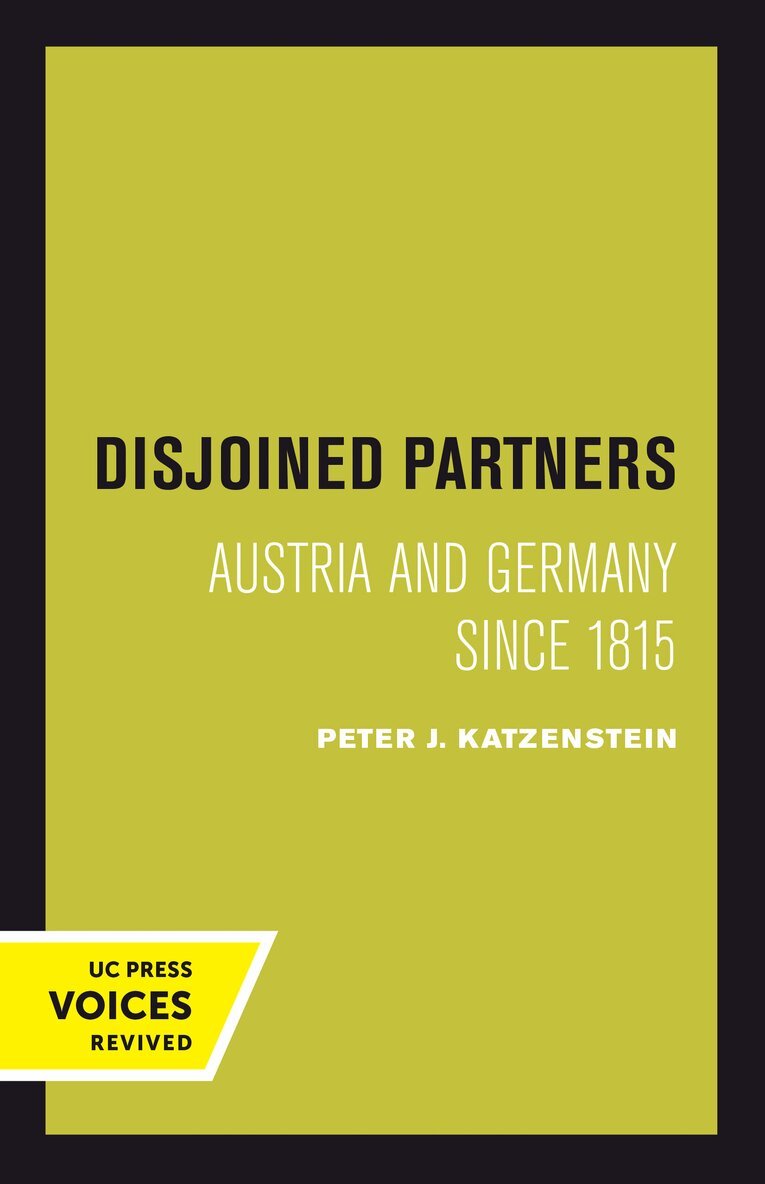
    Disjoined Partners

    Austria and Germany since 1815

    AvPeter Katzenstein

    Inbunden, Engelska, 2024

    1 476 kr

    Beställningsvara. Skickas inom 3-6 vardagar. Fri frakt över 249 kr.

    Fler format och utgåvor

    Häftad

    484 kr

    E-bok

    336 kr

    Beskrivning

    Is there a natural tendency toward the political integration of states that are united in culture but divided in politics? Disjoined Partners arrives at a largely negative response. In an application of political science techniques to a subject traditionally in the domain of history, Peter J. Katzenstein analyzes Austro-German relations since 1815 in six chronologically arranged case studies. Asking why these partners remain disjoined, Katzenstein finds the answer in the persistence of Austria’s political autonomy. In an appendix, the author illustrates how this type of analysis could be extended to include an examination of the unification of Germany and of Italy in the middle of the nineteenth century and of the fragmentation of Sweden-Norway and England-Ireland at the beginning of the twentieth. His study sheds new light on the reasons for the continued political autonomy of nation-states.  Disjoined Partners derives from the author's dissertation, which was awarded the Charles Sumner Prize at Harvard and the American Political Science Association’s Helen Dwight Reid Award for the best dissertation of the year in the field of international relations, law, and politics.This title is part of UC Press's Voices Revived program, which commemorates University of California Press’s mission to seek out and cultivate the brightest minds and give them voice, reach, and impact. Drawing on a backlist dating to 1893, Voices Revived makes high-quality, peer-reviewed scholarship accessible once again using print-on-demand technology. This title was originally published in 1976.

    Produktinformation

    • Utgivningsdatum:2024-06-04
    • Mått:140 x 216 x 20 mm
    • Vikt:499 g
    • Format:Inbunden
    • Språk:Engelska
    • Antal sidor:280
    • Förlag:University of California Press
    • ISBN:9780520414310

    Utforska kategorier

    • Politik och statsskick inom Samhälle och politik

    Mer om författaren

    Peter J. Katzenstein is the Walter S. Carpenter, Jr. Professor of International Studies at Cornell University.

    Innehållsförteckning

    • Tables and FiguresPrefaceI. IntroductionII. The Probability of Political AutonomyIII. Aristocratic Pattern (1815-1848)IV. Conflict Pattern (1848-1870)V. Hierarchical Pattern (1870-1918)VI. Voluntaristic Pattern (1918-1938)VII. Structural Pattern (1938-1945)VIII. Pluralistic Pattern (1945-1970)IX. Counterpressures and Political AutonomyX. ConclusionAPPENDIX. Political Unification,Political Fragmentation,and Cultural Cohesion inEurope Since 1815INDEX