• Fri frakt över 249 kr
  • •
  • Snabba leveranser
  • •
  • Billiga böcker
Kundservice

Du är på sajten för privatpersoner.

Företag, bibliotek eller offentlig verksamhet?

Du handlar på classic.bokus.com, där alla dina funktioner finns intakta.
Till classic.bokus.com
Bokus logotyp. Gå till startsidan.
  • Erbjudanden
  • Nyheter
  • Student
  • Topplistor
  • Barn & ungdom
  • Bokus Play
  • E-böcker
  • Pocketböcker
  • Spel & pussel

10% rabatt på allt med kod: NYSTART10 →

Sidfot

Mina sidor

    Hjälp

    • Kundservice
    • Vanliga frågor och svar
    • Frakt och leverans
    • Retur vid ångerrätt
    • Reklamera vara
    • Betalning
    • Köpvillkor
    • Allmänna villkor
    • Information om webbplatsens tillgänglighet

    Om Bokus

    • Om oss
    • Pressrum
    • För studenter
    • För företag
    • För bibliotek och offentlig verksamhet
    • För leverantörer
    • Hållbarhet

    Populärt

    • Aktuella erbjudanden
    • Presentkort
    • Studentlitteratur
    • Nya böcker
    • Topplistor
    • Signerade böcker
    • Engelska böcker

    Inspiration

    • Boktips
    • BookTok
    • Populära bokserier
    • Barnbokskaraktärer
    • Populära författare
    Logotyp för Bokus
    Följ oss på Facebook (extern länk)Följ oss på Instagram (extern länk)Följ oss på YouTube (extern länk)Följ oss på TikTok (extern länk)
    bokus @ CookiesAnpassa cookiesIntegritetspolicyKöpvillkor
    Till Citymail hemsida (extern länk)Till Budbee hemsida (extern länk)Till Postnord hemsida (extern länk)Till Schenker hemsida (extern länk)Till Early Bird hemsida (extern länk)Till Walleys hemsida (extern länk)
    1. Ekonomi och Ledarskap
    2. Nationalekonomi
    3. Internationell ekonomi

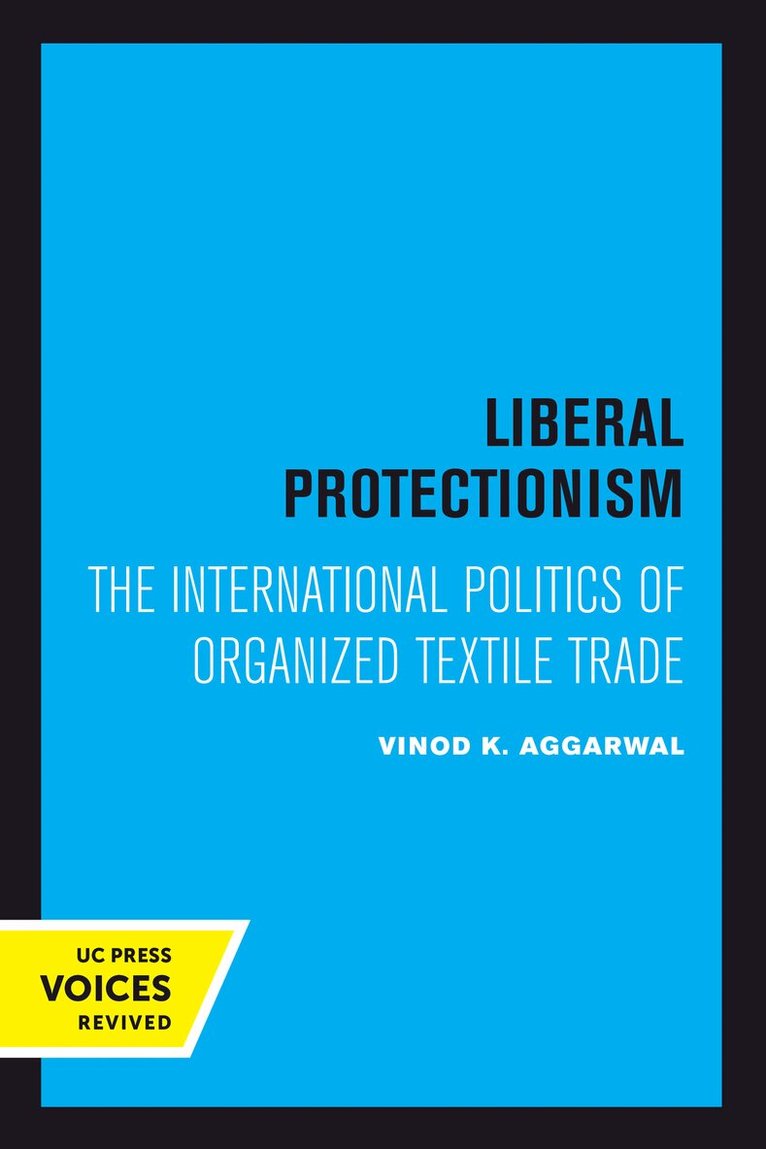
    Liberal Protectionism

    The International Politics of Organized Textile Trade

    AvVinod K. Aggarwal

    Inbunden, Engelska, 2024

    Del 13 i serien Studies in International Political Economy

    1 520 kr

    Beställningsvara. Skickas inom 3-6 vardagar. Fri frakt över 249 kr.

    Fler format och utgåvor

    Häftad

    499 kr

    E-bok

    346 kr

    Beskrivning

    What does organized trade portend for the future of the post–World War II trading order? Are we seeing a transition from liberalism to protectionism? These questions are central to Vinod K. Aggarwal's penetrating analysis of conflict and cooperation in trade among developed and less developed countries. In his examination of the evolution of organized trade, Aggarwal specifically analyses international regimes in textile and apparel trade. The author uses an original theoretical approach to investigate international regimes. Why are regimes desirable? Aggarwal shows how such accords can protect broader arrangements, allow countries to control one another's behavior, and minimize information and organization costs in negotiations. Several factors account for the form of regimes. The strength of regimes is enhanced by an asymmetry of international power. A hegemon is more willing and able to maintain a regime. Both the nature and scope of regimes are determined by the relative degree of trade competition and cognitive consensus among actors. As trade competition increases, and actors decide to link related issues, regimes become more protectionist in their goals and wider in their coverage. Aggarwal's theory successfully accounts for the transformation of international regimes in textile trade, demonstrating the importance of systematically incorporating international level factors into our theories. His empirical work is based on extensive archival research and interviews with key negotiators. Aggarwal concludes that the pattern of international cooperation which evolved in textile trade provides a portrait of the future for trade in other industrial sectors. He finds the trend of arrangements in textile trade disturbing and argues that organized trade will not prevent—and may in fact promote a slide from liberalism to protectionism. Regimes originally developed to counter protectionism may evolve into systems of organized protection that encourage neither efficiency nor equity. A lucid analysis of recent historical developments in textile trade, this study sheds light on the movement toward increasing protection in other sectors of trade as well. It is a significant work that will prove valuable to those who study international trade and regimes.This title is part of UC Press's Voices Revived program, which commemorates University of California Press’s mission to seek out and cultivate the brightest minds and give them voice, reach, and impact. Drawing on a backlist dating to 1893, Voices Revived makes high-quality, peer-reviewed scholarship accessible once again using print-on-demand technology. This title was originally published in 1986.

    Produktinformation

    • Utgivningsdatum:2024-06-12
    • Mått:152 x 229 x 23 mm
    • Vikt:590 g
    • Format:Inbunden
    • Språk:Engelska
    • Serie:Studies in International Political Economy
    • Antal sidor:318
    • Förlag:University of California Press
    • ISBN:9780520414723

    Utforska kategorier

    • Internationell ekonomi inom Ekonomi och Ledarskap

    Mer om författaren

    Vinod K. Aggarwal is Professor and Travers Family Senior Faculty Fellow in Political Science at UC Berkeley and Director, Berkeley APEC Study Center.

    Innehållsförteckning

    • PrefaceAbbreviationsPART I: THE THEORY1. The Growth of Protection and International RegimesThe New ProtectionismThe Importance of Textile and Apparel TradeOrganization of the Study2. The Process of International Regime TransformationThe Objective: International RegimesAn International System Theory of RegimeTransformationThe Role of Domestic Structure and Decision Makersin Regime TransformationThe Methodology: Comparative Case Studies andProcess-TracingPART II: THE CYCLE OF REGIME TRANSFORMATION3. Nonexistence: The Pre-Regime Period, 1950-1959The Early Period, 1950-1954The American Bilateral Agreements, 1955-1959:Success with JapanThe U.K. Agreement with Exporting CountriesU.S. Attempts to Restrain Hong Kong ExportsThe European ArrangementsSummary4. Creation: The Short-Term and Long-Term Arrangements,1960-1962Policy ChoicesThe NegotiationsBehavior of Countries and TransactionsConclusion5. Maintenance: The Renewal of the LT A and the Developmentof the MFA, 1963-1974The United States Tries to Secure an International WoolAgreementThe Renewal of the MFAExpansion of the MFA, The First Effort: 1969-1971The Second Effort: The Development of the MFA, 1973Conclusion6. Destruction: The Renewal of the Multi-Fiber Arrangement,1977 and 1981The Renewal of the MFA, 1977The Second Renewal of the MFA, 1981ConclusionPART III: WEAVING A NEW REGIME?7. ConclusionCollaboration in Textile TradeImplications for TheoryProspects for Textile TradeThe Cycle Repeats?CHRONOLOGY OF EVENTSAPPENDIXESNOTESGLOSSARYREFERENCESINDEX