• Fri frakt över 249 kr
  • •
  • Snabba leveranser
  • •
  • Billiga böcker
Kundservice

Du är på sajten för privatpersoner.

Företag, bibliotek eller offentlig verksamhet?

Du handlar på classic.bokus.com, där alla dina funktioner finns intakta.
Till classic.bokus.com
Bokus logotyp. Gå till startsidan.
  • Erbjudanden
  • Nyheter
  • Student
  • Topplistor
  • Barn & ungdom
  • Bokus Play
  • E-böcker
  • Pocketböcker
  • Spel & pussel

10% rabatt på allt med kod: NYSTART10 →

Sidfot

Mina sidor

    Hjälp

    • Kundservice
    • Vanliga frågor och svar
    • Frakt och leverans
    • Retur vid ångerrätt
    • Reklamera vara
    • Betalning
    • Köpvillkor
    • Allmänna villkor
    • Information om webbplatsens tillgänglighet

    Om Bokus

    • Om oss
    • Pressrum
    • För studenter
    • För företag
    • För bibliotek och offentlig verksamhet
    • För leverantörer
    • Hållbarhet

    Populärt

    • Aktuella erbjudanden
    • Presentkort
    • Studentlitteratur
    • Nya böcker
    • Topplistor
    • Signerade böcker
    • Engelska böcker

    Inspiration

    • Boktips
    • BookTok
    • Populära bokserier
    • Barnbokskaraktärer
    • Populära författare
    Logotyp för Bokus
    Följ oss på Facebook (extern länk)Följ oss på Instagram (extern länk)Följ oss på YouTube (extern länk)Följ oss på TikTok (extern länk)
    bokus @ CookiesAnpassa cookiesIntegritetspolicyKöpvillkor
    Till Citymail hemsida (extern länk)Till Budbee hemsida (extern länk)Till Postnord hemsida (extern länk)Till Schenker hemsida (extern länk)Till Early Bird hemsida (extern länk)Till Walleys hemsida (extern länk)
    1. Filosofi och religion
    2. Filosofi
    3. Filosofiska discipliner

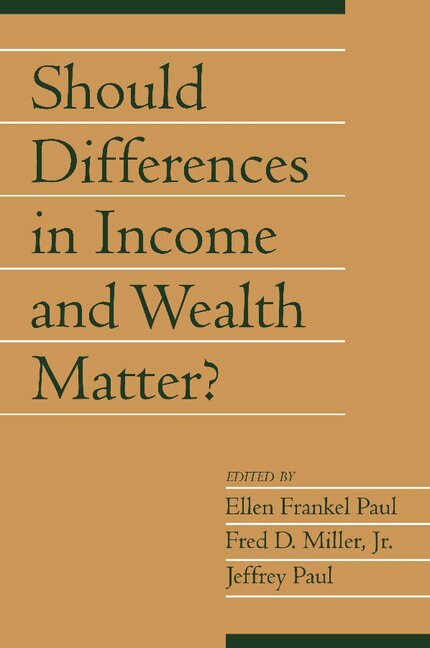
    Should Differences in Income and Wealth Matter?: Volume 19, Part 1

    AvEllen Frankel Paul,Fred D. Miller, Jr

    Häftad, Engelska, 2002

    Del i serien Social Philosophy and Policy

    369 kr

    Beställningsvara. Skickas inom 10-15 vardagar. Fri frakt över 249 kr.

    Beskrivning

    Is there a moral obligation to reduce differences in income and wealth? There is an egalitarian tradition that condemns these differences, particularly as they arise in free-market capitalist society, as unfair or unjust. The opponents of this view argue that the material disparities of capitalist society have been brought about by voluntary mechanisms and thus accord with the freely exercised liberties of its citizens. They conclude that capitalist inequality is not vulnerable to the ethical complaints of its critics. They maintain that the standard of living achieved as a by-product of the marketplace and its inequalities could not be adequately reproduced under egalitarian institutions. The essays in this volume, written by prominent economists, philosophers, and academic lawyers, assess the empirical and theoretical questions raised by inequalities of income and wealth.

    Produktinformation

    • Utgivningsdatum:2002-01-28
    • Mått:154 x 228 x 21 mm
    • Vikt:509 g
    • Format:Häftad
    • Språk:Engelska
    • Serie:Social Philosophy and Policy
    • Antal sidor:384
    • Förlag:Cambridge University Press
    • ISBN:9780521005357

    Utforska kategorier

    • Filosofiska discipliner inom Filosofi och religion

    Recensioner i media

    'This book is a good initiation for theologians, or any others who want to engage in serious economic debate.' The Heythrop Journal

    Innehållsförteckning

    • 1. Egalitarianism and welfare state redistribution Daniel Shapiro; 2. Does the welfare state help the poor? Tyler Cowen; 3. The stagnating fortunes of the middle class Edward N. Wolff; 4. Inequality, incentives, and opportunity Donald R. Deere and Finis Welch; 5. Misunderstanding distribution Young Back Choi; 6. Can anyone beat the flat tax? Richard A. Epstein; 7. Why justice requires transfers to offset income and wealth inequalities Richard J. Arneson; 8. The importance of being sufficiently equal James K. Galbraith; 9. Does inequality matter - for its own sake? Alan Ryan; 10. Equal respect and equal shares David Schmidtz; 11. Too much inequality Richard W. Miller; 12. Equality, benevolence, and responsiveness to agent-relative value Eric Mack; 13. How equality matters Hillel Steiner.