• Fri frakt över 249 kr
  • •
  • Snabba leveranser
  • •
  • Billiga böcker
Kundservice

Du är på sajten för privatpersoner.

Företag, bibliotek eller offentlig verksamhet?

Du handlar på classic.bokus.com, där alla dina funktioner finns intakta.
Till classic.bokus.com
Bokus logotyp. Gå till startsidan.
  • Erbjudanden
  • Nyheter
  • Student
  • Topplistor
  • Barn & ungdom
  • Bokus Play
  • E-böcker
  • Pocketböcker
  • Spel & pussel

10% rabatt på allt med kod: NYSTART10 →

Sidfot

Mina sidor

    Hjälp

    • Kundservice
    • Vanliga frågor och svar
    • Frakt och leverans
    • Retur vid ångerrätt
    • Reklamera vara
    • Betalning
    • Köpvillkor
    • Allmänna villkor
    • Information om webbplatsens tillgänglighet

    Om Bokus

    • Om oss
    • Pressrum
    • För studenter
    • För företag
    • För bibliotek och offentlig verksamhet
    • För leverantörer
    • Hållbarhet

    Populärt

    • Aktuella erbjudanden
    • Presentkort
    • Studentlitteratur
    • Nya böcker
    • Topplistor
    • Signerade böcker
    • Engelska böcker

    Inspiration

    • Boktips
    • BookTok
    • Populära bokserier
    • Barnbokskaraktärer
    • Populära författare
    Logotyp för Bokus
    Följ oss på Facebook (extern länk)Följ oss på Instagram (extern länk)Följ oss på YouTube (extern länk)Följ oss på TikTok (extern länk)
    bokus @ CookiesAnpassa cookiesIntegritetspolicyKöpvillkor
    Till Citymail hemsida (extern länk)Till Budbee hemsida (extern länk)Till Postnord hemsida (extern länk)Till Schenker hemsida (extern länk)Till Early Bird hemsida (extern länk)Till Walleys hemsida (extern länk)
    1. Ekonomi och Ledarskap
    2. Nationalekonomi

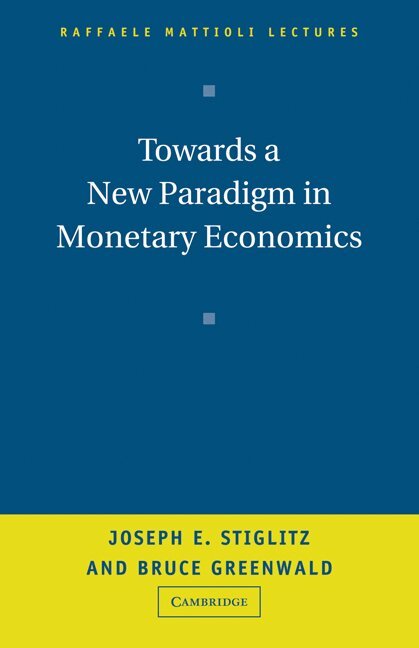
    Towards a New Paradigm in Monetary Economics

    AvJoseph Stiglitz,Bruce Greenwald

    Häftad, Engelska, 2003

    Del i serien Raffaele Mattioli Lectures

    628 kr

    Beställningsvara. Skickas inom 10-15 vardagar. Fri frakt över 249 kr.

    Fler format och utgåvor

    Inbunden

    1 444 kr

    Beskrivning

    Towards a New Paradigm for Monetary Economics presents a pioneer treatment of critical topics in monetary economics. Unlike the prevailing monetary theory, this book focuses not on the role of money in facilitating transactions, but on the role of credit in facilitating economic activities more broadly. The 'new paradigm' emphasizes the demand and supply of loanable funds, which in turn requires the understanding of the imperfections of information and the role of banks. One enlightening view is that credit is quite different from other commodities in the sense that the former is based on information and default risk. The book consists of two parts. The first part develops a basic model of credit based on banks' portfolio choices. The second part is dedicated to the policy implications, among which are the liberalization of financial markets, the East Asian Crisis, the 1991 US recession and the subsequent recovery.

    Produktinformation

    • Utgivningsdatum:2003-09-04
    • Mått:139 x 216 x 23 mm
    • Vikt:488 g
    • Format:Häftad
    • Språk:Engelska
    • Serie:Raffaele Mattioli Lectures
    • Antal sidor:344
    • Förlag:Cambridge University Press
    • ISBN:9780521008051

    Utforska kategorier

    • Nationalekonomi inom Ekonomi och Ledarskap

    Mer om författaren

    Professor of Economics, Stanford University and Senior Research Fellow of Brookings Institution. Formerly Senior Vice President and Chief Economist at World Bank. Professor of Finance, Columbia Business School.

    Recensioner i media

    '… recommended reading for all monetary economists and practitioners alike.' International Affairs

    Innehållsförteckning

    • Introduction; Part I. Theory: 1. Reflections on the current state of monetary economics; 2. How finance differs; 3. The ideal banking system; 4. Restricted banking; 5. Market equilibrium; 6. From the corn economy to the monetary economy; 7. Towards a general equilibrium theory of credit; Part II. Applications: 8. Monetary policy; 9. Regulatory policy and the new paradigm; 10. Financial market liberalization; 11. Restructuring the banking sector; 12. Regional downturns and development of monetary policy; 13. The East Asia Crisis; 14. The 1991 US recession and the recovery; 15. The new paradigm and the new economy; 16. Concluding remarks.