• Fri frakt över 249 kr
  • •
  • Snabba leveranser
  • •
  • Billiga böcker
Kundservice

Du är på sajten för privatpersoner.

Företag, bibliotek eller offentlig verksamhet?

Du handlar på classic.bokus.com, där alla dina funktioner finns intakta.
Till classic.bokus.com
Bokus logotyp. Gå till startsidan.
  • Erbjudanden
  • Student
  • Topplistor
  • Barn & ungdom
  • Bokus Play
  • E-böcker
  • Ljudböcker
  • Pocketböcker
  • Spel och pussel

Skapa nya rutiner – hälsoböcker upp till 50% →

Sidfot

Mina sidor

    Hjälp

    • Kundservice
    • Vanliga frågor och svar
    • Frakt och leverans
    • Retur vid ångerrätt
    • Reklamera vara
    • Betalning
    • Köpvillkor
    • Allmänna villkor
    • Information om webbplatsens tillgänglighet

    Om Bokus

    • Om oss
    • Pressrum
    • För studenter
    • För företag
    • För bibliotek och offentlig verksamhet
    • För leverantörer
    • Hållbarhet

    Populärt

    • Aktuella erbjudanden
    • Presentkort
    • Studentlitteratur
    • Nya böcker
    • Topplistor
    • Signerade böcker
    • Engelska böcker

    Inspiration

    • Boktips
    • BookTok
    • Barnbokskaraktärer
    • Populära författare
    Logotyp för Bokus
    Följ oss på Facebook (extern länk)Följ oss på Instagram (extern länk)Följ oss på YouTube (extern länk)Följ oss på TikTok (extern länk)
    bokus @ CookiesAnpassa cookiesIntegritetspolicyKöpvillkor
    Till Citymail hemsida (extern länk)Till Budbee hemsida (extern länk)Till Postnord hemsida (extern länk)Till Schenker hemsida (extern länk)Till Early Bird hemsida (extern länk)Till Walleys hemsida (extern länk)
    1. Ekonomi och Ledarskap
    2. Nationalekonomi
    3. Ekonomisk politik

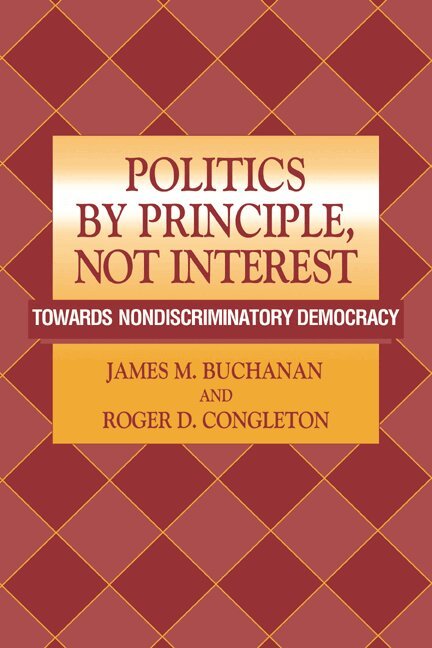
    Politics by Principle, Not Interest

    Towards Nondiscriminatory Democracy

    AvJames M. Buchanan,Roger D. Congleton

    Häftad, Engelska, 2006

    477 kr

    Beställningsvara. Skickas inom 7-10 vardagar. Fri frakt över 249 kr.

    Fler format och utgåvor

    Inbunden

    1 375 kr

    Beskrivning

    The very logic of majority rule implies unequal treatment or discrimination. If left unconstrained, majority coalitions will promote the interests of their own members at the expense of other persons. This book focuses on the effects of applying a generality constraint on the political process. Under this requirement, majorities would be constitutionally prohibited from treating different persons and groups differently. The generality principle is familiar in that all persons are to be treated equally. In summary, this book extends the generality norm to politics. Several defences of equal treatment or generality are developed and applied. These include the familiar intuition that invokes fairness. But the primary argument here is centred on political efficiency, which is increased when governments are constrained to treat persons or groups generally rather than differentially. The political efficiency defence of the generality constraint is based on a public choice analysis of the implication of majoritarian discrimination.

    Produktinformation

    • Utgivningsdatum:2006-11-23
    • Mått:152 x 229 x 11 mm
    • Vikt:303 g
    • Format:Häftad
    • Språk:Engelska
    • Antal sidor:192
    • Förlag:Cambridge University Press
    • ISBN:9780521031325

    Utforska kategorier

    • Ekonomisk politik inom Ekonomi och Ledarskap

    Recensioner i media

    "The idea that legislation should be general and non-discriminatory - that equals should be treated equally - is hardly new. But the notion that this idea might be a constitutional principle, serving to promote political efficiency in the face of the scope for special interest politics that simple majoritarianism provides - THAT notion is a distinctively 'public choice' one, and receives here at the hands of Buchanan and Congleton its most elegant, detailed and compelling exposition." Geoffrey Brennan, Australian National University

    Innehållsförteckning

    • List of figures and tables; Preface; Acknowledgements; Part I. Introduction: 1. Generality, law, and politics; Part II. Analysis: 2. Majoritarian democracy; 3. Eliminating the off-diagonals; 4. Extending the argument; 5. Generality and the political agenda; Part III. Application: 6. Generality and externality; 7. Market restriction and the generality norm; 8. The political efficiency of general taxation; 9. Deficit financing and intertemporal discrimination; 10. Generality and the supply of public services; 11. Generality and redistribution; 12. Generality without uniformity: social insurance; 13. Generality without uniformity: federalism; Part IV. Prospect: 14. The political shape of constitutional order; Endnotes; References; Index.