• Fri frakt över 249 kr
  • •
  • Snabba leveranser
  • •
  • Billiga böcker
Kundservice

Du är på sajten för privatpersoner.

Företag, bibliotek eller offentlig verksamhet?

Du handlar på classic.bokus.com, där alla dina funktioner finns intakta.
Till classic.bokus.com
Bokus logotyp. Gå till startsidan.
  • Erbjudanden
  • Nyheter
  • Student
  • Topplistor
  • Barn & ungdom
  • Bokus Play
  • E-böcker
  • Pocketböcker
  • Spel & pussel

10% rabatt på allt med kod: NYSTART10 →

Sidfot

Mina sidor

    Hjälp

    • Kundservice
    • Vanliga frågor och svar
    • Frakt och leverans
    • Retur vid ångerrätt
    • Reklamera vara
    • Betalning
    • Köpvillkor
    • Allmänna villkor
    • Information om webbplatsens tillgänglighet

    Om Bokus

    • Om oss
    • Pressrum
    • För studenter
    • För företag
    • För bibliotek och offentlig verksamhet
    • För leverantörer
    • Hållbarhet

    Populärt

    • Aktuella erbjudanden
    • Presentkort
    • Studentlitteratur
    • Nya böcker
    • Topplistor
    • Signerade böcker
    • Engelska böcker

    Inspiration

    • Boktips
    • BookTok
    • Populära bokserier
    • Barnbokskaraktärer
    • Populära författare
    Logotyp för Bokus
    Följ oss på Facebook (extern länk)Följ oss på Instagram (extern länk)Följ oss på YouTube (extern länk)Följ oss på TikTok (extern länk)
    bokus @ CookiesAnpassa cookiesIntegritetspolicyKöpvillkor
    Till Citymail hemsida (extern länk)Till Budbee hemsida (extern länk)Till Postnord hemsida (extern länk)Till Schenker hemsida (extern länk)Till Early Bird hemsida (extern länk)Till Walleys hemsida (extern länk)
    1. Medicin
    2. Andra medicinska specialiteter
    3. Psykiatri

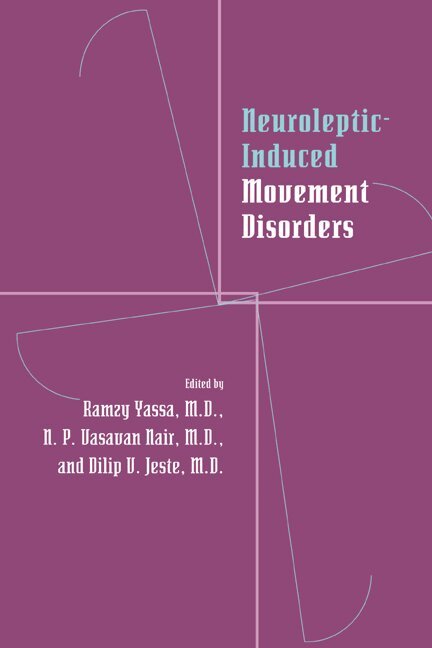
    Neuroleptic-induced Movement Disorders

    A Comprehensive Survey

    AvRamzy Yassa,N. P. V. Nair

    Häftad, Engelska, 2007

    1 354 kr

    Beställningsvara. Skickas inom 10-15 vardagar. Fri frakt över 249 kr.

    Beskrivning

    Neuroleptics, the most widely prescribed group of psychotropic drugs, are indispensable in the management of a majority of patients with schizophrenia, as well as other psychoses, yet they have not proved to be an unmixed blessing. They are associated with troublesome adverse effects, of which movement disorders are the most serious in terms of frequency, persistence and overall impact on the well-being of patients and care-givers. This book was prepared with the aim of improving understanding and clinical management of these iatrogenic conditions. It deals with historical, clinical and neurobiological aspects of tardive dyskinesia and related movement disorders such as parkinsonism, dystonia and akathisia. Sections are also devoted to the measurement of tardive dyskinesia, to geographical and ethnic differences, and to management with novel neuroleptic agents and biofeedback. With authoritative contributions and an international perspective, this book will be valuable to clinicians and researchers alike in psychiatry, neurology and related disciplines.

    Produktinformation

    • Utgivningsdatum:2007-02-01
    • Mått:152 x 228 x 31 mm
    • Vikt:772 g
    • Format:Häftad
    • Språk:Engelska
    • Antal sidor:516
    • Förlag:Cambridge University Press
    • ISBN:9780521033527

    Utforska kategorier

    • Psykiatri inom Medicin

    Recensioner i media

    "This is an excellent new book...Written and edited by internationally recognized experts in the field, this book is a valuable contribution to psychiatry...Any clinician who is involved in the treatment of patients with chronic psychoses should read and refer to this book." Michael J. Schrift, Doody's Health Sciences Book Review Journal

    Innehållsförteckning

    • Contributors; Preface; Part I. Historical Perspective: 1. Neuroleptic-induced movement disorders: historical perspective Marc-Alain Wolf, Ramzy Yassa and Pierre-Michel Llorca; Part II. Clinical Aspects of Tardive Dyskinesia: 2. Aging and tardive dyskinesia Bruce L. Saltz, John M. Kane, Margaret G. Woerner, Jeffrey A. Lieberman and José Ma. J. Alvir; 3. Gender as a factor in the development of tardive dyskinesia Ramzy Yassa and Dilip V. Jeste; 4. The Yale tardive dyskinesia study: a prospective incidence study among long-term outpatients William M. Glazer, Hal Morgenstern, Donna Raye Wagner and John Doucette; 5. Vulnerability to tardive dyskinesia in schizophrenia: an exploration of individual patient factors John L. Waddington, Eadbhard O'Callaghan, Peter Buckely, Cathy Madigan, Conall Larkin and Anthony Kinsella; 6. Tardive dyskinesia and affective disorder George Gardos and Jonathan O. Cole; 7. Diabetes mellitus and tardive dyskinesia Sukdeb Mukherjee and Sahebarao P. Mahadik; 8. Other factors in the development of tardive dyskinesia Ramzy Yassa; 9. Neuroleptic treatment and tardive dyskinesia George Gardos and Jonathan O. Cole; 10. Anticholinergic drugs as factors in the development of tardive dyskinesia Ramzy Yassa and N. P. V. Nair; Part III. Mechanisms Underlying Tardive Dyskinesia: 11. Neurochemistry of the basal ganglia N. P. V. Nair and T. E. G. West; 12. A reanalysis of the dopamine theory of tardive dyskinesia: the hypothesis of dopamine D1/D2 imbalance Linda Peacock and Jes Gerlach; 13. Tardive dyskinesia and phenylalanine metabolism: risk-factor studies Mary Ann Richardson, Cheryl Flynn, Laura Read, Margaret Reilly and Raymond Suckow; 14. Neuroendocrinological studies of tardive dyskinesia Margot Albus; 15. Cognitive deficits and tardive dyskinesia Marion E. Wolf, Alan S. DeWolfe and Aron D. Mosnaim; 16. Studies of tardive dyskinesia using computed tomography and magnetic-resonance imaging Christian L. Shriqui; 17. Rodent and other animal models of tardive dyskinesia during long-term neuroleptic-drug administration: controversies and implications for the clinical syndrome John L. Waddington; Part IV. Measurement of Tardive Dyskinesia: 18. Instrument measurements of tardive dyskinesia Michael P. Caligiuri; Part V. Tardive Dyskinesia in Different Populations: 19. Cultural aspects of tardive dyskinesia in Asia Shigeto Yamawaki, Teruo Hayashi; Ikuo Nagaoka, Hiroshi Saitoh, Norio Yokota and Yosuke Uchitomi; 20. Tardive dyskinesia in North America and the Middle East Driss Moussaoui; 21. Tardive dyskinesia in Europe H. A. McClelland and T. A. Kerr; 22. Role of ethnicity in the development of tardive dyskinesia Jonathan P. Lacro and Dilip V. Jeste; 23. Tardive dyskinesia in children and adolescents Mark Magulac and Dilip V. Jeste; Part VI. Other Neuropleptic-Induced Movement Disorders: 24. Drug-induced parkinsonism Thomas E. Hansen and William F. Hoffman; 25. Clinical aspects of neuroleptic-induced dystonia George A. Keepers and Linda Ganzini; 26. Tardive dystonia Paul Greene; 27. Tardive akathisia Robert E. Burke; Part VII. Treatment of Tardive Dyskinesia: 28. Development of novel antipsychotic drugs with reduced extrapyramidal side effects Allan Z. Safferman, Jeffrey A. Lieberman, Bruce J. Kinon, Daniel Umbricht, Jeffrey S. Aronowitz and John M. Kane; 29. GABAergic treatments for tardive dyskinesia Shawn L. Cassady, Gunvant K. Thaker and Carol A. Tamminga; 30. Using biofeedback to train suppression of the oral-lingual movements of tardive dyskinesia Ronald C. Fudge and Cecile E. Sison; Index.