• Fri frakt över 249 kr
  • •
  • Snabba leveranser
  • •
  • Billiga böcker
Kundservice

Du är på sajten för privatpersoner.

Företag, bibliotek eller offentlig verksamhet?

Du handlar på classic.bokus.com, där alla dina funktioner finns intakta.
Till classic.bokus.com
Bokus logotyp. Gå till startsidan.
  • Erbjudanden
  • Nyheter
  • Student
  • Topplistor
  • Barn & ungdom
  • Bokus Play
  • E-böcker
  • Pocketböcker
  • Spel & pussel

10% rabatt på allt med kod: NYSTART10 →

Sidfot

Mina sidor

    Hjälp

    • Kundservice
    • Vanliga frågor och svar
    • Frakt och leverans
    • Retur vid ångerrätt
    • Reklamera vara
    • Betalning
    • Köpvillkor
    • Allmänna villkor
    • Information om webbplatsens tillgänglighet

    Om Bokus

    • Om oss
    • Pressrum
    • För studenter
    • För företag
    • För bibliotek och offentlig verksamhet
    • För leverantörer
    • Hållbarhet

    Populärt

    • Aktuella erbjudanden
    • Presentkort
    • Studentlitteratur
    • Nya böcker
    • Topplistor
    • Signerade böcker
    • Engelska böcker

    Inspiration

    • Boktips
    • BookTok
    • Populära bokserier
    • Barnbokskaraktärer
    • Populära författare
    Logotyp för Bokus
    Följ oss på Facebook (extern länk)Följ oss på Instagram (extern länk)Följ oss på YouTube (extern länk)Följ oss på TikTok (extern länk)
    bokus @ CookiesAnpassa cookiesIntegritetspolicyKöpvillkor
    Till Citymail hemsida (extern länk)Till Budbee hemsida (extern länk)Till Postnord hemsida (extern länk)Till Schenker hemsida (extern länk)Till Early Bird hemsida (extern länk)Till Walleys hemsida (extern länk)
    1. Samhälle och politik
    2. Politik och statsskick

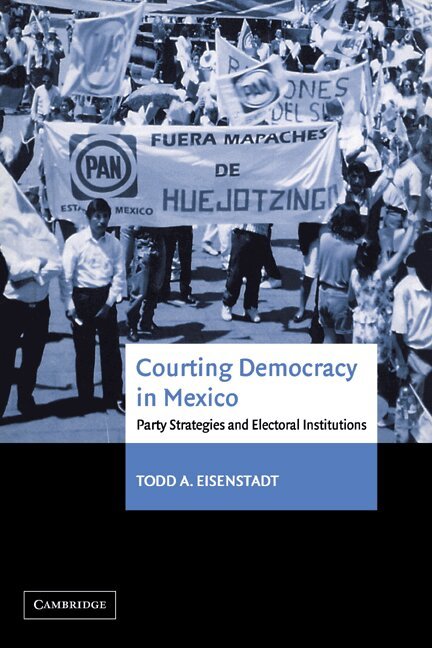
    Courting Democracy in Mexico

    Party Strategies and Electoral Institutions

    AvTodd A. Eisenstadt

    Häftad, Engelska, 2007

    545 kr

    Beställningsvara. Skickas inom 10-15 vardagar. Fri frakt över 249 kr.

    Fler format och utgåvor

    Inbunden

    1 482 kr

    Beskrivning

    This book documents Mexico's gradual transition to democracy, written from a perspective which pits opposition activists' post-electoral conflicts against their usage of regime-constructed electoral courts at the centre of the democratization process. It addresses the puzzle of why, during key moments of Mexico's 27-year democratic transition, opposition parties failed to use autonomous electoral courts established to mitigate the country's often violent post-electoral disputes, despite formal guarantees of court independence from the Party of the Institutional Revolution (PRI), Mexico's ruling party for 71 years (preceeding the watershed 2000 presidential elections). Drawing on hundreds of author interviews throughout Mexico over a three-year period and extensive archival research, the author explores choices by the rightist National Action Party (PAN) and the leftist Party of the Democratic Revolution (PRD) between post-electoral conflict resolution via electoral courts and via traditional routes - mobilization and bargaining with the PRI-state.

    Produktinformation

    • Utgivningsdatum:2007-03-26
    • Mått:150 x 228 x 22 mm
    • Vikt:569 g
    • Format:Häftad
    • Språk:Engelska
    • Antal sidor:376
    • Förlag:Cambridge University Press
    • ISBN:9780521035880

    Utforska kategorier

    • Politik och statsskick inom Samhälle och politik

    Recensioner i media

    "...a detailed and thorough account of the gradual transition to democracy in Mexico that focuses on the roles played by the two main opposition parties...provides a wealth of data...makes important contributions to our understanding of the complex and varied conditions under which democracy can be implemented, especially in his discussion of the interplay between formal and informal institutions." M.T. Kenney, Austin Peay State University, Choice

    Innehållsförteckning

    • Figures and tables; Acknowledgements; 1. Electoral courts and actor compliance: opposition-authoritarian relations and protracted transitions; 2. Ties that bind and even constrict: why authoritarians tolerate electoral reforms; 3. Mexico's national electoral justice success: from oxymoron to legal norm in just over a decade; 4. Mexico's local electoral justice failures: gubernatorial (s)election beyond the shadows of the law; 5. The gap between law and practice: institutional failure and opposition success in postelectoral conflicts, 1989–2000; 6. The National Action Party: dilemmas of rightist oppositions defined by authoritarian collusion; 7. The party of the democratic revolution: from postelectoral movements to electoral competitors; 8. Dedazo from the center to finger pointing from the periphery: PRI hard-liners challenge Mexico's electoral institutions; 9. A quarter century of 'Mexicanization': lessons from a protracted transition; Appendices; Bibliography; Index.