• Fri frakt över 249 kr
  • •
  • Snabba leveranser
  • •
  • Billiga böcker
Kundservice

Du är på sajten för privatpersoner.

Företag, bibliotek eller offentlig verksamhet?

Du handlar på classic.bokus.com, där alla dina funktioner finns intakta.
Till classic.bokus.com
Bokus logotyp. Gå till startsidan.
  • Erbjudanden
  • Nyheter
  • Student
  • Topplistor
  • Barn & ungdom
  • Bokus Play
  • E-böcker
  • Pocketböcker
  • Spel & pussel

10% rabatt på allt med kod NYSTART10 →

Sidfot

Mina sidor

    Hjälp

    • Kundservice
    • Vanliga frågor och svar
    • Frakt och leverans
    • Retur vid ångerrätt
    • Reklamera vara
    • Betalning
    • Köpvillkor
    • Allmänna villkor
    • Information om webbplatsens tillgänglighet

    Om Bokus

    • Om oss
    • Pressrum
    • För studenter
    • För företag
    • För bibliotek och offentlig verksamhet
    • För leverantörer
    • Hållbarhet

    Populärt

    • Aktuella erbjudanden
    • Presentkort
    • Studentlitteratur
    • Nya böcker
    • Topplistor
    • Signerade böcker
    • Engelska böcker

    Inspiration

    • Boktips
    • BookTok
    • Populära bokserier
    • Barnbokskaraktärer
    • Populära författare
    Logotyp för Bokus
    Följ oss på Facebook (extern länk)Följ oss på Instagram (extern länk)Följ oss på YouTube (extern länk)Följ oss på TikTok (extern länk)
    bokus @ CookiesAnpassa cookiesIntegritetspolicyKöpvillkor
    Till Citymail hemsida (extern länk)Till Budbee hemsida (extern länk)Till Postnord hemsida (extern länk)Till Schenker hemsida (extern länk)Till Early Bird hemsida (extern länk)Till Walleys hemsida (extern länk)
    1. Ekonomi och Ledarskap
    2. Nationalekonomi
    3. Makroekonomi

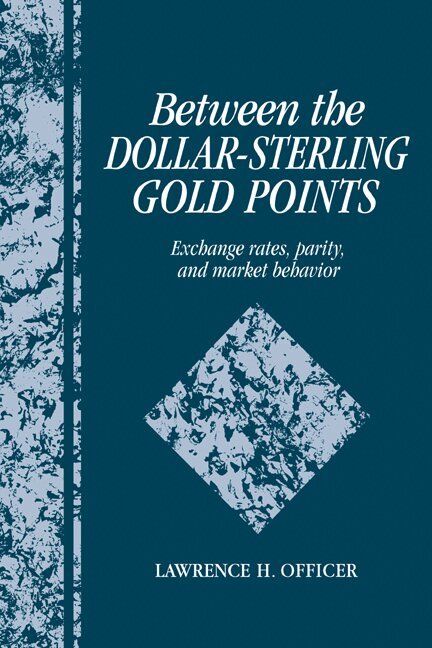
    Between the Dollar-Sterling Gold Points

    Exchange Rates, Parity and Market Behavior

    AvLawrence H. Officer

    Häftad, Engelska, 2007

    Del i serien Studies in Macroeconomic History

    739 kr

    Beställningsvara. Skickas inom 10-15 vardagar. Fri frakt över 249 kr.

    Beskrivning

    Officer begins this book with a historical perspective of the monetary standards of the United States and Britain. He then develops data on exchange rates, mint parity and gold points, with which he investigates three important features of Anglo-American monetary history. First, the integration of the American foreign-exchange market over time. Second, it is proved that gold-point arbitrage is markedly more efficient than either interest arbitrage or forward speculation. Third, regime efficiency is explored from standpoints of both private agents and policy-makers; the 1925-1931 gold standard, though less durable than the pre-war standard, is nevertheless shown to be surprisingly stable. The book will serve as a Dollar-Sterling handbook for those interested in this important aspect of international monetary history.

    Produktinformation

    • Utgivningsdatum:2007-07-02
    • Mått:151 x 227 x 20 mm
    • Vikt:551 g
    • Format:Häftad
    • Språk:Engelska
    • Serie:Studies in Macroeconomic History
    • Antal sidor:368
    • Förlag:Cambridge University Press
    • ISBN:9780521038218

    Utforska kategorier

    • Makroekonomi inom Ekonomi och Ledarskap

    Recensioner i media

    'Students of Dollar-Sterling exchange rates will find this book to be a superb US-British financial history of the period 1791–1931 as well as an original statistical and analytic study of how the gold standard worked.' Anna J. Schwartz, National Bureau of Economic Research

    Innehållsförteckning

    • List of figures; List of tables; Preface; List of symbols; 1. Introduction; Part I. Monetary Standards: 2. The various monetary standards; 3. American monetary standard; 4. British monetary standard; Part II. Exchange Rate: 5. Parity; 6. Exchange-rate data; 7. Exchange-market integration; Part III. Gold Points: 8. Gold points: theory and practice; 9. Gold-point estimates; Part IV. External and Internal Integration: 10. External integration; 11. Internal integration; Part V. Market Efficiency: 12. Theory of market efficiency; 13. Empirical testing of market efficiency; Part VI. Regime Efficiency; 14. Market forces; 15. Policy variables; 16. Net outcome; Part VII. Conclusions: 17. Summary and conclusions; Notes; References; Index.