• Fri frakt över 249 kr
  • •
  • Snabba leveranser
  • •
  • Billiga böcker
Kundservice

Du är på sajten för privatpersoner.

Företag, bibliotek eller offentlig verksamhet?

Du handlar på classic.bokus.com, där alla dina funktioner finns intakta.
Till classic.bokus.com
Bokus logotyp. Gå till startsidan.
  • Erbjudanden
  • Nyheter
  • Student
  • Topplistor
  • Barn & ungdom
  • Bokus Play
  • E-böcker
  • Pocketböcker
  • Spel & pussel

10% rabatt på allt med kod: NYSTART10 →

Sidfot

Mina sidor

    Hjälp

    • Kundservice
    • Vanliga frågor och svar
    • Frakt och leverans
    • Retur vid ångerrätt
    • Reklamera vara
    • Betalning
    • Köpvillkor
    • Allmänna villkor
    • Information om webbplatsens tillgänglighet

    Om Bokus

    • Om oss
    • Pressrum
    • För studenter
    • För företag
    • För bibliotek och offentlig verksamhet
    • För leverantörer
    • Hållbarhet

    Populärt

    • Aktuella erbjudanden
    • Presentkort
    • Studentlitteratur
    • Nya böcker
    • Topplistor
    • Signerade böcker
    • Engelska böcker

    Inspiration

    • Boktips
    • BookTok
    • Populära bokserier
    • Barnbokskaraktärer
    • Populära författare
    Logotyp för Bokus
    Följ oss på Facebook (extern länk)Följ oss på Instagram (extern länk)Följ oss på YouTube (extern länk)Följ oss på TikTok (extern länk)
    bokus @ CookiesAnpassa cookiesIntegritetspolicyKöpvillkor
    Till Citymail hemsida (extern länk)Till Budbee hemsida (extern länk)Till Postnord hemsida (extern länk)Till Schenker hemsida (extern länk)Till Early Bird hemsida (extern länk)Till Walleys hemsida (extern länk)
    1. Ekonomi och Ledarskap
    2. Nationalekonomi
    3. Ekonomiska system

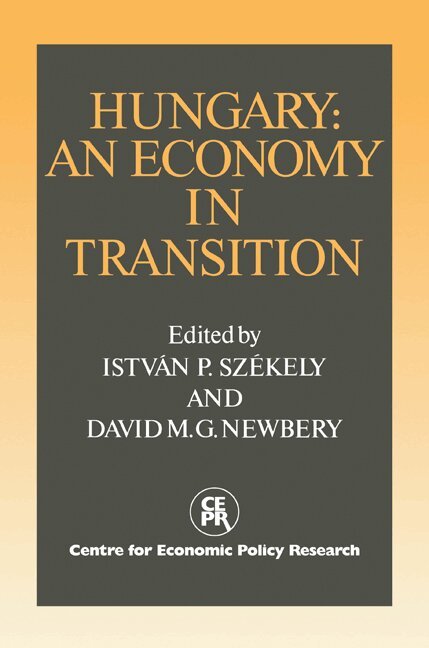
    Hungary: An Economy in Transition

    AvIstvan Szekely,David M. G. Newbery

    Häftad, Engelska, 2008

    546 kr

    Beställningsvara. Skickas inom 10-15 vardagar. Fri frakt över 249 kr.

    Fler format och utgåvor

    Inbunden

    1 665 kr

    Beskrivning

    The economic transformation of Hungary has reached a critical stage. Hungary has succeeded in attracting foreign capital, and has achieved its first current account surplus in convertible currency since 1984, despite upheavals, but the privatization process has reached a crucial stage. It is clear that it will be a lengthy and difficult process, with significant repercussions for the future of the economy and profound social and welfare consequences. This book presents some of the local arguments and perceptions informing the debate, and critical examination of these ideas from an international panel of scholars. The chapters address privatization; financial, tax and legal systems; integration into the international financial and monetary systems; labour markets, unemployment and the social safety net; and the political economy of the current economic transformation.

    Produktinformation

    • Utgivningsdatum:2008-01-28
    • Mått:156 x 234 x 21 mm
    • Vikt:560 g
    • Format:Häftad
    • Språk:Engelska
    • Antal sidor:392
    • Förlag:Cambridge University Press
    • ISBN:9780521057547

    Utforska kategorier

    • Ekonomiska system inom Ekonomi och Ledarskap

    Recensioner i media

    "This excellent volume will be of value to scholars studying the economics of transition. The editors have succeeded in presenting a comprehensive analysis of Hungary's transition from a centrally planned to a market economy." Slavic Review

    Innehållsförteckning

    • 1. Introduction István P. Székély and David M. G. Newbery; Part I. Foreign Trade: 2. Economic consequences of Soviet disintegration for Hungary László Czaba; 3. Regional cooperation in East-Central Europe Kálmán Mizsei; 4. Export supply and import demand in Hungary: an econometric analysis for 1968–1989 Laszlo Halpern and Istvan P. Szekely; Discussion of Part I Renzo Daviddi; Part II. Privatization and Competition Policy: 5. 10 percent already sold: privatization in Hungary Zsigmond Jarai; 6. Hungary: a unique approach to privatization - past, present and future Peter Mihalyi; 7. Competition policy in transition Janos Stadler; Discussion of Part II John P. Bonin, Rumen Dobrinsky and Paul Seabright; Part III. The Financial System and Private Savings: 8. Short-run money market model of Hungary Julia Kiraly; 9. The modernisation of the Hungarian banking sector Eva Varhegyi; 10. Changing structure of household portfolios in emerging market economics: the case of Hungary, 1970–1989 Istvan Abel and Istvan P. Szekely; Discussion of Part III John P. Bonin, Lucian Ionescu and Colin Mayer; Part IV. Foreign Debt and Monetary Policy: 11. Hungary's foreign debt controversies and macroeconomic problems Gábor Oblath; 12. Managing foreign debt and monetary policy Werner Riecke; Discussion of Part IV L. Alan Winters and Richard Portes; Part V. Legislative and Tax Reform: 13. A legal framework for the Hungarian transition, 1989–1991 Tamás Sárközy; 14. Tax reform in Hungary Jeno Koltay; Discussion of Part V Athar Hussain; Part VI. Labour Markets, Unemployment and Social Security: 15. The transformation of shop floor bargaining in Hungarian industry Janos Kollo; 16. The social security crisis in Hungary Maria Augusztinovics; Discussion of Part VI David M. G. Newbery and David Winter; Part VII. State Desertion: 17. State desertion and convertibility; the case of Hungary Istvan Abel and John P. Bonin; Discussion of Part VII David Begg and R. E. Rowthorn; Conclusion Sir Adam Ridley.