• Fri frakt över 249 kr
  • •
  • Snabba leveranser
  • •
  • Billiga böcker
Kundservice

Du är på sajten för privatpersoner.

Företag, bibliotek eller offentlig verksamhet?

Du handlar på classic.bokus.com, där alla dina funktioner finns intakta.
Till classic.bokus.com
Bokus logotyp. Gå till startsidan.
  • Erbjudanden
  • Nyheter
  • Student
  • Topplistor
  • Barn & ungdom
  • Bokus Play
  • E-böcker
  • Pocketböcker
  • Spel & pussel

10% rabatt på allt med kod NYSTART10 →

Sidfot

Mina sidor

    Hjälp

    • Kundservice
    • Vanliga frågor och svar
    • Frakt och leverans
    • Retur vid ångerrätt
    • Reklamera vara
    • Betalning
    • Köpvillkor
    • Allmänna villkor
    • Information om webbplatsens tillgänglighet

    Om Bokus

    • Om oss
    • Pressrum
    • För studenter
    • För företag
    • För bibliotek och offentlig verksamhet
    • För leverantörer
    • Hållbarhet

    Populärt

    • Aktuella erbjudanden
    • Presentkort
    • Studentlitteratur
    • Nya böcker
    • Topplistor
    • Signerade böcker
    • Engelska böcker

    Inspiration

    • Boktips
    • BookTok
    • Populära bokserier
    • Barnbokskaraktärer
    • Populära författare
    Logotyp för Bokus
    Följ oss på Facebook (extern länk)Följ oss på Instagram (extern länk)Följ oss på YouTube (extern länk)Följ oss på TikTok (extern länk)
    bokus @ CookiesAnpassa cookiesIntegritetspolicyKöpvillkor
    Till Citymail hemsida (extern länk)Till Budbee hemsida (extern länk)Till Postnord hemsida (extern länk)Till Schenker hemsida (extern länk)Till Early Bird hemsida (extern länk)Till Walleys hemsida (extern länk)
    1. Naturvetenskap och teknik
    2. Matematik och naturvetenskap
    3. Matematik
    4. Talteori

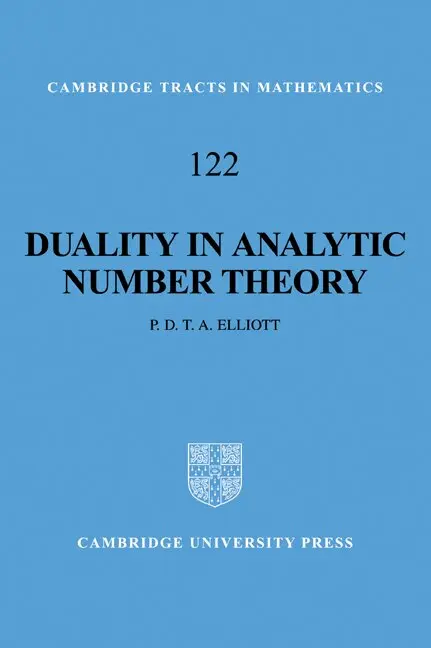
    Duality in Analytic Number Theory

    AvPeter D. T. A. Elliott

    Häftad, Engelska, 2008

    Del 122 i serien Cambridge Tracts in Mathematics

    772 kr

    Beställningsvara. Skickas inom 10-15 vardagar. Fri frakt över 249 kr.

    Fler format och utgåvor

    E-bok

    900 kr

    Inbunden

    1 898 kr

    Beskrivning

    In this stimulating book, aimed at researchers both established and budding, Peter Elliott demonstrates a method and a motivating philosophy that combine to cohere a large part of analytic number theory, including the hitherto nebulous study of arithmetic functions. Besides its application, the book also illustrates a way of thinking mathematically: historical background is woven into the narrative, variant proofs illustrate obstructions, false steps and the development of insight, in a manner reminiscent of Euler. It is shown how to formulate theorems as well as how to construct their proofs. Elementary notions from functional analysis, Fourier analysis, functional equations and stability in mechanics are controlled by a geometric view and synthesized to provide an arithmetical analogue of classical harmonic analysis that is powerful enough to establish arithmetic propositions until now beyond reach. Connections with other branches of analysis are illustrated by over 250 exercises, structured in chains about individual topics.

    Produktinformation

    • Utgivningsdatum:2008-01-28
    • Mått:153 x 228 x 21 mm
    • Vikt:581 g
    • Format:Häftad
    • Språk:Engelska
    • Serie:Cambridge Tracts in Mathematics
    • Antal sidor:360
    • Förlag:Cambridge University Press
    • ISBN:9780521058087

    Utforska kategorier

    • Talteori inom Naturvetenskap och teknik

    Recensioner i media

    ' … a fruitful atempt in finding a general method in Analytic Number Theory.' Monatshefte für Mathematik

    Innehållsförteckning

    • Preface; Notation; Introduction; 0. Duality and Fourier analysis; 1. Background philosophy; 2. Operator norm inequalities; 3. Dual norm inequalities; 4. Exercises: including the large sieve; 5. The Method of the Stable Dual (1): deriving the approximate functional equations; 6. The Method of the Stable Dual (2): solving the approximate functional equations; 7. Exercises: almost linear, almost exponential; 8. Additive functions of class La: a first application of the method; 9. Multiplicative functions of the class La: first approach; 10. Multiplicative functions of the class La: second approach; 11. Multiplicative functions of the class La: third approach; 12. Exercises: why the form? 13. Theorems of Wirsing and Halász; 14. Again Wirsing's theorem; 15. Exercises: the Prime Number Theorem; 16. Finitely distributed additive functions; 17. Multiplicative functions of the class La: mean value zero; 18. Exercises: including logarithmic weights; 19. Encounters with Ramanujan's function t(n); 20. The operator T on L2; 21. The operator T on La and other spaces; 22. Exercises: the operator D and differentiation; the operator T and the convergence of measures; 23. Pause: towards the discrete derivative; 24. Exercises: multiplicative functions on arithmetic progressions; Wiener phenomenon; 25. Fractional power large sieves; operators involving primes; 26. Exercises: probability seen from number theory; 27. Additive functions on arithmetic progressions: small moduli; 28. Additive functions on arithmetic progressions: large moduli; 29. Exercises: maximal inequalities; 30. Shifted operators and orthogonal duals; 31. Differences of additive functions; local inequalities; 32. Linear forms of additive functions in La; 33. Exercises: stability; correlations of multiplicative functions; 34. Further readings; 35. Rückblick (after the manner of Johannes Brahms); References; Author index; Subject index.