• Fri frakt över 249 kr
  • •
  • Snabba leveranser
  • •
  • Billiga böcker
Kundservice

Du är på sajten för privatpersoner.

Företag, bibliotek eller offentlig verksamhet?

Du handlar på classic.bokus.com, där alla dina funktioner finns intakta.
Till classic.bokus.com
Bokus logotyp. Gå till startsidan.
  • Erbjudanden
  • Nyheter
  • Student
  • Topplistor
  • Barn & ungdom
  • Bokus Play
  • E-böcker
  • Pocketböcker
  • Spel & pussel

10% rabatt på allt med kod: NYSTART10 →

Sidfot

Mina sidor

    Hjälp

    • Kundservice
    • Vanliga frågor och svar
    • Frakt och leverans
    • Retur vid ångerrätt
    • Reklamera vara
    • Betalning
    • Köpvillkor
    • Allmänna villkor
    • Information om webbplatsens tillgänglighet

    Om Bokus

    • Om oss
    • Pressrum
    • För studenter
    • För företag
    • För bibliotek och offentlig verksamhet
    • För leverantörer
    • Hållbarhet

    Populärt

    • Aktuella erbjudanden
    • Presentkort
    • Studentlitteratur
    • Nya böcker
    • Topplistor
    • Signerade böcker
    • Engelska böcker

    Inspiration

    • Boktips
    • BookTok
    • Populära bokserier
    • Barnbokskaraktärer
    • Populära författare
    Logotyp för Bokus
    Följ oss på Facebook (extern länk)Följ oss på Instagram (extern länk)Följ oss på YouTube (extern länk)Följ oss på TikTok (extern länk)
    bokus @ CookiesAnpassa cookiesIntegritetspolicyKöpvillkor
    Till Citymail hemsida (extern länk)Till Budbee hemsida (extern länk)Till Postnord hemsida (extern länk)Till Schenker hemsida (extern länk)Till Early Bird hemsida (extern länk)Till Walleys hemsida (extern länk)
    1. Psykologi och pedagogik
    2. Psykologi

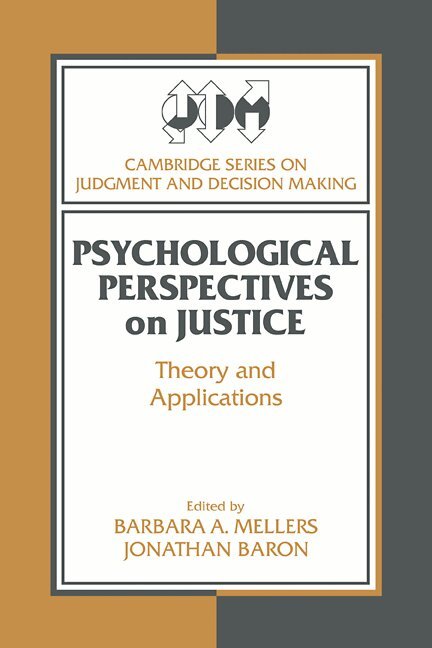
    Psychological Perspectives on Justice

    Theory and Applications

    AvBarbara A. Mellers,Jonathan Baron

    Häftad, Engelska, 2008

    Del i serien Cambridge Series on Judgment and Decision Making

    607 kr

    Beställningsvara. Skickas inom 10-15 vardagar. Fri frakt över 249 kr.

    Beskrivning

    Justice, equity, and fairness are central concerns of everyday life, whether we are assessing the fairness of individual acts, social programmes, or institutional policies. This book explores how the distribution of costs and benefits determine our intuition about fairness and why individual behaviour sometimes deviates from normative theories of justice. To make any comparison, one must first state how fair distributions of resources or burdens should be made. Here, competing theories, such as utilitarianism and economic efficiency, are discussed. The chapters cover many topics including an investigation of various rules and heuristics that people use to make fair distributions; the motivation for people to conform to rules of fairness even when they conflict with self-interest; differences between the views of liberals and conservatives; societal rules for the distribution or allocation of critical or scarce resources; and implications for public policy. This mixture of theoretical and applied perspectives provides a balanced look at the psychology of justice.

    Produktinformation

    • Utgivningsdatum:2008-11-13
    • Mått:152 x 229 x 21 mm
    • Vikt:530 g
    • Format:Häftad
    • Språk:Engelska
    • Serie:Cambridge Series on Judgment and Decision Making
    • Antal sidor:364
    • Förlag:Cambridge University Press
    • ISBN:9780521089982

    Utforska kategorier

    • Psykologi inom Psykologi och pedagogik

    Recensioner i media

    "The present tightly edited volume provides innovative and rigorous additions to this growing body of theoretical and empirical work....although the present volume clearly illustrates the usefulness of a behavioral decision theory in the study of justice, its greatest contribution lies in demonstrating how social goals and strategies, such as the pursuit of justice and fairness influence judgments and decisions about the allocation of valued resources." Terry L. Boles and Charles G. McClintock, Contemporary Psychology

    Innehållsförteckning

    • 1. Introductory remarks; Part I. Psychological Perspectives: 2. Equality as a decision heuristic David Messick; 3. Two insights occasioned by attempts to pin down the equity formula Richard Harris; 4. Judgments of justice Maya Bar-Hillel and Menahem Yaari; Part II. Economic Perspectives: 5. Justice in organised groups: comparing the self-interest and social identity perspectives Tom Tyler and Robyn Dawes; 6. Heuristics and biases in equity judgments: a utilitarian approach Jonathan Baron; 7. Tradeoffs in fairness and preference judgments Lisa Ordoñez and Barbara Mellers; 8. Information, fairness, and efficiency in bargaining Colin Camerer and George Loewenstein; Part III. Variations in Perspectives of Justice: 9. The unfolding of justice: a developmental perspective on reward allocations Colleen Moore, Sheri E. Hembree, and Robert D. Enright; 10. Of Ants and Grasshoppers: the political psychology of allocating scarce resources Linda Skitka and Philip E. Tetlock; 11. Liberal and conservative approaches to justice: conflicting psychopolitical perspectives Philip E. Tetlock and Gregory Mitchell; Part IV. Policy Perspectives: Justice and the allocation of scarce resources Jon Elster; 12. Models of equity in public risk Rakesh Sarin; 13. Fairness of distributions of risks with applications to Antarctica Ivy Broder and Robin Keller; Part V: Postscript.