Cambridge Series on Judgment and Decision Making - Böcker
Visar alla böcker i serien Cambridge Series on Judgment and Decision Making. Handla med fri frakt och snabb leverans.
19 produkter
19 produkter
540 kr
Skickas inom 7-10 vardagar
Justice, equity, and fairness are central concerns of everyday life, whether we are assessing the fairness of individual acts, social programmes, or institutional policies. This book explores how the distribution of costs and benefits determine our intuition about fairness and why individual behaviour sometimes deviates from normative theories of justice. To make any comparison, one must first state how fair distributions of resources or burdens should be made. Here, competing theories, such as utilitarianism and economic efficiency, are discussed. The chapters cover many topics including an investigation of various rules and heuristics that people use to make fair distributions; the motivation for people to conform to rules of fairness even when they conflict with self-interest; differences between the views of liberals and conservatives; societal rules for the distribution or allocation of critical or scarce resources; and implications for public policy. This mixture of theoretical and applied perspectives provides a balanced look at the psychology of justice.
660 kr
Skickas inom 7-10 vardagar
What makes some decisions easy and others difficult? Research in judgment and decision making indicates that conflict plays a decisive role in decision-making processes. The essays in this book address questions about the causes of conflict and its effects on decision making and emotions, particularly (but not only) the emotion of regret. Several chapters address the role of attribute tradeoffs, such as that between money and risk, in the measurement of values for policy purposes. The chapters provide overviews of several research programs and present intriguing data. Methods involve hypothetical scenarios, other questionnaires, interviews, and observations of behavior outside the laboratory. Although most authors are influenced by psychology, others take economic and sociological approaches.
570 kr
Skickas inom 7-10 vardagar
Behavioral decision theory draws on experimental research in cognitive psychology to provide a descriptively accurate model of human behavior. It shows that people systematically violate the normative assumptions of economic rationality by miscalculating probabilities and making choices based on one-economic criteria. Behavioral decision theory's ability to capture the complexity of human judgments and choices makes it a useful foundation for improving public policy analysis, design, and implementation. Originally published in 2001, this volume showcases the research of leading scholars who are working on applications of behavioral decision theory in diverse policy settings. It is designed to give policy analysts and practitioners who are non-psychologists a clearer understanding of the complexities of human judgment and choice, and suggest how to integrate behavioral decision theoretic insights into the policy sciences. This interdisciplinary volume should be insightful and useful wherever people's judgments and choices matter for policy formulation, acceptance, and effectiveness.
570 kr
Skickas inom 7-10 vardagar
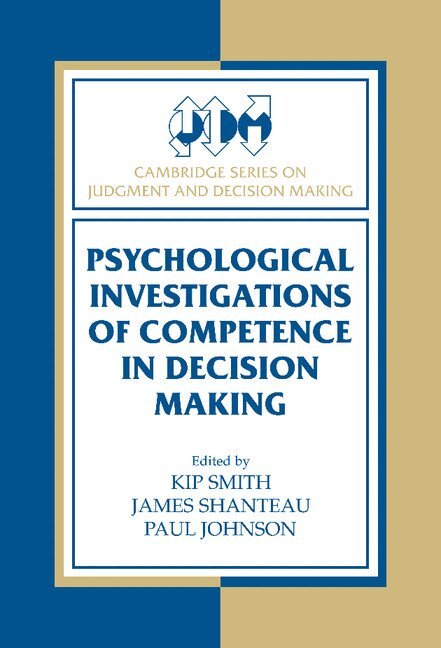
The premise of this book is that most activity in everyday life and work is based on tasks that are novel, infrequent in our experience, or variable with respect to the action to be taken. Such tasks require decisions to be made and actions taken in the face of ambiguous or incomplete information. Time pressure is frequently great and penalties for failure are severe. Examples include investing in markets, controlling industrial accidents, and detecting fraud. The environments in which such tasks occur defy a definition of optimal performance, yet the benefits of successful decision making are considerable. The authors refer to domains without criteria for optimal performance as competency-based and describe the able behaviour of individuals who work in them by the term competence. The chapters examine the propositions that metacognitive processes give structure to otherwise ill-structured tasks and are fundamental enablers of decision-making performance.
1 325 kr
Skickas inom 7-10 vardagar
The study of behavioural decision-making has expanded into the area of accounting and auditing. This branch of research seeks to understand the cognitive processes that govern such necessary functions as the pricing of products and services, evaluating corporate performance, granting credit to prospective borrowers, and investing in financial securities. In Judgment and Decision-Making Research in Accounting and Auditing, editors Robert and Alison Ashton present and review more than twenty years of research in decision-making science. The book analyzes the judgments that business managers, investors, auditors and creditors make daily. It considers the assets and liabilities of applied decision-making, and makes suggestions for future research. Accounting and auditing academics, researchers, practitioners, and students who seek a survey of the field and its applications will find this a solid reference work.
1 339 kr
Skickas inom 7-10 vardagar
Justice, equity, and fairness are central concerns of everyday life, whether we are assessing the fairness of individual acts, social programmes, or institutional policies. This book explores how the distribution of costs and benefits determine our intuition about fairness and why individual behaviour sometimes deviates from normative theories of justice. To make any comparison, one must first state how fair distributions of resources or burdens should be made. Here, competing theories, such as utilitarianism and economic efficiency, are discussed. The chapters cover many topics including an investigation of various rules and heuristics that people use to make fair distributions; the motivation for people to conform to rules of fairness even when they conflict with self-interest; differences between the views of liberals and conservatives; societal rules for the distribution or allocation of critical or scarce resources; and implications for public policy. This mixture of theoretical and applied perspectives provides a balanced look at the psychology of justice.
624 kr
Skickas inom 7-10 vardagar
Inside the Juror presents the most interesting and sophisticated work to date on juror decision making from several traditions - social psychology, behavioural decision theory, cognitive psychology, and behavioural modeling. The authors grapple with crucial questions, such as: why do jurors who hear the same evidence and arguments in the courtroom enter the jury room with disagreements about the proper verdict? how do biases and prejudices affect jurors' decisions? and just how 'rational' is the typical juror? As an introduction to the scientific study of juror decision making in criminal trials, Inside the Juror provides a comprehensive and understandable summary of the major theories of juror decision making and the research that has been conducted to evaluate their validity.
Research on Judgment and Decision Making
Currents, Connections, and Controversies
Häftad, Engelska, 1997
940 kr
Skickas inom 7-10 vardagar
This book offers an overview of recent research on the psychology of judgment and decision making, the field which investigates the processes by which people draw conclusions, reach evaluations, and make choices. An introductory, historically oriented chapter provides a way of viewing the overall structure of the field, its recent trends, and its possible directions. Subsequent sections present significant recent papers by prominent researchers, organized to reveal the currents, connections, and controversies that animate the field. Current trends in the field are illustrated with papers from ongoing streams of research. The papers on 'connections' explore memory, explanation, and argument, affect, attitudes, and motivation. Finally, a section on 'controversies' presents problem representation, domain knowledge, content specificity, rule-governed versus rule-described behavior, and proposals for radical departures and new beginnings in the field.
606 kr
Skickas inom 7-10 vardagar
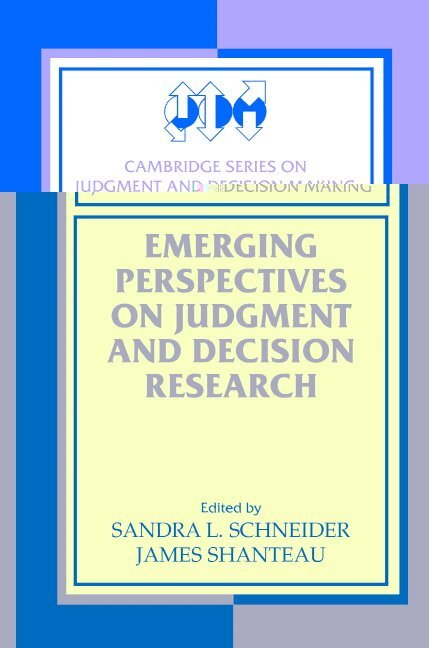
The 'Emerging Perspectives' offers answers by a top group of experts to the question, 'Where is judgment and decision research heading as we forge into the 21st century?' The chapters represent perspectives developed by some of the most innovative thinkers in the field. The book is organized around five themes: Fortifying traditional models of decision making - looking at traditional topics in new ways; Elaborating cognitive processes in decision making - exploring the interplay between decision research and cognitive psychology; Integrating affect and motivation in decision making - relating how affect/motivation interact with decision making; Understanding social and cultural influences on decision making - recognizing the importance of social and cultural context on decisions; Facing the challenge of real-world complexity in decision research - seeing the challenges, and rewards, of research outside the laboratory. The book concludes with a Commentary based on an analysis and synthesis of the new ideas presented here.
496 kr
Skickas inom 7-10 vardagar
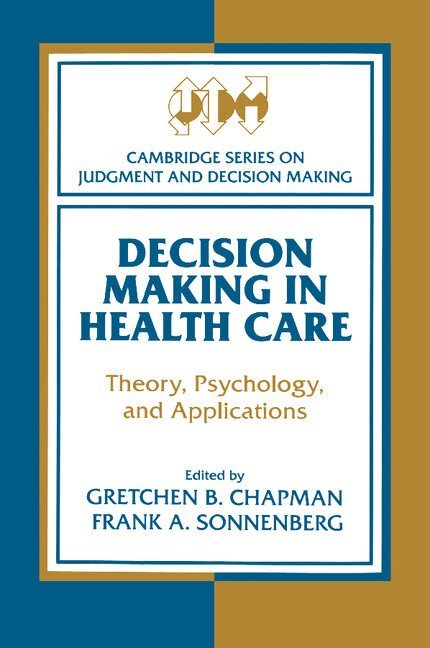
Decision making is a crucial element in the field of medicine. The physician has to determine what is wrong with the patient and recommend treatment, while the patient has to decide whether or not to seek medical care, and go along with the treatment recommended by the physician. Health policy makers and health insurers have to decide what to promote, what to discourage, and what to pay for. Together, these decisions determine the quality of health care that is provided. Decision Making in Health Care, first published in 2000, is a comprehensive overview of the field of medical decision making - a rapidly expanding field that includes quantitative theoretical tools for modeling decisions, psychological research on how decisions are actually made, and applied research on how physician and patient decision making can be improved.
1 286 kr
Skickas inom 7-10 vardagar
The premise of this book is that most activity in everyday life and work is based on tasks that are novel, infrequent in our experience, or variable with respect to the action to be taken. Such tasks require decisions to be made and actions taken in the face of ambiguous or incomplete information. Time pressure is frequently great and penalties for failure are severe. Examples include investing in markets, controlling industrial accidents, and detecting fraud. The environments in which such tasks occur defy a definition of optimal performance, yet the benefits of successful decision making are considerable. The authors refer to domains without criteria for optimal performance as competency-based and describe the able behaviour of individuals who work in them by the term competence. The chapters examine the propositions that metacognitive processes give structure to otherwise ill-structured tasks and are fundamental enablers of decision-making performance.
902 kr
Skickas inom 7-10 vardagar
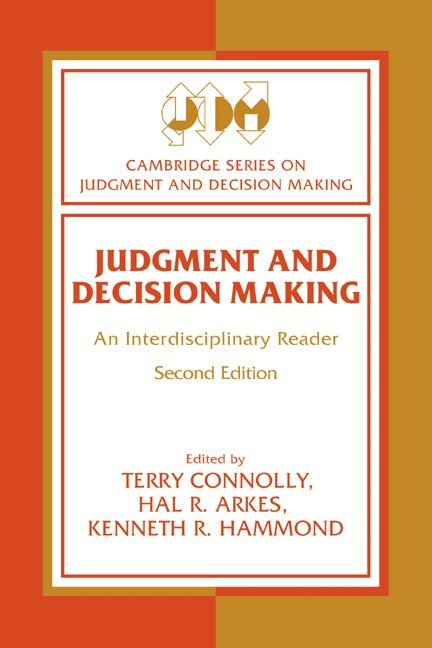
Researchers in a growing number of fields - public policy, law, business, medicine, psychology, engineering, and others - are working to understand and improve human judgment and decision making. This book, which presupposes no formal training, brings together a selection of key articles in the area, with careful organization, introduction and commentaries. Issues involving medical diagnosis, weather forecasting, labor negotiations, risk, public policy, business strategy, eyewitnesses, jury decisions issues, and more are treated in this largely expanded volume, indicating the variety of problems - and scope in judgment and decision making. This is a revision of Arkes and Hammond's 1986 collection of papers on judgment and decision making. Updated and extended, the focus of this volume is interdisciplinary and applied. The papers selected are scientific in nature, but chosen specifically to appeal to the scholar, student and layperson alike.
1 414 kr
Skickas inom 7-10 vardagar
Behavioral decision theory draws on experimental research in cognitive psychology to provide a descriptively accurate model of human behavior. It shows that people systematically violate the normative assumptions of economic rationality by miscalculating probabilities and making choices based on one-economic criteria. Behavioral decision theory's ability to capture the complexity of human judgments and choices makes it a useful foundation for improving public policy analysis, design, and implementation. Originally published in 2001, this volume showcases the research of leading scholars who are working on applications of behavioral decision theory in diverse policy settings. It is designed to give policy analysts and practitioners who are non-psychologists a clearer understanding of the complexities of human judgment and choice, and suggest how to integrate behavioral decision theoretic insights into the policy sciences. This interdisciplinary volume should be insightful and useful wherever people's judgments and choices matter for policy formulation, acceptance, and effectiveness.
1 318 kr
Skickas inom 7-10 vardagar
This exciting volume marks the birth of a new field, one which attempts to study law with reference to an accurate understanding of human behavior. It reports new findings in cognitive psychology which show that people are frequently both unselfish and over-optimistic; that people have limited willpower and limited self-control; and that people are 'boundedly' rational, in the sense that they have limited information-processing powers, and frequently rely on mental short-cuts and rules of thumb. Understanding this behavior has large-scale implications for the analysis of law, in areas including environmental protection, taxation, constitutional law, voting behavior, punitive damages for civil rights violations, labor negotiations, and corporate finance. With a better knowledge of human behavior, it is possible to predict the actual effects of law, to see how law can promote society's goals, and to reassess the questions of what law should be doing.
441 kr
Skickas inom 7-10 vardagar
The study of behavioural decision-making has expanded into the area of accounting and auditing. This branch of research seeks to understand the cognitive processes that govern such necessary functions as the pricing of products and services, evaluating corporate performance, granting credit to prospective borrowers, and investing in financial securities. In Judgment and Decision-Making Research in Accounting and Auditing, editors Robert and Alison Ashton present and review more than twenty years of research in decision-making science. The book analyzes the judgments that business managers, investors, auditors and creditors make daily. It considers the assets and liabilities of applied decision-making, and makes suggestions for future research. Accounting and auditing academics, researchers, practitioners, and students who seek a survey of the field and its applications will find this a solid reference work.
524 kr
Skickas inom 7-10 vardagar
This exciting volume marks the birth of a new field, one which attempts to study law with reference to an accurate understanding of human behavior. It reports new findings in cognitive psychology which show that people are frequently both unselfish and over-optimistic; that people have limited willpower and limited self-control; and that people are 'boundedly' rational, in the sense that they have limited information-processing powers, and frequently rely on mental short-cuts and rules of thumb. Understanding this behavior has large-scale implications for the analysis of law, in areas including environmental protection, taxation, constitutional law, voting behavior, punitive damages for civil rights violations, labor negotiations, and corporate finance. With a better knowledge of human behavior, it is possible to predict the actual effects of law, to see how law can promote society's goals, and to reassess the questions of what law should be doing.
1 414 kr
Skickas inom 7-10 vardagar
What makes some decisions easy and others difficult? Research in judgment and decision making indicates that conflict plays a decisive role in decision-making processes. The essays in this book address questions about the causes of conflict and its effects on decision making and emotions, particularly (but not only) the emotion of regret. Several chapters address the role of attribute tradeoffs, such as that between money and risk, in the measurement of values for policy purposes. The chapters provide overviews of several research programs and present intriguing data. Methods involve hypothetical scenarios, other questionnaires, interviews, and observations of behavior outside the laboratory. Although most authors are influenced by psychology, others take economic and sociological approaches.
1 427 kr
Skickas inom 7-10 vardagar
The 'Emerging Perspectives' offers answers by a top group of experts to the question, 'Where is judgment and decision research heading as we forge into the 21st century?' The chapters represent perspectives developed by some of the most innovative thinkers in the field. The book is organized around five themes: Fortifying traditional models of decision making - looking at traditional topics in new ways; Elaborating cognitive processes in decision making - exploring the interplay between decision research and cognitive psychology; Integrating affect and motivation in decision making - relating how affect/motivation interact with decision making; Understanding social and cultural influences on decision making - recognizing the importance of social and cultural context on decisions; Facing the challenge of real-world complexity in decision research - seeing the challenges, and rewards, of research outside the laboratory. The book concludes with a Commentary based on an analysis and synthesis of the new ideas presented here.
672 kr
Skickas inom 7-10 vardagar
Decision making in organizations is often pictured as a coherent and rational process in which alternative interests and perspectives are considered in an orderly manner until the optimal alternative is selected. Yet, as many members of organizations have discovered from their own experience, real decision processes in organizations only seldom fit such a description. This book brings together researchers who focus on cognitive aspects of decision processes, on the one hand, and those who study organizational aspects such as conflict, incentives, power, and ambiguity, on the other. It draws from the tradition of Herbert Simon, who studied organizational decision making's pervasive use of bounded rationality and heuristics of reasoning. These multiple perspectives may further our understanding of organizational decision making. Organizational Decision Making is particularly well suited for students and faculties of business, psychology, and public administration.