• Fri frakt över 249 kr
  • •
  • Snabba leveranser
  • •
  • Billiga böcker
Kundservice

Du är på sajten för privatpersoner.

Företag, bibliotek eller offentlig verksamhet?

Du handlar på classic.bokus.com, där alla dina funktioner finns intakta.
Till classic.bokus.com
Bokus logotyp. Gå till startsidan.
  • Erbjudanden
  • Nyheter
  • Student
  • Topplistor
  • Barn & ungdom
  • Bokus Play
  • E-böcker
  • Pocketböcker
  • Spel & pussel

10% studentrabatt med kod TERM26

Sidfot

Mina sidor

    Hjälp

    • Kundservice
    • Vanliga frågor och svar
    • Frakt och leverans
    • Retur vid ångerrätt
    • Reklamera vara
    • Betalning
    • Köpvillkor
    • Allmänna villkor
    • Information om webbplatsens tillgänglighet

    Om Bokus

    • Om oss
    • Pressrum
    • För studenter
    • För företag
    • För bibliotek och offentlig verksamhet
    • För leverantörer
    • Hållbarhet

    Populärt

    • Aktuella erbjudanden
    • Presentkort
    • Studentlitteratur
    • Nya böcker
    • Topplistor
    • Signerade böcker
    • Engelska böcker

    Inspiration

    • Boktips
    • BookTok
    • Populära bokserier
    • Barnbokskaraktärer
    • Populära författare
    Logotyp för Bokus
    Följ oss på Facebook (extern länk)Följ oss på Instagram (extern länk)Följ oss på YouTube (extern länk)Följ oss på TikTok (extern länk)
    bokus @ CookiesAnpassa cookiesIntegritetspolicyKöpvillkor
    Till Citymail hemsida (extern länk)Till Budbee hemsida (extern länk)Till Postnord hemsida (extern länk)Till Schenker hemsida (extern länk)Till Early Bird hemsida (extern länk)Till Walleys hemsida (extern länk)
    1. Historia och arkeologi
    2. Historia
    3. Europas historia

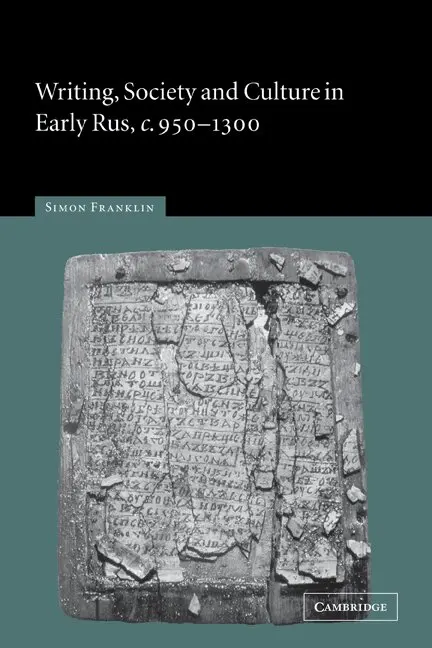
    Writing, Society and Culture in Early Rus, c.950-1300

    AvSimon Franklin

    Häftad, Engelska, 2010

    684 kr

    Beställningsvara. Skickas inom 10-15 vardagar. Fri frakt över 249 kr.

    Fler format och utgåvor

    Inbunden

    1 582 kr

    Beskrivning

    This book provides a thorough survey and analysis of the emergence and functions of written culture in Rus (covering roughly the modern East Slav lands of European Russia, Ukraine and Belarus). Part I introduces the full range of types of writing: the scripts and languages, the materials, the social and physical contexts, ranging from builders' scratches on bricks through to luxurious parchment manuscripts. Part II presents a series of thematic studies of the 'socio-cultural dynamics' of writing, in order to reveal and explain distinctive features in the Rus assimilation of the technology. The comparative approach means that the book may also serve as a case-study for those with a broader interest either in medieval uses of writing or in the social and cultural history of information technologies. Overall, the impressive scholarship and idiosyncratic wit of this volume commend it to students and specialists in Russian history and literature alike. Awarded the Alec Nove Prize, given by the British Association for Slavonic and East European Studies for the best book of 2002 in Russian, Soviet or Post-Soviet studies.

    Produktinformation

    • Utgivningsdatum:2010-02-04
    • Mått:140 x 216 x 20 mm
    • Vikt:450 g
    • Format:Häftad
    • Språk:Engelska
    • Antal sidor:356
    • Förlag:Cambridge University Press
    • ISBN:9780521129022

    Utforska kategorier

    • Europas historia inom Historia och arkeologi

    Mer om författaren

    Simon Franklin is a Reader in Slavonic Studies in the University of Cambridge and a Fellow of Clare College, Cambridge.

    Recensioner i media

    Review of the hardback: 'Written with wit and style as well as great erudition, Franklin's book breaks new ground … the virtual tour that Franklin constructs of a Kievan church combines all his gifts as historian, reader, and observer. The result is a spellbinding performance that brings Franklin's own reader as close as possible to reading the world through they eyes of a Kievan.' Medium Aevum

    Innehållsförteckning

    • Part I. The Graphic Environment: 1. The written remains; 2. Scripts and languages; 3. The changing environment; Part II. Functions and Perceptions of Writing: 4. Writing and social organisation; 5. Writing and learning; 6. Writing and pictures; 7. Writing and magic; 8. Afterword: on the social and cultural dynamics of writing.