• Fri frakt över 249 kr
  • •
  • Snabba leveranser
  • •
  • Billiga böcker
Kundservice

Du är på sajten för privatpersoner.

Företag, bibliotek eller offentlig verksamhet?

Du handlar på classic.bokus.com, där alla dina funktioner finns intakta.
Till classic.bokus.com
Bokus logotyp. Gå till startsidan.
  • Erbjudanden
  • Student
  • Topplistor
  • Barn & ungdom
  • Bokus Play
  • E-böcker
  • Ljudböcker
  • Pocketböcker
  • Spel & pussel

Upp till 25% på utvalda nyheter →

Sidfot

Mina sidor

    Hjälp

    • Kundservice
    • Vanliga frågor och svar
    • Frakt och leverans
    • Retur vid ångerrätt
    • Reklamera vara
    • Betalning
    • Köpvillkor
    • Allmänna villkor
    • Information om webbplatsens tillgänglighet

    Om Bokus

    • Om oss
    • Pressrum
    • För studenter
    • För företag
    • För bibliotek och offentlig verksamhet
    • För leverantörer
    • Hållbarhet

    Populärt

    • Aktuella erbjudanden
    • Presentkort
    • Studentlitteratur
    • Nya böcker
    • Topplistor
    • Signerade böcker
    • Engelska böcker

    Inspiration

    • Boktips
    • BookTok
    • Populära bokserier
    • Barnbokskaraktärer
    • Populära författare
    Logotyp för Bokus
    Följ oss på Facebook (extern länk)Följ oss på Instagram (extern länk)Följ oss på YouTube (extern länk)Följ oss på TikTok (extern länk)
    bokus @ CookiesAnpassa cookiesIntegritetspolicyKöpvillkor
    Till Citymail hemsida (extern länk)Till Budbee hemsida (extern länk)Till Postnord hemsida (extern länk)Till Schenker hemsida (extern länk)Till Early Bird hemsida (extern länk)Till Walleys hemsida (extern länk)
    1. Samhälle och politik
    2. Politik och statsskick
    3. Statsvetenskap och politisk teori

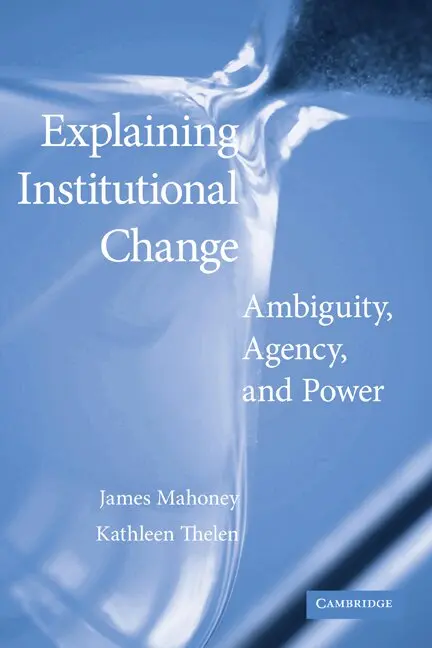
    Explaining Institutional Change

    Ambiguity, Agency, and Power

    AvJames Mahoney,Kathleen Thelen

    Häftad, Engelska, 2009

    328 kr

    Beställningsvara. Skickas inom 7-10 vardagar. Fri frakt över 249 kr.

    Beskrivning

    This book contributes to emerging debates in political science and sociology on institutional change. Its introductory essay proposes a new framework for analyzing incremental change that is grounded in a power-distributional view of institutions and that emphasizes ongoing struggles within but also over prevailing institutional arrangements. Five empirical essays then bring the general theory to life by evaluating its causal propositions in the context of sustained analyses of specific instances of incremental change. These essays range widely across substantive topics and across times and places, including cases from the United States, Africa, Latin America, and Asia. The book closes with a chapter reflecting on the possibilities for productive exchange in the analysis of change among scholars associated with different theoretical approaches to institutions.

    Produktinformation

    • Utgivningsdatum:2009-10-30
    • Mått:153 x 228 x 15 mm
    • Vikt:410 g
    • Format:Häftad
    • Språk:Engelska
    • Antal sidor:254
    • Förlag:Cambridge University Press
    • ISBN:9780521134323

    Utforska kategorier

    • Statsvetenskap och politisk teori inom Samhälle och politik

    Mer om författaren

    James Mahoney is a Professor of Political Science and sociology at Northwestern University. He is the author of The Legacies of Liberalism: Path Dependence and Political Regimes in Central America (2001), which received the Barrington Moore Jr. Prize of the Comparative and Historical Section of the American Sociological Association. He is also coeditor of Comparative Historical Analysis in the Social Sciences (Cambridge, 2003), which received the Giovanni Sartori Book Award of the Qualitative Methods Section of the American Political Science Association. His most recent book is Colonialism and Postcolonial Development: Spanish America in Comparative Perspective (Cambridge, 2010). Kathleen Thelen is Ford Professor of Political Science at the Massachusetts Institute of Technology. She also holds appointments at the Max Planck Institute for the Study of Societies in Germany and at Oxford University, and she is an elected member of the Berlin-Brandenburg Academy of Sciences and Humanities. She is the author, most recently, of How Institutions Evolve (Cambridge University Press, 2004), co-winner of the Woodrow Wilson Foundation Award of the American Political Science Association, and winner of the Mattei Dogan Award of the Society for Comparative Research. She has served as Chair of the Council for European Studies (Columbia University), as President of the Politics and History Section of the American Political Science Association, and as President of the Society for the Advancement of Socio-Economics.

    Recensioner i media

    'Explaining Institutional Change is, simply put, the best guide available to the incremental processes of institutional change that characterize so much of social and political life. Mahoney and Thelen have not only assembled an impressive and illuminating collection of essays showing how and why institutional change plays out as it does in a range of important domains (including a reflection on the field by Peter Hall that would make the book worth having even if it were the only chapter). With their own powerful synthesis of theories of incremental institutional change, they also break important new ground in institutional analysis.' Jacob S. Hacker, Yale University

    Innehållsförteckning

    • 1. A theory of gradual institutional change James Mahoney and Kathleen Thelen; 2. Infiltrating the state: the evolution of health care reforms in Brazil, 1964–88 Tulia G. Falleti; 3. The contradictory potential of institutions: the rise and decline of land documentation in Kenya Ato Kwamena Onoma; 4. Policymaking as political constraint: institutional development in the US social security program Alan M. Jacobs; 5. Altering authoritarianism: institutional complexity and autocratic agency in Indonesia Dan Slater; 6. Rethinking rules: creativity and constraint in the house of representatives Adam Sheingate; 7. Historical institutionalism in rationalist and sociological perspective Peter A. Hall.