• Fri frakt över 249 kr
  • •
  • Snabba leveranser
  • •
  • Billiga böcker
Kundservice

Du är på sajten för privatpersoner.

Företag, bibliotek eller offentlig verksamhet?

Du handlar på classic.bokus.com, där alla dina funktioner finns intakta.
Till classic.bokus.com
Bokus logotyp. Gå till startsidan.
  • Erbjudanden
  • Nyheter
  • Student
  • Topplistor
  • Barn & ungdom
  • Bokus Play
  • E-böcker
  • Pocketböcker
  • Spel & pussel

10% rabatt på allt med kod: NYSTART10 →

Sidfot

Mina sidor

    Hjälp

    • Kundservice
    • Vanliga frågor och svar
    • Frakt och leverans
    • Retur vid ångerrätt
    • Reklamera vara
    • Betalning
    • Köpvillkor
    • Allmänna villkor
    • Information om webbplatsens tillgänglighet

    Om Bokus

    • Om oss
    • Pressrum
    • För studenter
    • För företag
    • För bibliotek och offentlig verksamhet
    • För leverantörer
    • Hållbarhet

    Populärt

    • Aktuella erbjudanden
    • Presentkort
    • Studentlitteratur
    • Nya böcker
    • Topplistor
    • Signerade böcker
    • Engelska böcker

    Inspiration

    • Boktips
    • BookTok
    • Populära bokserier
    • Barnbokskaraktärer
    • Populära författare
    Logotyp för Bokus
    Följ oss på Facebook (extern länk)Följ oss på Instagram (extern länk)Följ oss på YouTube (extern länk)Följ oss på TikTok (extern länk)
    bokus @ CookiesAnpassa cookiesIntegritetspolicyKöpvillkor
    Till Citymail hemsida (extern länk)Till Budbee hemsida (extern länk)Till Postnord hemsida (extern länk)Till Schenker hemsida (extern länk)Till Early Bird hemsida (extern länk)Till Walleys hemsida (extern länk)
    1. Samhälle och politik
    2. Politik och statsskick

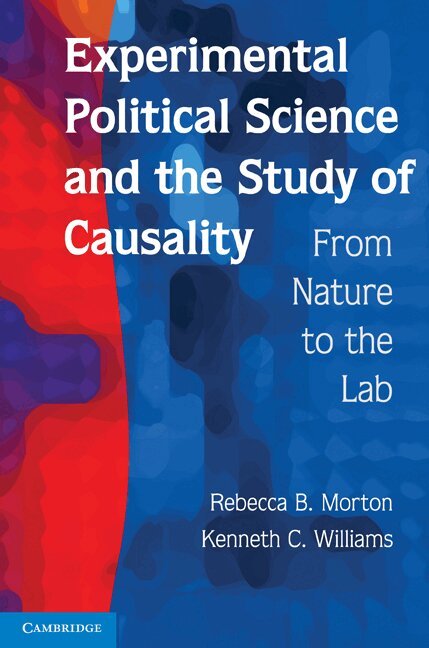
    Experimental Political Science and the Study of Causality

    From Nature to the Lab

    AvRebecca B. Morton,Kenneth C. Williams

    Häftad, Engelska, 2010

    623 kr

    Beställningsvara. Skickas inom 10-15 vardagar. Fri frakt över 249 kr.

    Fler format och utgåvor

    Inbunden

    1 536 kr

    Beskrivning

    Increasingly, political scientists use the term 'experiment' or 'experimental' to describe their empirical research. One of the primary reasons for doing so is the advantage of experiments in establishing causal inferences. In this book, Rebecca B. Morton and Kenneth C. Williams discuss in detail how experiments and experimental reasoning with observational data can help researchers determine causality. They explore how control and random assignment mechanisms work, examining both the Rubin causal model and the formal theory approaches to causality. They also cover general topics in experimentation such as the history of experimentation in political science; internal and external validity of experimental research; types of experiments - field, laboratory, virtual, and survey - and how to choose, recruit, and motivate subjects in experiments. They investigate ethical issues in experimentation, the process of securing approval from institutional review boards for human subject research, and the use of deception in experimentation.

    Produktinformation

    • Utgivningsdatum:2010-08-06
    • Mått:147 x 229 x 41 mm
    • Vikt:910 g
    • Format:Häftad
    • Språk:Engelska
    • Antal sidor:608
    • Förlag:Cambridge University Press
    • ISBN:9780521136488
    • Utmärkelser:Best Book Award from the Experimental Research section of the American Political Science Association 2011

    Utforska kategorier

    • Politik och statsskick inom Samhälle och politik

    Mer om författaren

    Rebecca B. Morton is a Professor in the Wilf Family Department of Politics at New York University. She received her Ph.D. from Tulane University and has held academic positions at Tulane, Texas A & M University, University of Iowa, University of California San Diego, and University of Houston. She was a Visiting Scholar at the Center for the Study of Democratic Politics at the Woodrow Wilson School at Princeton University, the Russell Sage Foundation, and the Hanse-Wissenschaftkolleg in Delmenhorst, Germany. Her book Learning by Voting: Sequential Choices in Presidential Primaries and Other Elections (with Kenneth Williams, 2001) addresses the effects of voting sequentially, as in presidential primaries in the United States. Her more recent book, Analyzing Elections (2006), is a comprehensive study of the American electoral process. Morton also considered the complexity of empirical evaluation of formal models in her book Methods and Models: A Guide to the Empirical Analysis of Formal Models in Political Science (Cambridge University Press, 1999). Her research has appeared in the American Economic Review, the American Journal of Political Science, the American Political Science Review, the Journal of Law and Economics, the Review of Economics and Statistics, and the Review of Economic Studies. Kenneth C. Williams is currently a Professor of Political Science at Michigan State University. He received his Ph.D. from the University of Texas at Austin and did a postdoctoral fellowship at Massachusetts Institute of Technology. He was a Visiting Professor at the University of California at Santa Barbara and also taught several summer courses at Birkbeck, University of London. He has published articles in the American Political Science Review, the American Journal of Political Science, Experimental Economics, Economics and Politics, the Journal of Theoretical Politics, and Public Choice. He is also co-author of Learning by Voting (with Rebecca Morton, 2001).

    Recensioner i media

    'This is a landmark contribution - not only in what it offers for experimentalists but for social science in general. Morton and Williams present a distinctive approach to how to conduct research that is sure to be widely discussed and debated.' James N. Druckman, Northwestern University

    Innehållsförteckning

    • Part I. Introduction: 1. The advent of experimental political science; Part II. Experimental Reasoning about Causality: 2. Experiments and causal relations; 3. The causal inference problem and the Rubin causal model; 4. Controlling observables and unobservables; 5. Randomization and pseudo-randomization; 6. Formal theory and causality; Part III. What Makes a Good Experiment?: 7. Validity and experimental manipulations; 8. Location, artificiality, and related design issues; 9. Choosing subjects; 10. Subjects' motivations; 11. History of codes of ethics and human subjects research; 12. Ethical decision making and political science experiments; 13. Deception in experiments; 14. The future of experimental political science; 15. Appendix: the experimentalist's to do list.