Rebecca B. Morton - Böcker
Visar alla böcker från författaren Rebecca B. Morton. Handla med fri frakt och snabb leverans.
6 produkter
6 produkter
372 kr
Tillfälligt slut
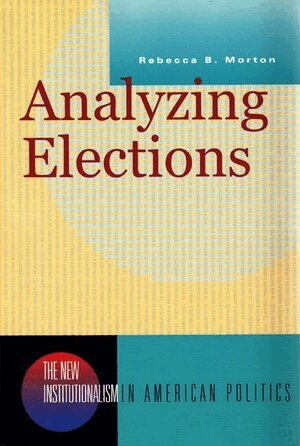
It begins by examining the roles of the basic actors in elections—voters, candidates, parties and interest groups—and the institutional process through which the actors move. The analytical techniques presented in the first part of the book are then applied to questions about the effects of money and the mass media on electoral outcomes, the extent to which elections can control errant officials, and the problems of measuring public opinion and preferences. Special attention is devoted to the unique issues involved in the congressional redistricting as well as presidential primaries and the Electoral College. The analysis is extended to consider the roles played my minor party and independent candidates and the problems minorities face in achieving representation in the American electoral process.
Learning by Voting
Sequential Choices in Presidential Primaries and Other Elections
Inbunden, Engelska, 2001
1 159 kr
Skickas
The presidential primary season used to be a long sequence of elections. In recent years many states have moved their presidential primaries earlier in the year in the belief that this increases their influence over the choice of presidential nominees. Similarly, in the past most voters have gone to a polling place and voted on election day. Now an increasing number of voters are not voting on election day but are using mail-in or absentee ballots to vote, often weeks before other voters.Does the movement to a large number of early presidential primaries reduce the ability of voters to learn about the candidates? Do voters who vote early miss important information by not following the entire campaign, or are they, as some argue, more partisan? In a unique study Rebecca B. Morton and Kenneth C. Williams investigate the impact these changes have on the choices voters make. The authors combine a formal, theoretical model to derive hypotheses with experiments, elections conducted in labs, to test the hypotheses.Their analysis finds that sequence in voting does matter. In simultaneous voting elections well-known candidates are more likely to win, even if that candidate is the first preference of only a minority of the voters and would be defeated by another candidate, if that candidate were better known. These results support the concerns of policy makers that front-loaded primaries prevent voters from learning during the primary process. The authors also find evidence that in sequential elections those who vote on election day have the benefit of information received throughout the whole course of the campaign, thus supporting concerns with mail-in ballots and other early balloting procedures.This book will interest scholars interested in elections, the design of electoral systems, and voting behavior as well as the use of formal modeling and experiments in the study of politics. It is written in a manner that can be easily read by those in the public concerned with presidential elections and voting.Rebecca B. Morton is Associate Professor of Political Science, University of Iowa. Kenneth C. Williams is Associate Professor of Political Science, Michigan State University.
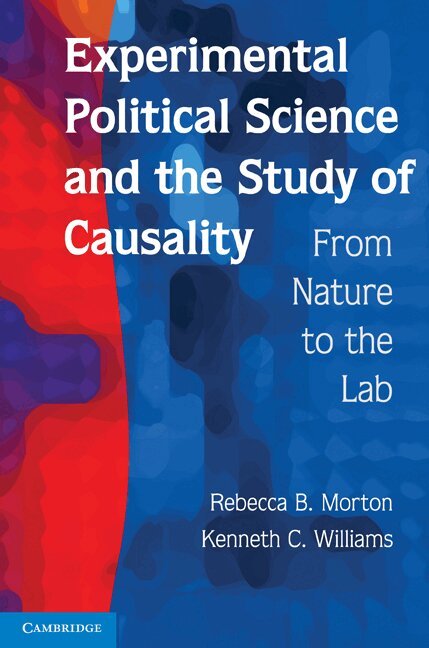
Experimental Political Science and the Study of Causality
From Nature to the Lab
Häftad, Engelska, 2010
586 kr
Skickas inom 7-10 vardagar
Increasingly, political scientists use the term 'experiment' or 'experimental' to describe their empirical research. One of the primary reasons for doing so is the advantage of experiments in establishing causal inferences. In this book, Rebecca B. Morton and Kenneth C. Williams discuss in detail how experiments and experimental reasoning with observational data can help researchers determine causality. They explore how control and random assignment mechanisms work, examining both the Rubin causal model and the formal theory approaches to causality. They also cover general topics in experimentation such as the history of experimentation in political science; internal and external validity of experimental research; types of experiments - field, laboratory, virtual, and survey - and how to choose, recruit, and motivate subjects in experiments. They investigate ethical issues in experimentation, the process of securing approval from institutional review boards for human subject research, and the use of deception in experimentation.
Experimental Political Science and the Study of Causality
From Nature to the Lab
Inbunden, Engelska, 2010
1 442 kr
Skickas inom 7-10 vardagar
Increasingly, political scientists use the term 'experiment' or 'experimental' to describe their empirical research. One of the primary reasons for doing so is the advantage of experiments in establishing causal inferences. In this book, Rebecca B. Morton and Kenneth C. Williams discuss in detail how experiments and experimental reasoning with observational data can help researchers determine causality. They explore how control and random assignment mechanisms work, examining both the Rubin causal model and the formal theory approaches to causality. They also cover general topics in experimentation such as the history of experimentation in political science; internal and external validity of experimental research; types of experiments - field, laboratory, virtual, and survey - and how to choose, recruit, and motivate subjects in experiments. They investigate ethical issues in experimentation, the process of securing approval from institutional review boards for human subject research, and the use of deception in experimentation.
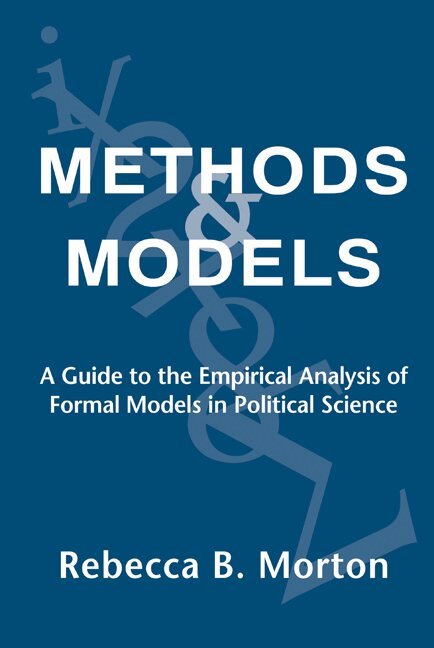
Methods and Models
A Guide to the Empirical Analysis of Formal Models in Political Science
Inbunden, Engelska, 1999
1 034 kr
Skickas inom 7-10 vardagar
At present much of political science consists of a large body of formal mathematical work that remains largely unexplored empirically and an expanding use of sophisticated statistical techniques. While there are examples of noteworthy efforts to bridge the gap between these, there is still a need for much more cooperative work between formal theorists and empirical researchers in the discipline. This book explores how empirical analysis has, can, and should be used to evaluate formal models in political science. The book is intended to be a guide for active and future political scientists who are confronting the issues of empirical analysis with formal models in their work and as a basis for a needed dialogue between empirical and formal theoretical researchers in political science. These developments, if combined, are potentially a basis for a new revolution in political science.
Methods and Models
A Guide to the Empirical Analysis of Formal Models in Political Science
Häftad, Engelska, 1999
372 kr
Skickas inom 7-10 vardagar
At present much of political science consists of a large body of formal mathematical work that remains largely unexplored empirically and an expanding use of sophisticated statistical techniques. While there are examples of noteworthy efforts to bridge the gap between these, there is still a need for much more cooperative work between formal theorists and empirical researchers in the discipline. This book explores how empirical analysis has, can, and should be used to evaluate formal models in political science. The book is intended to be a guide for active and future political scientists who are confronting the issues of empirical analysis with formal models in their work and as a basis for a needed dialogue between empirical and formal theoretical researchers in political science. These developments, if combined, are potentially a basis for a new revolution in political science.