• Fri frakt över 249 kr
  • •
  • Snabba leveranser
  • •
  • Billiga böcker
Kundservice

Du är på sajten för privatpersoner.

Företag, bibliotek eller offentlig verksamhet?

Du handlar på classic.bokus.com, där alla dina funktioner finns intakta.
Till classic.bokus.com
Bokus logotyp. Gå till startsidan.
  • Erbjudanden
  • Nyheter
  • Student
  • Topplistor
  • Barn & ungdom
  • Bokus Play
  • E-böcker
  • Pocketböcker
  • Spel & pussel

10% rabatt på allt med kod: NYSTART10 →

Sidfot

Mina sidor

    Hjälp

    • Kundservice
    • Vanliga frågor och svar
    • Frakt och leverans
    • Retur vid ångerrätt
    • Reklamera vara
    • Betalning
    • Köpvillkor
    • Allmänna villkor
    • Information om webbplatsens tillgänglighet

    Om Bokus

    • Om oss
    • Pressrum
    • För studenter
    • För företag
    • För bibliotek och offentlig verksamhet
    • För leverantörer
    • Hållbarhet

    Populärt

    • Aktuella erbjudanden
    • Presentkort
    • Studentlitteratur
    • Nya böcker
    • Topplistor
    • Signerade böcker
    • Engelska böcker

    Inspiration

    • Boktips
    • BookTok
    • Populära bokserier
    • Barnbokskaraktärer
    • Populära författare
    Logotyp för Bokus
    Följ oss på Facebook (extern länk)Följ oss på Instagram (extern länk)Följ oss på YouTube (extern länk)Följ oss på TikTok (extern länk)
    bokus @ CookiesAnpassa cookiesIntegritetspolicyKöpvillkor
    Till Citymail hemsida (extern länk)Till Budbee hemsida (extern länk)Till Postnord hemsida (extern länk)Till Schenker hemsida (extern länk)Till Early Bird hemsida (extern länk)Till Walleys hemsida (extern länk)
    1. Samhälle och politik
    2. Politik och statsskick
    3. Statsvetenskap och politisk teori

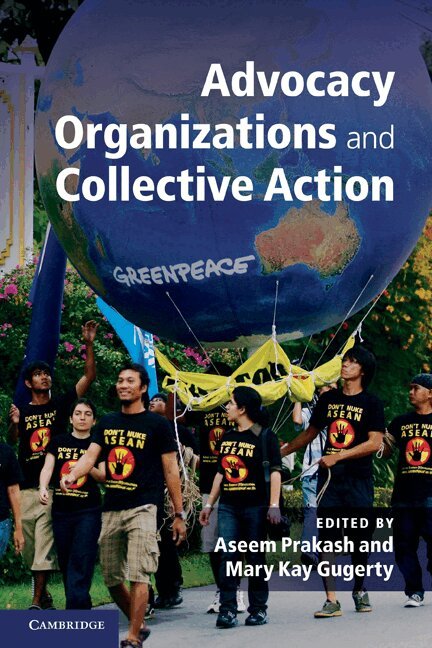
    Advocacy Organizations and Collective Action

    AvAseem Prakash,Mary Kay Gugerty

    Häftad, Engelska, 2010

    443 kr

    . Fri frakt över 249 kr.

    Beskrivning

    Advocacy organizations are viewed as actors motivated primarily by principled beliefs. This volume outlines a new agenda for the study of advocacy organizations, proposing a model of NGOs as collective actors that seek to fulfil normative concerns and instrumental incentives, face collective action problems, and compete as well as collaborate with other advocacy actors. The analogy of the firm is a useful way of studying advocacy actors because individuals, via advocacy NGOs, make choices which are analytically similar to those that shareholders make in the context of firms. The authors view advocacy NGOs as special types of firms that make strategic choices in policy markets which, along with creating public goods, support organizational survival, visibility, and growth. Advocacy NGOs' strategy can therefore be understood as a response to opportunities to supply distinct advocacy products to well-defined constituencies, as well as a response to normative or principled concerns.

    Produktinformation

    • Utgivningsdatum:2010-11-25
    • Mått:152 x 226 x 15 mm
    • Vikt:530 g
    • Format:Häftad
    • Språk:Engelska
    • Antal sidor:336
    • Förlag:Cambridge University Press
    • ISBN:9780521139670

    Utforska kategorier

    • Statsvetenskap och politisk teori inom Samhälle och politik

    Mer om författaren

    Aseem Prakash is Professor of Political Science and the Walker Family Professor for the College of Arts and Sciences at the University of Washington. He is the founding, General Editor of the Cambridge University Press Series on Business and Public Policy and the co-editor of the Journal of Policy Analysis and Management. Professor Prakash's research examines core issues in the study of governance: how do institutions emerge, how they diffuse and get adopted, and how they impact outcomes. In doing so, he studies the complex relationship of businesses with governments and non-governmental organizations. His recent work focuses on the emergence, recruitment/diffusion, and efficacy of voluntary programs in the for-profit as well as the non-profit sectors. He is also examining issues pertaining to (1) NGO advocacy, (2) Corporate Responsibility, and (3) the influence of trade and FDI networks on the cross-country diffusion of rules, standards, and norms in areas such as the environment, human rights, labor rights, property rights and women's rights. Aseem Prakash is author of Greening the Firm: The Politics of Corporate Environmentalism (Cambridge, 2000), co-author of The Voluntary Environmentalists: Green Clubs, ISO 14001, and Voluntary Environmental Regulations (Cambridge, 2006) and co-editor of Voluntary Regulations of NGOs and Nonprofits: An Accountability Club Framework (Cambridge, 2010), Voluntary Programs: A Club Theory Perspective (2009), Coping with Globalization (2000), Responding to Globalization (2000) and Globalization and Governance (1999). Professor Prakash received a joint PhD from the Department of Political Science and the School of Public and Environmental Affairs (SPEA), Indiana University, Bloomington. His dissertation won the Academy of Management's 1998 Organization and the Natural Environment best dissertation award. Prior to gaining his PhD, he received an MBA from the Indian Institute of Management, Ahmedabad, and worked for Procter and Gamble, Mary Kay Gugerty is Associate Professor in the Daniel J. Evans School of Public Affairs at the University of Washington.

    Recensioner i media

    'This book brings together a top-flight team of scholars to address the factors that help shape the advocacy activities of international NGOs. Complementing previous research but starting from a different perspective than most, the chapters show that leaders of NGOs must establish their organizations' individual identities, maintain their memberships, and worry about survival. Advocacy strategies are influenced, then, by these concerns as well as by the moral convictions of their members. An important contribution sure to inform as well as provoke.' Frank R. Baumgartner, University of North Carolina, Chapel Hill

    Innehållsförteckning

    • Introduction: 1. Advocacy organization and collective action: an introduction Aseem Prakash and Mary Kay Gugerty; Part I. The Institutional Environment and Advocacy Organizations: 2. The price of advocacy: mobilization and maintenance in advocacy organizations McGee Young; 3. Acting in good faith: an economic approach to religious organizations as advocacy groups Anthony J. Gill and Steven J. Pfaff; 4. Institutional environment and the organization of advocacy NGOs in the OECD Elizabeth A. Bloodgood; Part II. Advocacy Tactics and Strategies: 5. The market for human rights Clifford Bob; 6. Brand identity and the tactical repertoires of advocacy organizations Maryann Barakso; 7. Shopping around: environmental organizations and the search for policy venues Sarah B. Pralle; Part III. International Advocacy and Market Structures: 8. The political economy of transnational action among international NGOs Alexander Cooley and James Ron; 9. Advocacy organizations, networks, and the firm analogy Jesse D. Lecy, George E. Mitchell and Hans Peter Schmitz; 10. Shaping civic advocacy: international and domestic policies towards Russia's NGO Sarah L. Henderson; Part IV. Towards a New Research Program: 11. Rethinking advocacy organizations? A critical comment Thomas Risse; 12. Conclusions and future research: rethinking advocacy organizations Mary Kay Gugerty and Aseem Prakash.