• Fri frakt över 249 kr
  • •
  • Snabba leveranser
  • •
  • Billiga böcker
Kundservice

Du är på sajten för privatpersoner.

Företag, bibliotek eller offentlig verksamhet?

Du handlar på classic.bokus.com, där alla dina funktioner finns intakta.
Till classic.bokus.com
Bokus logotyp. Gå till startsidan.
  • Erbjudanden
  • Nyheter
  • Student
  • Topplistor
  • Barn & ungdom
  • Bokus Play
  • E-böcker
  • Pocketböcker
  • Spel & pussel

10% rabatt på allt med kod: NYSTART10 →

Sidfot

Mina sidor

    Hjälp

    • Kundservice
    • Vanliga frågor och svar
    • Frakt och leverans
    • Retur vid ångerrätt
    • Reklamera vara
    • Betalning
    • Köpvillkor
    • Allmänna villkor
    • Information om webbplatsens tillgänglighet

    Om Bokus

    • Om oss
    • Pressrum
    • För studenter
    • För företag
    • För bibliotek och offentlig verksamhet
    • För leverantörer
    • Hållbarhet

    Populärt

    • Aktuella erbjudanden
    • Presentkort
    • Studentlitteratur
    • Nya böcker
    • Topplistor
    • Signerade böcker
    • Engelska böcker

    Inspiration

    • Boktips
    • BookTok
    • Populära bokserier
    • Barnbokskaraktärer
    • Populära författare
    Logotyp för Bokus
    Följ oss på Facebook (extern länk)Följ oss på Instagram (extern länk)Följ oss på YouTube (extern länk)Följ oss på TikTok (extern länk)
    bokus @ CookiesAnpassa cookiesIntegritetspolicyKöpvillkor
    Till Citymail hemsida (extern länk)Till Budbee hemsida (extern länk)Till Postnord hemsida (extern länk)Till Schenker hemsida (extern länk)Till Early Bird hemsida (extern länk)Till Walleys hemsida (extern länk)
    1. Ekonomi och Ledarskap
    2. Nationalekonomi
    3. Makroekonomi

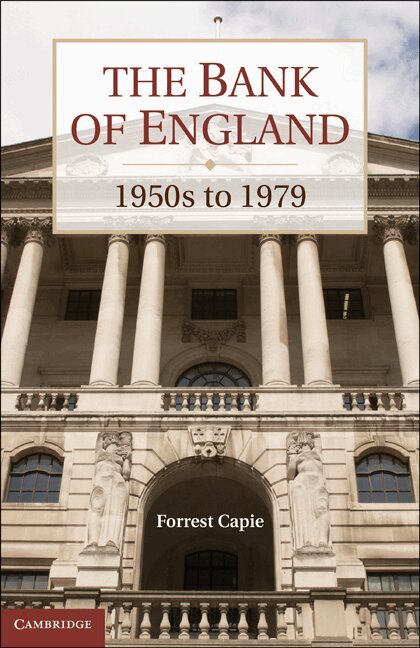
    The Bank of England

    1950s to 1979

    AvForrest Capie

    Inbunden, Engelska, 2010

    Del i serien Studies in Macroeconomic History

    2 190 kr

    Beställningsvara. Skickas inom 10-15 vardagar. Fri frakt över 249 kr.

    Fler format och utgåvor

    Häftad

    698 kr

    Beskrivning

    This history of the Bank of England takes its story from the 1950s to the end of the 1970s. This period probably saw the peak of the Bank's influence and prestige, as it dominated the financial landscape. One of the Bank's central functions was to manage the exchange rate. It was also responsible for administering all the controls that made up monetary policy. In the first part of the period, the Bank did all this with a remarkable degree of freedom. But economic policy was a failure, and sluggish output, banking instability and rampant inflation characterised the 1970s. The pegged exchange rate was discontinued, and the Bank's freedom of movement was severely constrained, as new approaches to policy were devised and implemented. The Bank lost much of its freedom of movement but also took on more formal supervision.

    Produktinformation

    • Utgivningsdatum:2010-07-20
    • Mått:165 x 235 x 55 mm
    • Vikt:1 350 g
    • Format:Inbunden
    • Språk:Engelska
    • Serie:Studies in Macroeconomic History
    • Antal sidor:920
    • Förlag:Cambridge University Press
    • ISBN:9780521192828

    Utforska kategorier

    • Makroekonomi inom Ekonomi och Ledarskap

    Mer om författaren

    Forrest Capie is Professor Emeritus of Economic History at the Cass Business School, City University of London.

    Recensioner i media

    Reviews of the hardback: 'A treasure trove for economic historians. Capie has done a fine job and is particularly strong on what one might call the science of inter-institutional dynamics.' Howard Davies, The Financial Times

    Innehållsförteckning

    • 1. Introduction and overview; 2. The Bank in the 1950s; 3. The monetary setting and the Bank; 4. The Bank's external responsibilities to 1964; 5. From crisis to 'crucifixion'; 6. Domestic monetary policy after Radcliffe; 7. Other activities and performance; 8. Sterling from devaluation to Smithsonian; 9. The road to competition and credit control; 10. Competition and credit control; 11. The secondary banking crisis; 12. Banking supervision; 13. Monetary targets and monetary control; 14. The Bank and sterling in the 1970s; 15. The Bank's freedom to operate; 16. Epilogue.