• Fri frakt över 249 kr
  • •
  • Snabba leveranser
  • •
  • Billiga böcker
Kundservice

Du är på sajten för privatpersoner.

Företag, bibliotek eller offentlig verksamhet?

Du handlar på classic.bokus.com, där alla dina funktioner finns intakta.
Till classic.bokus.com
Bokus logotyp. Gå till startsidan.
  • Erbjudanden
  • Student
  • Topplistor
  • Barn & ungdom
  • Bokus Play
  • E-böcker
  • Ljudböcker
  • Pocketböcker
  • Spel & pussel

10% rabatt på allt med kod NYSTART10 →

Sidfot

Mina sidor

    Hjälp

    • Kundservice
    • Vanliga frågor och svar
    • Frakt och leverans
    • Retur vid ångerrätt
    • Reklamera vara
    • Betalning
    • Köpvillkor
    • Allmänna villkor
    • Information om webbplatsens tillgänglighet

    Om Bokus

    • Om oss
    • Pressrum
    • För studenter
    • För företag
    • För bibliotek och offentlig verksamhet
    • För leverantörer
    • Hållbarhet

    Populärt

    • Aktuella erbjudanden
    • Presentkort
    • Studentlitteratur
    • Nya böcker
    • Topplistor
    • Signerade böcker
    • Engelska böcker

    Inspiration

    • Boktips
    • BookTok
    • Populära bokserier
    • Barnbokskaraktärer
    • Populära författare
    Logotyp för Bokus
    Följ oss på Facebook (extern länk)Följ oss på Instagram (extern länk)Följ oss på YouTube (extern länk)Följ oss på TikTok (extern länk)
    bokus @ CookiesAnpassa cookiesIntegritetspolicyKöpvillkor
    Till Citymail hemsida (extern länk)Till Budbee hemsida (extern länk)Till Postnord hemsida (extern länk)Till Schenker hemsida (extern länk)Till Early Bird hemsida (extern länk)Till Walleys hemsida (extern länk)
    1. Psykologi och pedagogik
    2. Psykologi

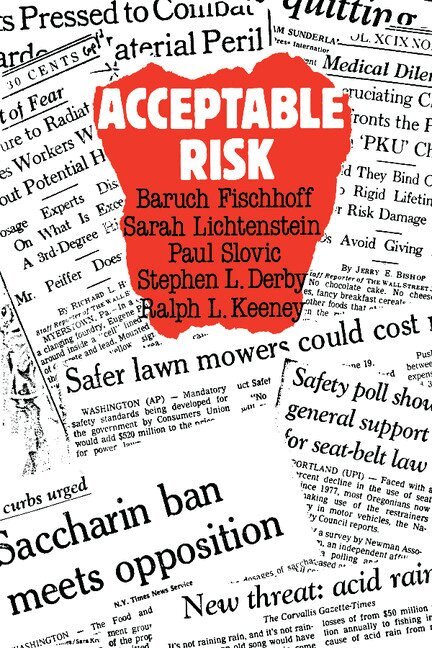
    Acceptable Risk

    AvBaruch Fischhoff,Sarah Lichtenstein

    Häftad, Engelska, 1984

    543 kr

    Beställningsvara. Skickas inom 7-10 vardagar. Fri frakt över 249 kr.

    Beskrivning

    The common denominator of a growing number of hard decisions facing modern societies is the need to determine 'how safe is safe enough?'. The authors begin by defining acceptable-risk problems and analysing why they are so difficult to resolve, considering such issues as uncertainty about their definition, lack of relevant facts, conflicting and conflicted social values, and disagreements between technical experts and the lay public. Drawing on their own experience in risk management as well as the relevant research literatures, they identify and characterise the variety of methods that have been proposed for resolving acceptable-risk problems. They subject these methods to a rigorous critique in terms of philosophical presuppositions, technical feasibility, political acceptability, and validity of underlying assumptions about human behaviour. The authors construct a framework for deciding how to make decisions about risks, and offer recommendations for research, public policy, and practice. Although their principal focus is on technological hazards, their analysis applies to many risks, such as those from new medical treatments or innovative programmes in criminal justice. The necessity of balancing risks and benefits impinges on most people's lives, and a broad audience will find this book thought-provoking and useful.

    Produktinformation

    • Utgivningsdatum:1984-01-27
    • Mått:153 x 230 x 24 mm
    • Vikt:340 g
    • Format:Häftad
    • Språk:Engelska
    • Antal sidor:204
    • Förlag:Cambridge University Press
    • ISBN:9780521278928

    Utforska kategorier

    • Psykologi inom Psykologi och pedagogik

    Recensioner i media

    'A brief summary cannot do justice to the depth and breadth of the analysis laid out in Acceptable Risk … [The authors] have achieved a masterly systematization of the many practical, methodological, and philosophical problems raised by attempts to answer the question, “how safe is safe enough?”' Nature

    Innehållsförteckning

    • 1. How safe is safe enough?; 2. Why is it so hard to resolve acceptable-risk problems?; 3. Choosing an approach to acceptable risk: a metadecision problem; 4. Professional judgment; 5. Bootstrapping; 6. Formal analysis; 7. Comparison of approaches; 8. What have we learned?; 9. Recommendations for improving acceptable-risk decision making; 10. What do we need to learn?; References; Index.