• Fri frakt över 249 kr
  • •
  • Snabba leveranser
  • •
  • Billiga böcker
Kundservice

Du är på sajten för privatpersoner.

Företag, bibliotek eller offentlig verksamhet?

Du handlar på classic.bokus.com, där alla dina funktioner finns intakta.
Till classic.bokus.com
Bokus logotyp. Gå till startsidan.
  • Erbjudanden
  • Student
  • Topplistor
  • Barn & ungdom
  • Bokus Play
  • E-böcker
  • Ljudböcker
  • Pocketböcker
  • Spel och pussel

Pocketfynda! Hundratals böcker för 49 kr/st →

Sidfot

Mina sidor

    Hjälp

    • Kundservice
    • Vanliga frågor och svar
    • Frakt och leverans
    • Retur vid ångerrätt
    • Reklamera vara
    • Betalning
    • Köpvillkor
    • Allmänna villkor
    • Information om webbplatsens tillgänglighet

    Om Bokus

    • Om oss
    • Pressrum
    • För studenter
    • För företag
    • För bibliotek och offentlig verksamhet
    • För leverantörer
    • Hållbarhet

    Populärt

    • Aktuella erbjudanden
    • Presentkort
    • Studentlitteratur
    • Nya böcker
    • Topplistor
    • Signerade böcker
    • Engelska böcker

    Inspiration

    • Boktips
    • BookTok
    • Barnbokskaraktärer
    • Populära författare
    Logotyp för Bokus
    Följ oss på Facebook (extern länk)Följ oss på Instagram (extern länk)Följ oss på YouTube (extern länk)Följ oss på TikTok (extern länk)
    bokus @ CookiesAnpassa cookiesIntegritetspolicyKöpvillkor
    Till Citymail hemsida (extern länk)Till Budbee hemsida (extern länk)Till Postnord hemsida (extern länk)Till Schenker hemsida (extern länk)Till Early Bird hemsida (extern länk)Till Walleys hemsida (extern länk)
    1. Filosofi och religion
    2. Filosofi
    3. Filosofiska discipliner

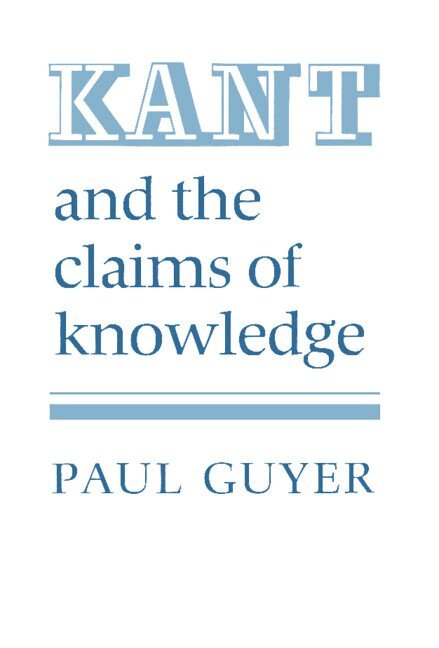
    Kant and the Claims of Knowledge

    AvPaul Guyer

    Häftad, Engelska, 1987

    417 kr

    Beställningsvara. Skickas inom 7-10 vardagar. Fri frakt över 249 kr.

    Beskrivning

    This book offers a radically new account of the development and structure of the central arguments of Kant's Critique of Pure Reason: the defense of the objective validity of such categories as substance, causation, and independent existence. Paul Guyer makes far more extensive use than any other commentator of historical materials from the years leading up to the publication of the Critique and surrounding its revision, and he shows that the work which has come down to us is the result of some striking and only partially resolved theoretical tensions. Kant had originally intended to demonstrate the validity of the categories by exploiting what he called 'analogies of appearance' between the structure of self-knowledge and our knowledge of objects. The idea of a separate 'transcendental deduction', independent from the analysis of the necessary conditions of empirical judgements, arose only shortly before publication of the Critique in 1781, and distorted much of Kant's original inspiration. Part of what led Kant to present this deduction separately was his invention of a new pattern of argument - very different from the 'transcendental arguments' attributed by recent interpreters to Kant - depending on initial claims to necessary truth.

    Produktinformation

    • Utgivningsdatum:1987-12-25
    • Mått:152 x 229 x 28 mm
    • Vikt:675 g
    • Format:Häftad
    • Språk:Engelska
    • Antal sidor:500
    • Förlag:Cambridge University Press
    • ISBN:9780521337724

    Utforska kategorier

    • Filosofiska discipliner inom Filosofi och religion

    Innehållsförteckning

    • Acknowledgments; Notes on sources; Introduction; Part I. Kant's Early View: 1. The problem of objective validity; 2. The transcendental theory of experience: 1774–1775; Part II. The Transcendental Deduction from 1781 to 1787: 3. The real premises of the deduction; 4. The deduction from knowledge of objects; 5. The deduction and aperception; Part III. The Principles of Empirical Knowledge: 6. The schematism and system of principles; 7. Axioms and anticipations; 8. The general principle of the analogies; 9. The first analogy: substance; 10. The second analogy: causation; 11. The third analogy: interaction; Part IV. The Refutation of Idealism: 12. The problem, project, and promise of the refutation; 13. The central arguments of the refutation; 14. The metaphysics of the refutation; Part V. Transcendental Idealism: 15. Appearances and things in themselves; 16. Transcendental idealism and the forms of intuition; 17. Transcendental idealism and the theory of judgment; 18. Transcendental idealism and the 'Antinomy of Pure Reason'; Afterword; Notes; General index.