• Fri frakt över 249 kr
  • •
  • Snabba leveranser
  • •
  • Billiga böcker
Kundservice

Du är på sajten för privatpersoner.

Företag, bibliotek eller offentlig verksamhet?

Du handlar på classic.bokus.com, där alla dina funktioner finns intakta.
Till classic.bokus.com
Bokus logotyp. Gå till startsidan.
  • Erbjudanden
  • Nyheter
  • Student
  • Topplistor
  • Barn & ungdom
  • Bokus Play
  • E-böcker
  • Pocketböcker
  • Spel & pussel

10% rabatt på allt med kod: NYSTART10 →

Sidfot

Mina sidor

    Hjälp

    • Kundservice
    • Vanliga frågor och svar
    • Frakt och leverans
    • Retur vid ångerrätt
    • Reklamera vara
    • Betalning
    • Köpvillkor
    • Allmänna villkor
    • Information om webbplatsens tillgänglighet

    Om Bokus

    • Om oss
    • Pressrum
    • För studenter
    • För företag
    • För bibliotek och offentlig verksamhet
    • För leverantörer
    • Hållbarhet

    Populärt

    • Aktuella erbjudanden
    • Presentkort
    • Studentlitteratur
    • Nya böcker
    • Topplistor
    • Signerade böcker
    • Engelska böcker

    Inspiration

    • Boktips
    • BookTok
    • Populära bokserier
    • Barnbokskaraktärer
    • Populära författare
    Logotyp för Bokus
    Följ oss på Facebook (extern länk)Följ oss på Instagram (extern länk)Följ oss på YouTube (extern länk)Följ oss på TikTok (extern länk)
    bokus @ CookiesAnpassa cookiesIntegritetspolicyKöpvillkor
    Till Citymail hemsida (extern länk)Till Budbee hemsida (extern länk)Till Postnord hemsida (extern länk)Till Schenker hemsida (extern länk)Till Early Bird hemsida (extern länk)Till Walleys hemsida (extern länk)
    1. Filosofi och religion
    2. Filosofi
    3. Filosofiska discipliner

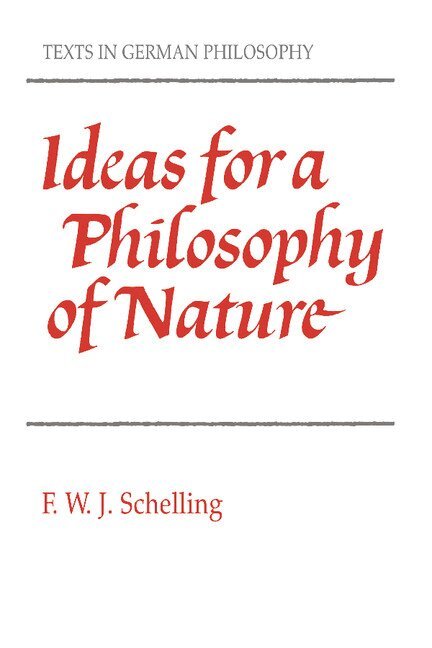
    Ideas for a Philosophy of Nature

    AvF. W. J. von Schelling

    Häftad, Engelska, 1988

    Del i serien Texts in German Philosophy

    430 kr

    Beställningsvara. Skickas inom 10-15 vardagar. Fri frakt över 249 kr.

    Beskrivning

    This is an English translation of Schelling's Ideas for a Philosophy of Nature (first published in 1797 and revised in 1803), one of the most significant works in the German tradition of philosophy of nature and early nineteenth-century philosophy of science. It stands in opposition to the Newtonian picture of matter as constituted by inert, impenetrable particles, and argues instead for matter as an equilibrium of active forces that engage in dynamic polar opposition to one another. In the revisions of 1803 Schelling incorporated this dialectical view into a neo-Platonic conception of an original unity divided upon itself. The text is of more than simply historical interest: its daring and original vision of nature, philosophy, and empirical science will prove absorbing reading for all philosophers concerned with post-Kantian German idealism, for scholars of German Romanticism, and for historians of science.

    Produktinformation

    • Utgivningsdatum:1988-09-30
    • Mått:155 x 245 x 25 mm
    • Vikt:500 g
    • Format:Häftad
    • Språk:Engelska
    • Serie:Texts in German Philosophy
    • Antal sidor:324
    • Upplaga:88002
    • Förlag:Cambridge University Press
    • ISBN:9780521357333
    • Översättare:Errol E. Harris, Peter Heath

    Utforska kategorier

    • Filosofiska discipliner inom Filosofi och religion

    Innehållsförteckning

    • Introduction Robert Stern; Translators' note; Glossary; 1. Of the combustion of bodies; 2. Of light; 3. Of the air and the kinds of air; 4. Of electricity; 5. Of the magnet; 6. General considerations, as results of the foregoing; 7. On attraction and repulsion in general, as principles of a system of nature; 8. On the fictitious use of these two principles; 9. Some remarks on the mechanical physics of M. Le Sage; 10. First origin of the concept of matter, from the nature of perception and the human mind; 11. Basic principles of dynamics; 12. Of contingent determinations of matter - gradual transition into the domain of mere experience; 13. Philosophy of chemistry in general; 14. Application of these principles to particular topics of chemistry; 15. Projected outline of the first principles of chemistry; Concluding note and transition to the following part; Appendix; Index of names; Index of subjects.