• Fri frakt över 249 kr
  • •
  • Snabba leveranser
  • •
  • Billiga böcker
Kundservice

Du är på sajten för privatpersoner.

Företag, bibliotek eller offentlig verksamhet?

Du handlar på classic.bokus.com, där alla dina funktioner finns intakta.
Till classic.bokus.com
Bokus logotyp. Gå till startsidan.
  • Erbjudanden
  • Student
  • Topplistor
  • Barn & ungdom
  • Bokus Play
  • E-böcker
  • Ljudböcker
  • Pocketböcker
  • Spel & pussel

10% rabatt på allt med kod NYSTART10 →

Sidfot

Mina sidor

    Hjälp

    • Kundservice
    • Vanliga frågor och svar
    • Frakt och leverans
    • Retur vid ångerrätt
    • Reklamera vara
    • Betalning
    • Köpvillkor
    • Allmänna villkor
    • Information om webbplatsens tillgänglighet

    Om Bokus

    • Om oss
    • Pressrum
    • För studenter
    • För företag
    • För bibliotek och offentlig verksamhet
    • För leverantörer
    • Hållbarhet

    Populärt

    • Aktuella erbjudanden
    • Presentkort
    • Studentlitteratur
    • Nya böcker
    • Topplistor
    • Signerade böcker
    • Engelska böcker

    Inspiration

    • Boktips
    • BookTok
    • Populära bokserier
    • Barnbokskaraktärer
    • Populära författare
    Logotyp för Bokus
    Följ oss på Facebook (extern länk)Följ oss på Instagram (extern länk)Följ oss på YouTube (extern länk)Följ oss på TikTok (extern länk)
    bokus @ CookiesAnpassa cookiesIntegritetspolicyKöpvillkor
    Till Citymail hemsida (extern länk)Till Budbee hemsida (extern länk)Till Postnord hemsida (extern länk)Till Schenker hemsida (extern länk)Till Early Bird hemsida (extern länk)Till Walleys hemsida (extern länk)
    1. Psykologi och pedagogik
    2. Psykologi
    3. Barnpsykologi och utvecklingspsykologi

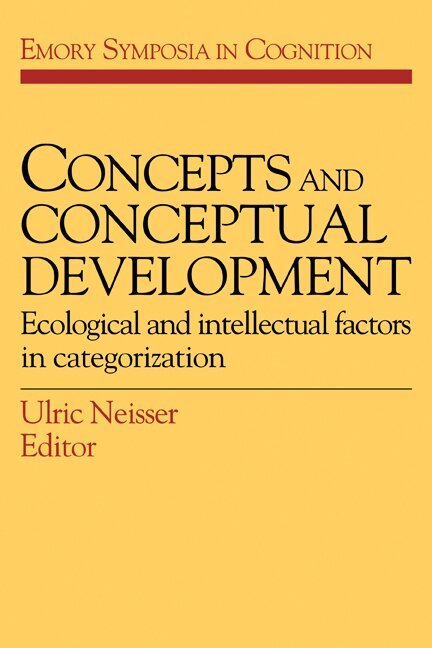
    Concepts and Conceptual Development

    Ecological and Intellectual Factors in Categorization

    AvUlric Neisser

    Häftad, Engelska, 1989

    Del 1 i serien Emory Symposia in Cognition

    607 kr

    Beställningsvara. Skickas inom 10-15 vardagar. Fri frakt över 249 kr.

    Beskrivning

    Categories straddle the boundary between the mind and the world: they are socially developed mental representations, but they must fit the properties of real objects in the real environment if they are to be useful. Concepts and Conceptual Development reflects the view that a full understanding of categorization must take all these constraints into account. Everyday terms and categories depend not only on the implicit theories that people have about the world (their 'idealised cognitive models'), but also on the objective properties of particular objects and the perceptible similarities among these objects. An understanding of these multiple relationships can reshape studies of concepts and conceptual development. Concepts and Conceptual Development draws together theorists from a wide range of theoretical orientations to consider many different aspects of 'the psychology of concepts'.

    Produktinformation

    • Utgivningsdatum:1989-03-31
    • Mått:152 x 229 x 19 mm
    • Vikt:480 g
    • Format:Häftad
    • Språk:Engelska
    • Serie:Emory Symposia in Cognition
    • Antal sidor:328
    • Förlag:Cambridge University Press
    • ISBN:9780521378758

    Utforska kategorier

    • Barnpsykologi och utvecklingspsykologi inom Psykologi och pedagogik

    Innehållsförteckning

    • Preface; List of contributors; 1. Introduction: the ecological and intellectual bases of categorisation Ulric Neisser; 2. From direct perception to conceptual structure Ulric Neisser; 3. Category cohesiveness, theories and cognitive archaeology Douglas L. Medin and William D. Wattenmaker; 4. Cognitive models and prototype theory George Lakoff; 5. The instability of graded structure: implications for the nature of concepts Lawrence W. Barsalou; 6. Decentralised control of categorisation: the role of prior processing episodes Lee R. Brooks; 7. Conceptual development and category structure Frank C. Keil; 8. Child-basic object categories and early lexical development Carolyn B. Mervis; 9. Scripts and categories: interrelationships in development Robyn Fivush; 10. How children constrain the possible meanings of words Ellen M. Markman; 11. The role of theories in a theory of concepts Robert N. McCauley; Indexes.