• Fri frakt över 249 kr
  • •
  • Snabba leveranser
  • •
  • Billiga böcker
Kundservice

Du är på sajten för privatpersoner.

Företag, bibliotek eller offentlig verksamhet?

Du handlar på classic.bokus.com, där alla dina funktioner finns intakta.
Till classic.bokus.com
Bokus logotyp. Gå till startsidan.
  • Erbjudanden
  • Nyheter
  • Student
  • Topplistor
  • Barn & ungdom
  • Bokus Play
  • E-böcker
  • Pocketböcker
  • Spel & pussel

10% rabatt på allt med kod: NYSTART10 →

Sidfot

Mina sidor

    Hjälp

    • Kundservice
    • Vanliga frågor och svar
    • Frakt och leverans
    • Retur vid ångerrätt
    • Reklamera vara
    • Betalning
    • Köpvillkor
    • Allmänna villkor
    • Information om webbplatsens tillgänglighet

    Om Bokus

    • Om oss
    • Pressrum
    • För studenter
    • För företag
    • För bibliotek och offentlig verksamhet
    • För leverantörer
    • Hållbarhet

    Populärt

    • Aktuella erbjudanden
    • Presentkort
    • Studentlitteratur
    • Nya böcker
    • Topplistor
    • Signerade böcker
    • Engelska böcker

    Inspiration

    • Boktips
    • BookTok
    • Populära bokserier
    • Barnbokskaraktärer
    • Populära författare
    Logotyp för Bokus
    Följ oss på Facebook (extern länk)Följ oss på Instagram (extern länk)Följ oss på YouTube (extern länk)Följ oss på TikTok (extern länk)
    bokus @ CookiesAnpassa cookiesIntegritetspolicyKöpvillkor
    Till Citymail hemsida (extern länk)Till Budbee hemsida (extern länk)Till Postnord hemsida (extern länk)Till Schenker hemsida (extern länk)Till Early Bird hemsida (extern länk)Till Walleys hemsida (extern länk)
    1. Psykologi och pedagogik
    2. Psykologi
    3. Kognitiv psykologi

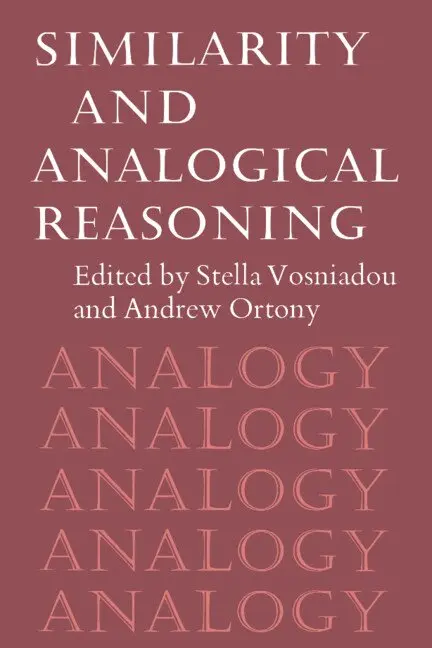
    Similarity and Analogical Reasoning

    AvStella Vosniadou,Andrew Ortony

    Häftad, Engelska, 1989

    750 kr

    Beställningsvara. Skickas inom 10-15 vardagar. Fri frakt över 249 kr.

    Beskrivning

    Similarity and analogy are fundamental in human cognition. They are crucial for recognition and classification, and have been associated with scientific discovery and creativity. Successful learning is generally less dependent on the memorization of isolated facts and abstract rules than it is on the ability to identify relevant bodies of knowledge already stored as the starting point for new learning. Similarity and analogy play an important role in this process - a role that in recent years has received much attention from cognitive scientists. Any adequate understanding of similarity and analogy requires the integration of theory and data from diverse domains. This interdisciplinary volume explores current developments in research and theory from psychological, computational, and educational perspectives, and considers their implications for learning and instruction. Well-known cognitive scientists examine the psychological processes involved in reasoning by similarity and analogy, the computational problems encountered in simulating analogical processing in problem solving, and the conditions promoting the application of analogical reasoning in everyday situations.

    Produktinformation

    • Utgivningsdatum:1989-07-28
    • Mått:156 x 230 x 28 mm
    • Vikt:875 g
    • Format:Häftad
    • Språk:Engelska
    • Antal sidor:608
    • Förlag:Cambridge University Press
    • ISBN:9780521389358

    Utforska kategorier

    • Kognitiv psykologi inom Psykologi och pedagogik

    Innehållsförteckning

    • Preface; Similarity and analogical reasoning: a synthesis Stella Vosniadou and Andrew Ortony; Part I. Similarity and the Structure of Concepts: 1. Similarity, typicality, and categorization Lance J. Rips; 2. Similarity and decision making Edward E. Smith and Daniel N. Osherson; 3. Intraconcept similarity and its implications for interconcept similarity Lawrence W. Barsalou; 4. Two-tiered concept meaning, inferential matching, and conceptual cohesiveness Ryszard S. Michalski; 5. From global similarities to kinds of similarities: the construction of dimensions in development Linda B. Smith; 6. Comments on Part I. Psychological essentialism Douglas Medin and Andrew Ortony; Part II. Analogical Reasoning: 7. The mechanisms of analogical learning Dedre Genter; 8. A computational model of analogical problem solving Keith J. Holyoak and Paul R. Thagard; 9. Use of analogy in production system architecture John R. Anderson and Ross Thompson; 10. Toward a microstructural account of human reasoning David E. Rumelhart; 11. Analogy and the exercise of creativity Philip N. Johnson-Laird; 12. Comments on Part II. Levels of description in information-processing theories of analogy Stephen E. Palmer; 13. Comments on Part II. The role of explanation in analogy; or, the curse of an alluring name Gerald Dejong; Part III. Similarity and Analogy in Development, Learning and Instruction: 14. Analogical learning and transfer: what develops? Ann L. Brown; 15. Analogical reasoning as a mechanism in knowledge acquisition: a developmental perspective Stella Vosniadou; 16. Remindings in learning and instruction Brian H. Ross; 17. New approaches to instruction: because wisdom can't be told John D. Bransford, Jeffery J. Franks, Nancy J. Vye and Robert Sherwood; 18. Multiple analogies for complex concepts: antidotes for analogy-induced misconception in advanced knowledge acquisition Rand J. Spiro, Paul J. Feltovich, Richard L. Coulson and Daniel K. Anderson; 19. Comments on Part III. The activation and acquisition of knowledge William F. Brewer; Afterword Allan Collins and Mark Burstein; Name index; Subject index.