• Fri frakt över 249 kr
  • •
  • Snabba leveranser
  • •
  • Billiga böcker
Kundservice

Du är på sajten för privatpersoner.

Företag, bibliotek eller offentlig verksamhet?

Du handlar på classic.bokus.com, där alla dina funktioner finns intakta.
Till classic.bokus.com
Bokus logotyp. Gå till startsidan.
  • Erbjudanden
  • Nyheter
  • Student
  • Topplistor
  • Barn & ungdom
  • Bokus Play
  • E-böcker
  • Pocketböcker
  • Spel & pussel

10% rabatt på allt med kod: NYSTART10 →

Sidfot

Mina sidor

    Hjälp

    • Kundservice
    • Vanliga frågor och svar
    • Frakt och leverans
    • Retur vid ångerrätt
    • Reklamera vara
    • Betalning
    • Köpvillkor
    • Allmänna villkor
    • Information om webbplatsens tillgänglighet

    Om Bokus

    • Om oss
    • Pressrum
    • För studenter
    • För företag
    • För bibliotek och offentlig verksamhet
    • För leverantörer
    • Hållbarhet

    Populärt

    • Aktuella erbjudanden
    • Presentkort
    • Studentlitteratur
    • Nya böcker
    • Topplistor
    • Signerade böcker
    • Engelska böcker

    Inspiration

    • Boktips
    • BookTok
    • Populära bokserier
    • Barnbokskaraktärer
    • Populära författare
    Logotyp för Bokus
    Följ oss på Facebook (extern länk)Följ oss på Instagram (extern länk)Följ oss på YouTube (extern länk)Följ oss på TikTok (extern länk)
    bokus @ CookiesAnpassa cookiesIntegritetspolicyKöpvillkor
    Till Citymail hemsida (extern länk)Till Budbee hemsida (extern länk)Till Postnord hemsida (extern länk)Till Schenker hemsida (extern länk)Till Early Bird hemsida (extern länk)Till Walleys hemsida (extern länk)
    1. Psykologi och pedagogik
    2. Psykologi
    3. Kognitiv psykologi

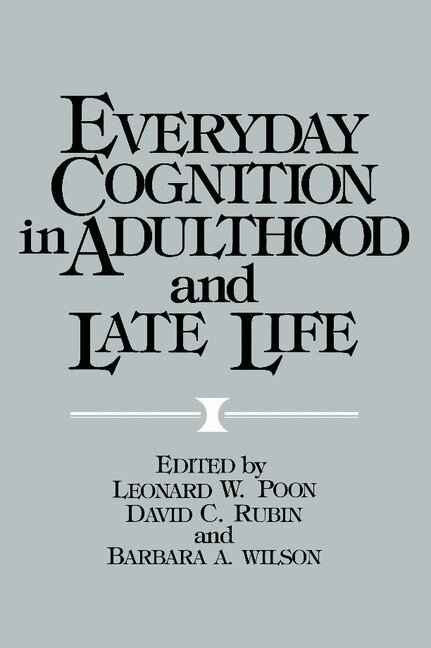
    Everyday Cognition in Adulthood and Late Life

    AvLeonard W. Poon,David C. Rubin

    Häftad, Engelska, 1992

    750 kr

    Beställningsvara. Skickas inom 10-15 vardagar. Fri frakt över 249 kr.

    Beskrivning

    Provides a firm theoretical grounding for the increasing movement of cognitive psychologists, neuropsychologists and their students beyond the laboratory, in an attempt to understand human cognitive abilities as they are manifested in natural contexts. The pros and cons of the laboratory and the real world - the problems of generalizability versus rigor - are thoroughly analyzed, and practical escapes from what has become a false dichotomy are suggested. The authors present relevant data that open up new directions for those studying cognitive aging. Finally, they consider the applications of the new knowledge for clinicians and educators.

    Produktinformation

    • Utgivningsdatum:1992-01-31
    • Mått:157 x 235 x 35 mm
    • Vikt:1 007 g
    • Format:Häftad
    • Språk:Engelska
    • Antal sidor:724
    • Förlag:Cambridge University Press
    • ISBN:9780521428606

    Utforska kategorier

    • Kognitiv psykologi inom Psykologi och pedagogik

    Recensioner i media

    "...a useful interim report on a very active area of research in the broad field of cognitive psychology." Timothy A. Salthouse, Science

    Innehållsförteckning

    • Part I. Adult Cognitive Abilities in the Laboratory and in Real-life Settings: Basic Theoretical and Methodological Issues; 1. Introduction to Part I: the how, when and why of studying everyday cognition David C. Rubin; Part IA. Systematic Approaches to Laboratory and Real-world Research: 2. Representative design and the quality of generalization Lewis Petrinovich; 3. The myth of external validity Douglas G. Mook; 4. Functional explanations of memory Darryl Bruce; 5. General systems theory: a rationale for the study of everyday memory Jan D. Sinnott; Part IB. Combining Laboratory and Real-world Research: 6. The laboratory and ecology: supplementary sources of data for memory research Harry P. Bahrick; 7. Issues of regularity and control: confessions of a regularity freak David C. Rubin; 8. Finding the bloody horse Alan Baddeley; 9. Some bad and some good reasons for studying memory and cognition in the wild Thomas K. Landauer; Part II. Cognition in Adulthood and Late Life: Findings in Real-life Settings: 10. Introduction to Part II: What do we know about the aging of cognitive abilities in everyday life? Leonard W. Poon; Part IIA. Everyday Cognitive Abilities: 11. Memory for prose: perspectives on the reader Joellen T. Hartley; 12. Prose processing in adulthood: the text, the reader and the task Bonnie J. F. Meyer and G. Elizabeth Rice; 13. Speech comprehension and memory through adulthood: the roles of time and strategy Elizabeth Lotz Stine, Arthur Wingfield and Leonard W. Poon; 14. The effects of aging on perceived and generated memories Gillian Cohen and Dorothy Faulkner; 15. Aging and word retrieval: naturalistic, clinical and laboratory data Nancy L. Bowles, Loraine K. Obler and Leonard W. Poon; 16. Acquisition and utilization of spatial information by elderly adults: implications for day-to-day situations Kathleen C. Kirasic; 17. Inner-city decay? Age changes in structure and process in recall of familiar topographical information Patrick Rabbitt; 18. The cognitive ecology of problem solving Alan A. Hartley; 19. Everyday problem solving: methodological issues, research findings and a model Nancy Wadsworth Denney; 20. Prospective/intentional memory and aging: memory as adaptive action Jan D. Sinnott; Part IIB. Concomitant Influences: 21. Motivation and aging Lawrence C. Perlmuter and Richard A. Monty; 22. Questionnaire research on metamemory and aging: issues of structure and function Roger A. Dixon; 23. The importance of awareness in memory aging John C. Cavanaugh; 24. Age and expertise: responding to Talland's challenge Neil Charness; 25. World-knowledge systems Cameron J. Camp; 26. Comments on aging memory and its everyday operations Donald H. Kausler; Part III. Cognitive Enhancement and Aging: Clinical and Educational Applications: 27. Introduction to Part III: approaches to practical applications Barbara A. Wilson and Leonard W. Poon; Part IIIA. Issues and Perspectives: 28. Varieties of memory compensation by older adults in episodic remembering Lars Bäckman; 29. Improvement with cognitive training: which old dogs learn what tricks? Sherry L. Willis; Part IIIB. Enhancement Approaches: 30. Planning practical memory training for the aged Robin L. West; 31. Mnemonics as modified for use by the elderly Jerome A. Yesavage, Danielle Lapp and Javaid I. Sheikh; Part IIIC. Designing Programs for Cognitive Rehabilitation: 32. Designing memory-therapy programs Barbara A. Wilson; 33. Management of memory problems in a hospital setting Nadina B. Lincoln; 34. Home-based cognitive rehabilitation with the elderly Nicholas J. Moffat; 35. Memory retraining: everyday needs and future prospects Herbert F. Crovitz; Indexes.