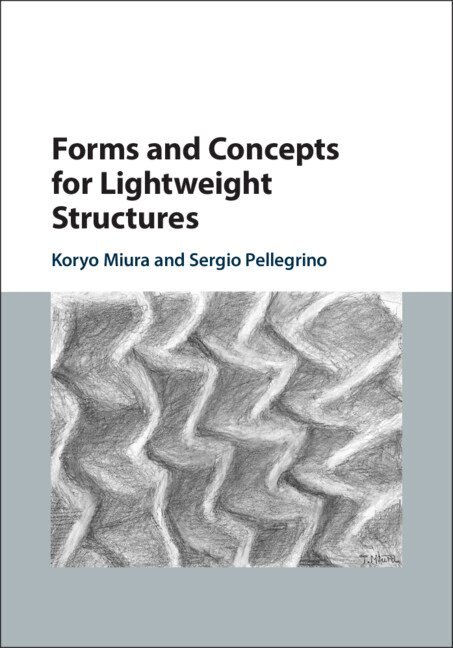
Inbunden, Engelska, 2020
Forms and Concepts for Lightweight Structures
Av Koryo Miura, Sergio Pellegrino
2834 kr
Beställningsvara. Skickas inom 5-8 vardagar. Fri frakt över 249 kr.
Beskrivning
Produktinformation
- Utgivningsdatum: 2020-03-26
- Mått: 180 x 253 x 29 mm
- Vikt: 930 g
- Format: Inbunden
- Språk: Engelska
- Antal sidor: 502
- Förlag: Cambridge University Press
- ISBN: 9780521432740
Utforska kategorier
Mer om författaren
Koryo Miura is a prominent inventor in the field of space structures and a Professor Emeritus at the University of Tokyo and the Institute of Space and Astronautical Science, JAXA. He invented the two-dimensionally deployable solar array as a fundamental step towards the Space Solar Power Station, which was successfully tested onboard the Space Solar Flyer Unit in 1996. He has also invented the tension truss concept for large deployable reflector antennas, adopted in several space missions. The basic geometric form called 'Miura-ori', invented by Miura, opened the door toward origami engineering. Sergio Pellegrino is a leading academic researcher in deployable structures and the Joyce and Kent Kresa Professor of Aerospace and Civil Engineering at the California Institute of Technology and a Senior Research Scientist at the NASA Jet Propulsion Laboratory. Pellegrino has made pioneering contributions to lightweight structures, including the development of a general theory for the analysis of structures that are statically and kinematically indeterminate, the invention of cable-deployed truss structures, analytical and experimental methods for composite tape-spring hinges that have led to their adoption in space missions, and ultralight structural architectures for space-based solar power satellites.
Recensioner i media
'In this book Miura (emer., Univ. of Tokyo and Japan Aerospace Exploration Agency) and Pellegrino (California Institute of Technology and Jet Propulsion Laboratory, NASA) present a comprehensive look into lightweight structural design, organized into topical areas including truss, tension, shell, and sandwich structures, among many others. The book also delves into the area of deployable structures, that is, designs whose applications are heavily dependent on packaging and folding theories. Origami concepts are playing an ever-increasing role for the design of structures whose efficient transport before application is critical. Several references to origami research are sprinkled throughout the sections on folding. The extensive bibliography is only one of several appendixes. This book should be a valuable reference for students and structural designers interested in aeronautics and space applications.' H. I. Epstein, Choice
Betyg & recensioner
0 recensioner
Inga recensioner tillgängliga.