• Fri frakt över 249 kr
  • •
  • Snabba leveranser
  • •
  • Billiga böcker
Kundservice

Du är på sajten för privatpersoner.

Företag, bibliotek eller offentlig verksamhet?

Du handlar på classic.bokus.com, där alla dina funktioner finns intakta.
Till classic.bokus.com
Bokus logotyp. Gå till startsidan.
  • Erbjudanden
  • Nyheter
  • Student
  • Topplistor
  • Barn & ungdom
  • Bokus Play
  • E-böcker
  • Pocketböcker
  • Spel & pussel

10% rabatt på allt med kod: NYSTART10 →

Sidfot

Mina sidor

    Hjälp

    • Kundservice
    • Vanliga frågor och svar
    • Frakt och leverans
    • Retur vid ångerrätt
    • Reklamera vara
    • Betalning
    • Köpvillkor
    • Allmänna villkor
    • Information om webbplatsens tillgänglighet

    Om Bokus

    • Om oss
    • Pressrum
    • För studenter
    • För företag
    • För bibliotek och offentlig verksamhet
    • För leverantörer
    • Hållbarhet

    Populärt

    • Aktuella erbjudanden
    • Presentkort
    • Studentlitteratur
    • Nya böcker
    • Topplistor
    • Signerade böcker
    • Engelska böcker

    Inspiration

    • Boktips
    • BookTok
    • Populära bokserier
    • Barnbokskaraktärer
    • Populära författare
    Logotyp för Bokus
    Följ oss på Facebook (extern länk)Följ oss på Instagram (extern länk)Följ oss på YouTube (extern länk)Följ oss på TikTok (extern länk)
    bokus @ CookiesAnpassa cookiesIntegritetspolicyKöpvillkor
    Till Citymail hemsida (extern länk)Till Budbee hemsida (extern länk)Till Postnord hemsida (extern länk)Till Schenker hemsida (extern länk)Till Early Bird hemsida (extern länk)Till Walleys hemsida (extern länk)
    1. Historia och arkeologi
    2. Historia
    3. Europas historia

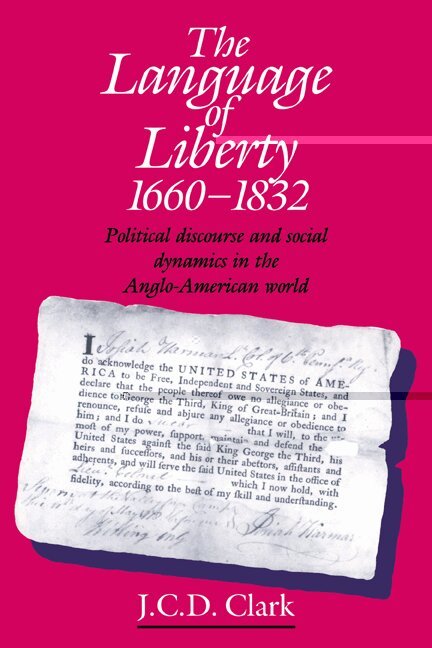
    The Language of Liberty 1660-1832

    Political Discourse and Social Dynamics in the Anglo-American World, 1660-1832

    AvJ. C. D. Clark

    Häftad, Engelska, 1993

    590 kr

    Beställningsvara. Skickas inom 10-15 vardagar. Fri frakt över 249 kr.

    Beskrivning

    This book creates a new framework for the political and intellectual relations between the British Isles and America in a momentous period which witnessed the formation of modern states on both sides of the Atlantic and the extinction of an Anglican, aristocratic and monarchical order. Jonathan Clark integrates evidence from law and religion to reveal how the dynamics of early modern societies were essentially denominational. In a study of British and American discourse, he shows how rival conceptions of liberty were expressed in the conflicts created by Protestant dissent's hostility to an Anglican hegemony. The book argues that this model provides a key to collective acts of resistance to the established order throughout the period. The book's final section focuses on the defining episode for British and American history, and shows the way in which the American Revolution can be understood as a war of religion.

    Produktinformation

    • Utgivningsdatum:1993-10-14
    • Mått:152 x 229 x 24 mm
    • Vikt:620 g
    • Format:Häftad
    • Språk:Engelska
    • Antal sidor:424
    • Förlag:Cambridge University Press
    • ISBN:9780521449571

    Utforska kategorier

    • Europas historia inom Historia och arkeologi

    Recensioner i media

    'Jonathan Clark is the most controversial historian of his generation. … constantly arresting, intellectually provocative and demanding … throughout the work of a first class mind. The book will be required reading for all those interested in the period …' Jeremy Black, The Times

    Innehållsförteckning

    • Introduction: the structure of Anglo-American political discouse; 1. Law, Religion and Sovereignty; 2. Constitutional Innovations and their English Antecedents; 3. The genesis of political discourse; 4. Transatlantic ties and their failure; 5. The Commonwealth paradigm; 6. Denominational discourse; 7. The implications of theological conflict; 8. Denominational dynamics and political rebellions; Part I. The Conflict Between Laws: Sovereignty and State Formation in the Uniter Kingdom and United States: 1. Law, nationality and nationalism: monarchical allegiance and identity; 2. The creation of the United Kingdom, 1536–1801: religion and the origins of the common-law doctrine of sovereignty; 3. Sovereignty and political theory from Justinian to the English jurists; 4. Natural law versus common law: the polarisation of a common idiom; 5. Sovereignty, dissent, and the American rejection of the British state; 6. Sovereignty and the New Republic: the American constitution in transatlantic perspective; Part II. The Conflict Between Denominations: The Religious Identity of Early Modern Societies: 1. Before redefinition: politics and religion in the old society; 2. Anglicanism as an agency of state formation: the question of establishment; 3. Canon law, heterodoxy and the American perception of tyranny; 4. The Anglican ascendancy as the hegemony of discourse; 5. The Anglican dream: harmony and conflict in the English parish; 6. The Anglican nightmare: sectarian diversity in colonial America; Part III. Predispositions: Rebellion and its Social Constituencies in the English Atlantic Empire, 1660–1800: 1. Rebellions and their analysis in the Anglo-American tradition; 2. Covenanters, Presbyterians and Whigs: resistance to the Stuarts in England and Scotland, 1660–1689; 3. Colonial American rebellions, 1660–1689, and transatlantic discourse; 4. The rights of Englishmen, the rhetoric of slavery, and rebellions in Britain and America, 1689–1760; 5. The right of resistance and its sectarian preconditions in north America, 1760–1799; 6. The rhetoric of resistance and its social constituencies in England and Ireland, 1733–1828: some transatlantic analogies; 7. Denominations, social constituencies and their activation; Part IV. Political Mobilisation: The American Revolution as a War of Religion: 1. The American Revolution as a civil war; 2. Predispositions, accelerators and catalysts: the role of theology; 3. Heterodox and orthodox in the Church of England; 4. The divisions and disruptions of English dissent; 5. Heterodoxy and rebellion in colonial America, 1760–1776; Conclusion: 'Desolating Devastation': The Origins of Anglo-American Divergence.