• Fri frakt över 249 kr
  • •
  • Snabba leveranser
  • •
  • Billiga böcker
Kundservice

Du är på sajten för privatpersoner.

Företag, bibliotek eller offentlig verksamhet?

Du handlar på classic.bokus.com, där alla dina funktioner finns intakta.
Till classic.bokus.com
Bokus logotyp. Gå till startsidan.
  • Erbjudanden
  • Nyheter
  • Student
  • Topplistor
  • Barn & ungdom
  • Bokus Play
  • E-böcker
  • Pocketböcker
  • Spel & pussel

10% rabatt på allt med kod: NYSTART10 →

Sidfot

Mina sidor

    Hjälp

    • Kundservice
    • Vanliga frågor och svar
    • Frakt och leverans
    • Retur vid ångerrätt
    • Reklamera vara
    • Betalning
    • Köpvillkor
    • Allmänna villkor
    • Information om webbplatsens tillgänglighet

    Om Bokus

    • Om oss
    • Pressrum
    • För studenter
    • För företag
    • För bibliotek och offentlig verksamhet
    • För leverantörer
    • Hållbarhet

    Populärt

    • Aktuella erbjudanden
    • Presentkort
    • Studentlitteratur
    • Nya böcker
    • Topplistor
    • Signerade böcker
    • Engelska böcker

    Inspiration

    • Boktips
    • BookTok
    • Populära bokserier
    • Barnbokskaraktärer
    • Populära författare
    Logotyp för Bokus
    Följ oss på Facebook (extern länk)Följ oss på Instagram (extern länk)Följ oss på YouTube (extern länk)Följ oss på TikTok (extern länk)
    bokus @ CookiesAnpassa cookiesIntegritetspolicyKöpvillkor
    Till Citymail hemsida (extern länk)Till Budbee hemsida (extern länk)Till Postnord hemsida (extern länk)Till Schenker hemsida (extern länk)Till Early Bird hemsida (extern länk)Till Walleys hemsida (extern länk)
    1. Psykologi och pedagogik
    2. Pedagogik
    3. Pedagogisk psykologi

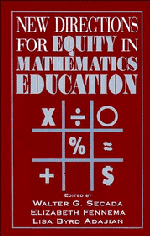
    New Directions for Equity in Mathematics Education

    AvW. Secada,Walter G. Secada

    Häftad, Engelska, 1995

    528 kr

    Beställningsvara. Skickas inom 10-15 vardagar. Fri frakt över 249 kr.

    Beskrivning

    The issue of how to provide equitable schooling for ethnic and linguistic minorities has come to the forefront of education. Walter Secada has brought together top researchers to examine equity from the standpoint of mathematics education - an excellent forum for the topic, since the results are quantifiable and the disparity in performance is stark. New Directions for Equity in Mathematics Education first addresses broad cultural issues, such as how social class and our notion of merit enter into education. The second section of the book analyses gender issues in maths learning, and the third and final section looks at language and mathematics. A number of themes cut across these three groupings. For example, there is a critique of the reform movement across several chapters; many of the chapters look closely at teachers and the dynamics of the classroom. And chapters in different sections address issues of teacher empowerment and the re-skilling of teachers. Michael Apple, author of Education and Power, provides a provocative concluding chapter to the book.

    Produktinformation

    • Utgivningsdatum:1995-04-28
    • Mått:158 x 234 x 24 mm
    • Vikt:589 g
    • Format:Häftad
    • Språk:Engelska
    • Antal sidor:380
    • Förlag:Cambridge University Press
    • ISBN:9780521477208

    Utforska kategorier

    • Pedagogisk psykologi inom Psykologi och pedagogik

    Recensioner i media

    "Readers will be rewarded in many ways! This book should be required reading for all mathematics educators, both teachers and teachers of teachers; administrators; and policymakers." Jacqueline M. Dewar, Teaching Children Mathematics

    Innehållsförteckning

    • Part I. Introduction: 1. The Quasar project: equity concerns meet mathematics education reform in the middle school; 2. Can equity thrive in a culture of mathematical excellence?; 3. Equity and mathematics education; 4. Making mathematics meaningful in multicultural contexts; 5. Social and critical dimensions for equity in mathematics education; 6. Equity in mathematics education: class in the world outside the class; 7. Economics, equity, and the national mathematics assessment: are we creating a national tollroad?; Part II. Equity Inside the Mathematics Classroom: Fact or Artefact?: 8. Redefining the 'girl problem in mathematics'; 9. Gender and mathematics from a feminist standpoint; 10. Attitudes, persistence, and mathematics achievement: qualifying race and sex differences; Part III. Making Inequality: Issues of Language and Meanings in Mathematics Teaching with Hispanic Students: 11. Equity in the future tense: redefining relationships among teachers, students, and science in linguistic minority classrooms; 12. Taking power seriously: new directions in equity in mathematics education and beyond.