• Fri frakt över 249 kr
  • •
  • Snabba leveranser
  • •
  • Billiga böcker
Kundservice

Du är på sajten för privatpersoner.

Företag, bibliotek eller offentlig verksamhet?

Du handlar på classic.bokus.com, där alla dina funktioner finns intakta.
Till classic.bokus.com
Bokus logotyp. Gå till startsidan.
  • Erbjudanden
  • Nyheter
  • Student
  • Topplistor
  • Barn & ungdom
  • Bokus Play
  • E-böcker
  • Pocketböcker
  • Spel & pussel

10% rabatt på allt med kod: NYSTART10 →

Sidfot

Mina sidor

    Hjälp

    • Kundservice
    • Vanliga frågor och svar
    • Frakt och leverans
    • Retur vid ångerrätt
    • Reklamera vara
    • Betalning
    • Köpvillkor
    • Allmänna villkor
    • Information om webbplatsens tillgänglighet

    Om Bokus

    • Om oss
    • Pressrum
    • För studenter
    • För företag
    • För bibliotek och offentlig verksamhet
    • För leverantörer
    • Hållbarhet

    Populärt

    • Aktuella erbjudanden
    • Presentkort
    • Studentlitteratur
    • Nya böcker
    • Topplistor
    • Signerade böcker
    • Engelska böcker

    Inspiration

    • Boktips
    • BookTok
    • Populära bokserier
    • Barnbokskaraktärer
    • Populära författare
    Logotyp för Bokus
    Följ oss på Facebook (extern länk)Följ oss på Instagram (extern länk)Följ oss på YouTube (extern länk)Följ oss på TikTok (extern länk)
    bokus @ CookiesAnpassa cookiesIntegritetspolicyKöpvillkor
    Till Citymail hemsida (extern länk)Till Budbee hemsida (extern länk)Till Postnord hemsida (extern länk)Till Schenker hemsida (extern länk)Till Early Bird hemsida (extern länk)Till Walleys hemsida (extern länk)
    1. Samhälle och politik
    2. Politik och statsskick
    3. Statsvetenskap och politisk teori

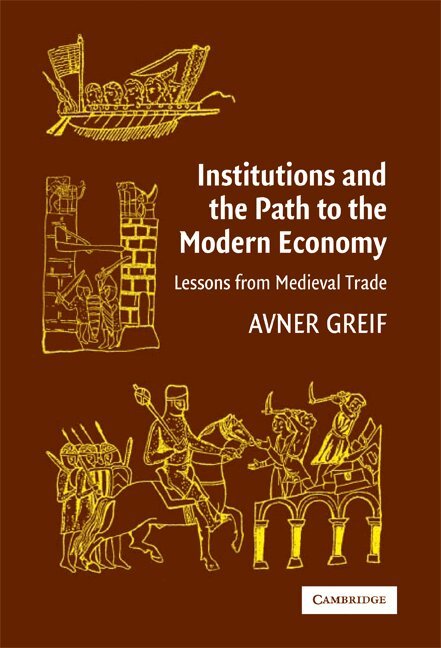
    Institutions and the Path to the Modern Economy

    Lessons from Medieval Trade

    AvAvner Greif

    Inbunden, Engelska, 2006

    Del i serien Political Economy of Institutions and Decisions

    1 402 kr

    Beställningsvara. Skickas inom 10-15 vardagar. Fri frakt över 249 kr.

    Fler format och utgåvor

    Häftad

    443 kr

    Beskrivning

    It is widely believed that current disparities in economic, political, and social outcomes reflect distinct institutions. Institutions are invoked to explain why some countries are rich and others poor, some democratic and others dictatorial. But arguments of this sort gloss over the question of what institutions are, how they come about, and why they persist. They also fail to explain why institutions are influenced by the past, why it is that they can sometimes change, why they differ so much from society to society, and why it is hard to study them empirically and devise a policy aimed at altering them. This 2006 book seeks to overcome these problems, which have exercised economists, sociologists, political scientists, and a host of other researchers who use the social sciences to study history, law, and business administration. It presents a multi-disciplinary perspective to study endogenous institutions and their dynamics.

    Produktinformation

    • Utgivningsdatum:2006-01-16
    • Mått:159 x 236 x 32 mm
    • Vikt:805 g
    • Format:Inbunden
    • Språk:Engelska
    • Serie:Political Economy of Institutions and Decisions
    • Antal sidor:526
    • Förlag:Cambridge University Press
    • ISBN:9780521480444
    • Utmärkelser:AFEE-EAEPE Veblen Prize 2007

    Utforska kategorier

    • Statsvetenskap och politisk teori inom Samhälle och politik

    Mer om författaren

    Avner Greif is the Bowman Family Endowed Professor in Humanities and Sciences at Stanford University where he teaches economics. He is the recipient of fellowships from the American Academy of Arts and Sciences, the Econometrics Society, and the MacArthur Foundation. He has published articles in American Political Science Review, European Review of Economic History, Chicago Journal of International Law, and the Journal of Political Economy as well as many edited books. Greif is also a co-author of Analytic Narrative (1998).

    Recensioner i media

    'Greif strips economic transactions down to their elements. He focuses on the core question: who (or what) were the watchdogs that allowed the merchants to trust one another and to bear with the princes who could confiscate the fruits of all their efforts? And who (or what) were the watchdogs' watchdogs? Greif repeatedly and carefully relates these questions to economic theory. He illustrates them with real transactions of medieval merchants. He takes the right approach to economic development, and thereby achieves an original and important new perspective on its causes. Institutions and the Path to the Modern Economy is a seminal work in economics and in history. It should be read by all social scientists.' George A. Akerlof, 2001 Nobel Laureate in Economics and University of California, Berkeley

    Innehållsförteckning

    • Part I. Preliminaries: 1. Introduction; 2. Institutions and transactions; Part II. Institutions as Systems in Equilibria: 3. Private-order contract enforcement institutions: the Maghribi traders coalition; 4. The organizational underpinnings of credible commitment by the state: the Merchant Guild; 5. Endogenous institutions and game-theoretic analysis; Part III. Institutional Dynamics as a Historical Process: 6. A theory of endogenous institutional change; 7. Institutional trajectories: how past institutions affect current ones; 8. Building a state: Genoa's Rise and Fall; 9. Cultural beliefs and the organization of society; Part IV. The Empirical Method of Comparative and Historical Institutional Analysis: 10. The institutional foundations of impersonal exchange; 11. Interactive, context-specific analysis; Part V. Concluding Comments: 12. Institutions, history, and development.