• Fri frakt över 249 kr
  • •
  • Snabba leveranser
  • •
  • Billiga böcker
Kundservice

Du är på sajten för privatpersoner.

Företag, bibliotek eller offentlig verksamhet?

Du handlar på classic.bokus.com, där alla dina funktioner finns intakta.
Till classic.bokus.com
Bokus logotyp. Gå till startsidan.
  • Erbjudanden
  • Nyheter
  • Student
  • Topplistor
  • Barn & ungdom
  • Bokus Play
  • E-böcker
  • Pocketböcker
  • Spel & pussel

10% rabatt på allt med kod NYSTART10 →

Sidfot

Mina sidor

    Hjälp

    • Kundservice
    • Vanliga frågor och svar
    • Frakt och leverans
    • Retur vid ångerrätt
    • Reklamera vara
    • Betalning
    • Köpvillkor
    • Allmänna villkor
    • Information om webbplatsens tillgänglighet

    Om Bokus

    • Om oss
    • Pressrum
    • För studenter
    • För företag
    • För bibliotek och offentlig verksamhet
    • För leverantörer
    • Hållbarhet

    Populärt

    • Aktuella erbjudanden
    • Presentkort
    • Studentlitteratur
    • Nya böcker
    • Topplistor
    • Signerade böcker
    • Engelska böcker

    Inspiration

    • Boktips
    • BookTok
    • Populära bokserier
    • Barnbokskaraktärer
    • Populära författare
    Logotyp för Bokus
    Följ oss på Facebook (extern länk)Följ oss på Instagram (extern länk)Följ oss på YouTube (extern länk)Följ oss på TikTok (extern länk)
    bokus @ CookiesAnpassa cookiesIntegritetspolicyKöpvillkor
    Till Citymail hemsida (extern länk)Till Budbee hemsida (extern länk)Till Postnord hemsida (extern länk)Till Schenker hemsida (extern länk)Till Early Bird hemsida (extern länk)Till Walleys hemsida (extern länk)
    1. Naturvetenskap och teknik
    2. Teknik och industri
    3. Maskinteknik och material

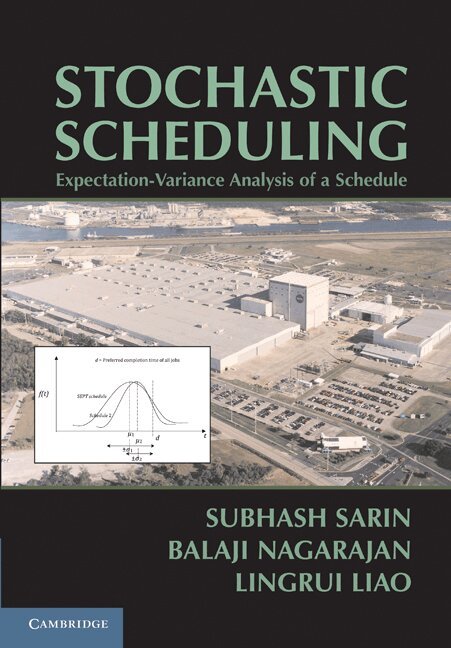
    Stochastic Scheduling

    Expectation-Variance Analysis of a Schedule

    AvSubhash C. Sarin,Balaji Nagarajan

    Inbunden, Engelska, 2010

    798 kr

    Tillfälligt slut

    Fler format och utgåvor

    Häftad

    905 kr

    Beskrivning

    Stochastic scheduling is in the area of production scheduling. There is a dearth of work that analyzes the variability of schedules. In a stochastic environment, in which the processing time of a job is not known with certainty, a schedule is typically analyzed based on the expected value of a performance measure. This book addresses this problem and presents algorithms to determine the variability of a schedule under various machine configurations and objective functions. It is intended for graduate and advanced undergraduate students in manufacturing, operations management, applied mathematics, and computer science, and it is also a good reference book for practitioners. Computer software containing the algorithms is provided on an accompanying website for ease of student and user implementation.

    Produktinformation

    • Utgivningsdatum:2010-03-31
    • Mått:183 x 260 x 18 mm
    • Vikt:660 g
    • Format:Inbunden
    • Språk:Engelska
    • Antal sidor:208
    • Förlag:Cambridge University Press
    • ISBN:9780521518512

    Utforska kategorier

    • Maskinteknik och material inom Naturvetenskap och teknik

    Mer om författaren

    Dr Subhash Sarin earned his PhD at North Carolina State University in 1978. He has made research contributions in production scheduling, sequencing, applied mathematical programming, and analyzing and designing algorithms for the operational control of manufacturing systems. He is a member of the editorial board of the International Journal of Production Planning and Control. Currently, Dr Sarin is the Paul T. Norton Endowed Professor at Virginia Polytechnic Institute and State University's Grado Department of Industrial and Systems Engineering. He is also Director of the Electronics Manufacturing Research Laboratory there, which provides a facility to support research on semiconductors and the electronics industry.

    Innehållsförteckning

    • 1. Introduction; 2. Robust scheduling approaches to hedge against processing time uncertainty; 3. Expectation-variance analysis in stochastic multi-objective scheduling; 4. Single machine models; 5. Flow shop models; 6. Job shop models; 7. The case of general processing time distribution; 8. Concluding remarks.