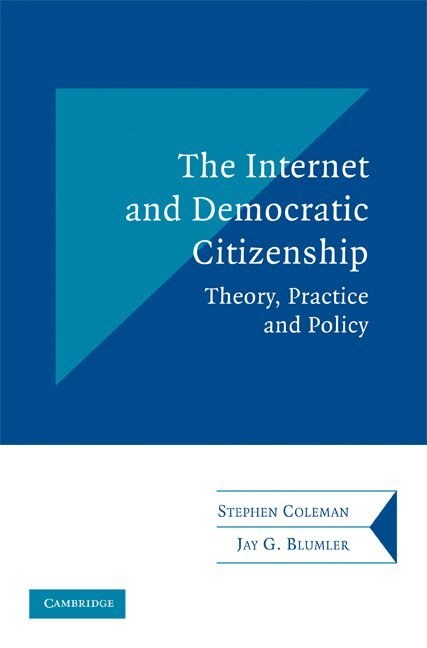
Häftad, Engelska, 2009
The Internet and Democratic Citizenship
Theory, Practice and Policy
Av Stephen Coleman, Jay G. Blumler
Del i serien Communication, Society and Politics
455 kr
Beställningsvara. Skickas inom 5-8 vardagar. Fri frakt över 249 kr.
Beskrivning
Produktinformation
- Utgivningsdatum: 2009-03-30
- Mått: 152 x 229 x 13 mm
- Vikt: 350 g
- Format: Häftad
- Språk: Engelska
- Serie: Communication, Society and Politics
- Antal sidor: 232
- Förlag: Cambridge University Press
- ISBN: 9780521520782
Utforska kategorier
Mer om författaren
Stephen Coleman is Professor of Political Communication and Co-Director of the Centre for Digital Citizenship at the Institute of Communications Studies at the University of Leeds. He was previously Professor of e-Democracy at the Oxford Internet Institute, University of Oxford and a senior fellow of Jesus College, Oxford. In recent years he has served as specialist adviser to the House of Commons Information Select Committee inquiry on ICT and public participation in Parliament, a member of the Puttnam Commission on parliamentary communication with the public and chair of the Electoral Reform Society's Independent Commission on Alternative Voting Methods. His publications include Bowling Together (with John Gotze, 2001; Realising Democracy Online: A Civic Commons in Cyberspace (with Jay G. Blumler, 2001; A Tale of Two Houses: The House of Commons, the Big Brother House and the People at Home (2003); and Direct Representation: Towards a Conversational Democracy (2005). He has contributed numerous articles and chapters to academic volumes. Jay G. Blumler is Emeritus Professor of Public Communication at the University of Leeds, and also Emeritus Professor of Journalism at the University of Maryland. He is a leading, internationally recognized figure in political communication, having published numerous books, including (with Denis McQuail) Television in Politics: Its Uses and Influences (1968); (with Elihu Katz) The Uses of Mass Communications: Current Perspectives on Gratifications Research (1974); and (with Michael Gurevitch) The Crisis of Public Communication (1995) He is a past President of the International Communications Association. In 2006 Blumler was given a lifetime achievement award by the American Political Science Association.
Recensioner i media
'The potential for the Internet to support democracy is substantial, but as yet unrealized. The authors - two world-leading scholars of political communication - provide a penetrating synthesis of theory and research to explain the limitation of contemporary approaches to using the Internet and related media to enhance the communicative power of citizens. Their analysis leads to a bold prescription for creating a new civic commons 2.0 that will enable 'more deliberative democracy'. This is an excellent scholarly book that will stimulate and inform public debate in a vital area of communication research. It is must reading not only for students of the iternet, but also for anyone interested in the vitality of democratic institutions and processes.' William H. Dutton, Director, Oxford Internet Institute, University of Oxford
Betyg & recensioner
0 recensioner
Inga recensioner tillgängliga.