• Fri frakt över 249 kr
  • •
  • Snabba leveranser
  • •
  • Billiga böcker
Kundservice

Du är på sajten för privatpersoner.

Företag, bibliotek eller offentlig verksamhet?

Du handlar på classic.bokus.com, där alla dina funktioner finns intakta.
Till classic.bokus.com
Bokus logotyp. Gå till startsidan.
  • Erbjudanden
  • Student
  • Topplistor
  • Barn & ungdom
  • Bokus Play
  • E-böcker
  • Ljudböcker
  • Pocketböcker
  • Spel och pussel

Pocketfynda! Hundratals böcker för 49 kr/st →

Sidfot

Mina sidor

    Hjälp

    • Kundservice
    • Vanliga frågor och svar
    • Frakt och leverans
    • Retur vid ångerrätt
    • Reklamera vara
    • Betalning
    • Köpvillkor
    • Allmänna villkor
    • Information om webbplatsens tillgänglighet

    Om Bokus

    • Om oss
    • Pressrum
    • För studenter
    • För företag
    • För bibliotek och offentlig verksamhet
    • För leverantörer
    • Hållbarhet

    Populärt

    • Aktuella erbjudanden
    • Presentkort
    • Studentlitteratur
    • Nya böcker
    • Topplistor
    • Signerade böcker
    • Engelska böcker

    Inspiration

    • Boktips
    • BookTok
    • Barnbokskaraktärer
    • Populära författare
    Logotyp för Bokus
    Följ oss på Facebook (extern länk)Följ oss på Instagram (extern länk)Följ oss på YouTube (extern länk)Följ oss på TikTok (extern länk)
    bokus @ CookiesAnpassa cookiesIntegritetspolicyKöpvillkor
    Till Citymail hemsida (extern länk)Till Budbee hemsida (extern länk)Till Postnord hemsida (extern länk)Till Schenker hemsida (extern länk)Till Early Bird hemsida (extern länk)Till Walleys hemsida (extern länk)
    1. Samhälle och politik
    2. Politik och statsskick

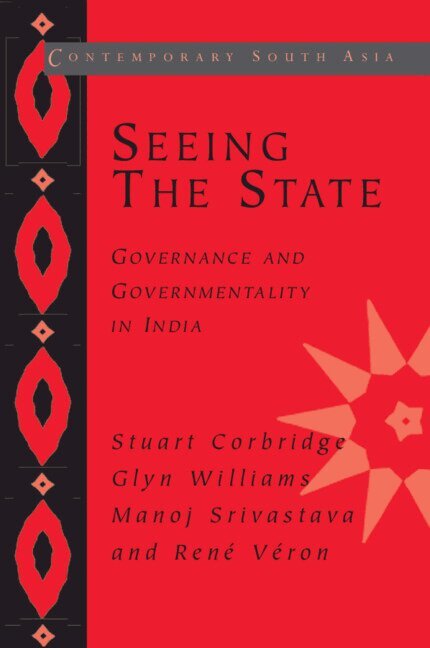
    Seeing the State

    Governance and Governmentality in India

    AvStuart Corbridge,Glyn Williams

    Häftad, Engelska, 2005

    Del 10 i serien Contemporary South Asia

    517 kr

    Beställningsvara. Skickas inom 7-10 vardagar. Fri frakt över 249 kr.

    Fler format och utgåvor

    Inbunden

    Tillf. slut

    Beskrivning

    Poor people confront the state on an everyday basis all over the world. But how do they see the state, and how are these engagements conducted? This book considers the Indian case where people's accounts, in particular in the countryside, are shaped by a series of encounters that are staged at the local level, and which are also informed by ideas that are circulated by the government and the broader development community. Drawing extensively on fieldwork conducted in eastern India and their broad range of expertise, the authors review a series of key debates in development studies on participation, good governance, and the structuring of political society. They do so with particular reference to the Employment Assurance Scheme and primary education provision. Seeing the State engages with the work of James Scott, James Ferguson and Partha Chatterjee, and offers a new interpretation of the formation of citizenship in South Asia.

    Produktinformation

    • Utgivningsdatum:2005-09-22
    • Mått:153 x 229 x 20 mm
    • Vikt:539 g
    • Format:Häftad
    • Språk:Engelska
    • Serie:Contemporary South Asia
    • Antal sidor:334
    • Förlag:Cambridge University Press
    • ISBN:9780521542555

    Utforska kategorier

    • Politik och statsskick inom Samhälle och politik

    Mer om författaren

    Stuart Corbridge is Professor of Geography at the London School of Economics and at the University of Miami. His recent publications include Reinventing India (with John Harriss, 2000). Glyn Williams is Lecturer in Geography at Keele University. He is the co-editor of a collection of essays on South Asia in a Globalising World (2002). Manoj Srivastava is a Research Associate in the Crisis State Programme, Development Studies Institute, London School of Economics. Rene Veron is Assistant Professor in Geography at the University of Guelph, Ontario. He is the author of Real Markets and Environmental Change in Kerala (1999).

    Innehållsförteckning

    • Part I. The State and the Poor: 1. Seeing the state; 2. Technologies of rule and the war on poverty; Part II. The Everyday State and Society: 3. Meeting the state; 4. Participation; 5. Governance; 6. Political society; Part III. The Poor and the State: 7. Protesting the state; 8. Postcolonialism, development studies and spaces of empowerment; 9. Postscript: development ethics and the ethics of critique.