• Fri frakt över 249 kr
  • •
  • Snabba leveranser
  • •
  • Billiga böcker
Kundservice

Du är på sajten för privatpersoner.

Företag, bibliotek eller offentlig verksamhet?

Du handlar på classic.bokus.com, där alla dina funktioner finns intakta.
Till classic.bokus.com
Bokus logotyp. Gå till startsidan.
  • Erbjudanden
  • Nyheter
  • Student
  • Topplistor
  • Barn & ungdom
  • Bokus Play
  • E-böcker
  • Pocketböcker
  • Spel & pussel

10% rabatt på allt med kod NYSTART10 →

Sidfot

Mina sidor

    Hjälp

    • Kundservice
    • Vanliga frågor och svar
    • Frakt och leverans
    • Retur vid ångerrätt
    • Reklamera vara
    • Betalning
    • Köpvillkor
    • Allmänna villkor
    • Information om webbplatsens tillgänglighet

    Om Bokus

    • Om oss
    • Pressrum
    • För studenter
    • För företag
    • För bibliotek och offentlig verksamhet
    • För leverantörer
    • Hållbarhet

    Populärt

    • Aktuella erbjudanden
    • Presentkort
    • Studentlitteratur
    • Nya böcker
    • Topplistor
    • Signerade böcker
    • Engelska böcker

    Inspiration

    • Boktips
    • BookTok
    • Populära bokserier
    • Barnbokskaraktärer
    • Populära författare
    Logotyp för Bokus
    Följ oss på Facebook (extern länk)Följ oss på Instagram (extern länk)Följ oss på YouTube (extern länk)Följ oss på TikTok (extern länk)
    bokus @ CookiesAnpassa cookiesIntegritetspolicyKöpvillkor
    Till Citymail hemsida (extern länk)Till Budbee hemsida (extern länk)Till Postnord hemsida (extern länk)Till Schenker hemsida (extern länk)Till Early Bird hemsida (extern länk)Till Walleys hemsida (extern länk)
    1. Psykologi och pedagogik
    2. Psykologi
    3. Barnpsykologi och utvecklingspsykologi

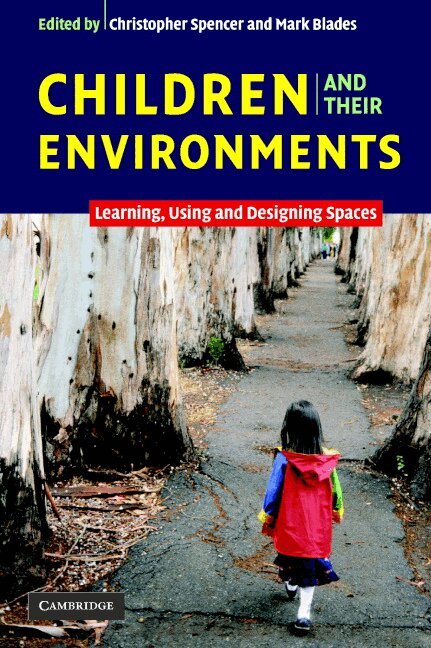
    Children and their Environments

    Learning, Using and Designing Spaces

    AvChristopher Spencer,Mark Blades

    Häftad, Engelska, 2006

    567 kr

    Beställningsvara. Skickas inom 10-15 vardagar. Fri frakt över 249 kr.

    Beskrivning

    This fascinating book examines theories of children's perceptions of space and place and explores how these theories are applied to the world of children. The focus is on children in large real world spaces; places that children live in, explore and learn from. These include classrooms, playgrounds, homes and yards, towns, communities, countryside, natural environments, and the wider world. An international team of authors compare the experiences of children from different cultures and backgrounds. Often excluded from discussions of place-design on the presumption of lack of awareness, young children have many environmental competencies which should lead to their inclusion. They can read maps and study photographs, respond to the natural and man-made world with great sensitivity, and contribute considerably to the community. This book will appeal to environmental and developmental psychologists and geographers, and also to planners by linking research on children's understandings and on their daily lives to recommendations for practice.

    Produktinformation

    • Utgivningsdatum:2006-02-23
    • Mått:153 x 229 x 19 mm
    • Vikt:479 g
    • Format:Häftad
    • Språk:Engelska
    • Antal sidor:296
    • Förlag:Cambridge University Press
    • ISBN:9780521546829

    Utforska kategorier

    • Barnpsykologi och utvecklingspsykologi inom Psykologi och pedagogik

    Mer om författaren

    Christopher Spencer is Professor of Environmental Psychology at the University of Sheffield. His books include The Child in the Physical Environment: The Development of Spatial Knowledge and Cognition (with Blades, M. & Morsley, K., 1989), Readings in Environmental Psychology: The Child's Environment (1995), and Psychology: A Contemporary Introduction (1998). Mark Blades is a Senior Lecturer in Developmental Psychology at the University of Sheffield. He has jointly authored several books including The Child in the Physical Environment (1989), The Cognition of Geographic Space (2002), and Understanding Children's Development, Fourth edition (2003).

    Innehållsförteckning

    • An introduction Christopher Spencer and Mark Blades; Part I. Children's Understanding of Places: 1. Scale in children's experience with the environment Scott Bell; 2. The problem of lost children Edward H. Cornell and Kenneth A. Hill; 3. Children's understanding of environmental representations: aerial photographs and model towns Beverly Plester, Mark Blades and Christopher Spencer; 4. Children's knowledge of countries Martyn Barrett, Evanthia Lyons and Alison Bourchier-Sutton; Part II. Children's Experience of Places: 5. Learning neighbourhood environments: the loss of experience in a modern world Antonella Rissotto and M. Vittoria Giuliani; 6. The classroom environment and children's performance - is there a relationship? Sandra Horne Martin; 7. 'Sometimes birds sound like fish': perspectives on children's place experiences Victoria Derr; 8. Is contact with nature important for healthy child development? State of the evidence Andrea Faber Taylor and Frances E. Kuo; 9. Environmental child-friendliness in the light of the Bullerby Model Marketta Kyttä; Part III. Adolescents' Worlds?: 10. On the other side of the tracks: the psychogeographies and everyday lives of rural teenagers in the UK Hugh Matthews and Faith Tucker; 11. The socio-environmental affordances of adolescents' environments Charlotte Clark and David L. Uzzell; Part IV. Children and the Design Process: 12. Children as agents in sustainable development: the ecology of competence Harry Heft and Louise Chawla; 13. Children and city design: proactive process and the 'renewal' of childhood Mark Francis and Ray Lorenzo; 14. A learning-based approach to urban planning with young people Liisa Horelli; 15. Young people's participation in constructing a socially just public sphere Sharon Egretta Sutton and Susan P. Kemp.