• Fri frakt över 249 kr
  • •
  • Snabba leveranser
  • •
  • Billiga böcker
Kundservice

Du är på sajten för privatpersoner.

Företag, bibliotek eller offentlig verksamhet?

Du handlar på classic.bokus.com, där alla dina funktioner finns intakta.
Till classic.bokus.com
Bokus logotyp. Gå till startsidan.
  • Erbjudanden
  • Nyheter
  • Student
  • Topplistor
  • Barn & ungdom
  • Bokus Play
  • E-böcker
  • Pocketböcker
  • Spel & pussel

10% rabatt på allt med kod NYSTART10 →

Sidfot

Mina sidor

    Hjälp

    • Kundservice
    • Vanliga frågor och svar
    • Frakt och leverans
    • Retur vid ångerrätt
    • Reklamera vara
    • Betalning
    • Köpvillkor
    • Allmänna villkor
    • Information om webbplatsens tillgänglighet

    Om Bokus

    • Om oss
    • Pressrum
    • För studenter
    • För företag
    • För bibliotek och offentlig verksamhet
    • För leverantörer
    • Hållbarhet

    Populärt

    • Aktuella erbjudanden
    • Presentkort
    • Studentlitteratur
    • Nya böcker
    • Topplistor
    • Signerade böcker
    • Engelska böcker

    Inspiration

    • Boktips
    • BookTok
    • Populära bokserier
    • Barnbokskaraktärer
    • Populära författare
    Logotyp för Bokus
    Följ oss på Facebook (extern länk)Följ oss på Instagram (extern länk)Följ oss på YouTube (extern länk)Följ oss på TikTok (extern länk)
    bokus @ CookiesAnpassa cookiesIntegritetspolicyKöpvillkor
    Till Citymail hemsida (extern länk)Till Budbee hemsida (extern länk)Till Postnord hemsida (extern länk)Till Schenker hemsida (extern länk)Till Early Bird hemsida (extern länk)Till Walleys hemsida (extern länk)
    1. Naturvetenskap och teknik
    2. Matematik och naturvetenskap
    3. Fysik

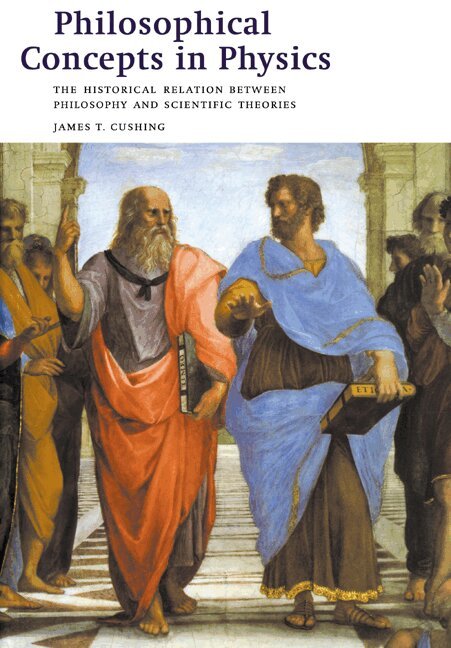
    Philosophical Concepts in Physics

    The Historical Relation between Philosophy and Scientific Theories

    AvJames T. Cushing

    Häftad, Engelska, 1998

    1 025 kr

    Beställningsvara. Skickas inom 10-15 vardagar. Fri frakt över 249 kr.

    Beskrivning

    This book examines a selection of philosophical issues in the context of specific episodes in the development of physical theories. Advances in science are presented against the historical and philosophical backgrounds in which they occurred. A major aim is to impress upon the reader the essential role that philosophical considerations have played in the actual practice of science. The book begins with some necessary introduction to the history of ancient and early modern science, with major emphasis being given to the two great watersheds of twentieth-century physics: relativity and, especially, quantum mechanics. At times the term 'construction' may seem more appropriate than 'discovery' for the way theories have developed and, especially in the later chapters, the question of the influence of historical, philosophical and even social factors on the very form and content of scientific theories is discussed.

    Produktinformation

    • Utgivningsdatum:1998-01-29
    • Mått:175 x 248 x 23 mm
    • Vikt:879 g
    • Format:Häftad
    • Språk:Engelska
    • Antal sidor:448
    • Förlag:Cambridge University Press
    • ISBN:9780521578233

    Utforska kategorier

    • Fysik inom Naturvetenskap och teknik

    Recensioner i media

    'For anyone who really wants to understand physics, this is a splendid and beautifully written book … this book is an excellent introduction to a historically based philosophy of science, with accurate reporting of many examples from physics, and much attention to primary sources. I would recommend it strongly as an adjunct to standard textbooks of physics for students who seek a real understanding of their subject.' Michael Redhead, Physics World

    Innehållsförteckning

    • Preface; Part I. The Scientific Enterprise: 1. Ways of knowing; 2. Aristotle and Francis Bacon; 3. Science and metaphysics; Part II. Ancient and Modern Models of the Universe: 4. Observational astronomy and the Ptolemaic model; 5. The Copernican model and Kepler's laws; 6. Galileo on motion; Part III. The Newtonian Universe: 7. Newton's Principia; 8. Newton's law of universal gravitation; 9. Some old questions revisited; Part IV. A Perspective: 10. Galileo's Letter to the Grand Duchess; 11. An overarching Newtonian framework; 12. A view of the world based on science: determinism; Part V. Mechanical Versus Electrodynamical World Views: 13. Models of the aether; 14. Maxwell's theory; 15. The Kaufmann experiments; Part VI. The Theory of Relativity: 16. The background to and essentials of special relativity; 17. Further logical consequences of Einstein's postulates; 18. General relativity and the expanding universe; Part VII. The Quantum World and the Completeness of Quantum Mechanics: 19. The road to quantum mechanics; 20. 'Copenhage' quantum mechanics; 21. Is quantum mechanics complete?; Part VIII. Some Philosophical Lessons from Quantum Mechanics: 22. The EPR paper and Bell's theorem; 23. An alternative version of quantum mechanics; 24. An essential role for historical contingency?; Part IX. A Retrospective: 25. The goals of science and the status of its knowledge; Notes; General references; Bibliography; Author index; Subject index.